Marine Bank (New York, NY)

Episode Information

Episode UID
6726817891013
Episode Type
Run โ†’ Suspension โ†’ Closure
Bank Type
state
Bank ID
672681789 hash
Start Date
May 6, 1884
Location
New York, New York (40.714, -74.006)

Metadata

Model
gpt-5-mini (chosen from majority vote of a three-model LLM ensemble)
Short Digest
90e2a1cd8971b4da

Response Measures

None

Description

Suspension led to receivership and later dividend payments; failure tied to Grant & Ward exposures.

Events (3)

1. May 6, 1884 Run
Cause
Bank Specific Adverse Info
Cause Details
Heavy withdrawals precipitated by the collapse/exposures of Grant & Ward and large overdrafts tied to the bank
Measures
None reported
Newspaper Excerpt
CONSIDERABLE of a panic was caused in New York on the 6th, caused by the failure of the Marine Bank
Source
newspapers
2. May 7, 1884 Suspension
Cause
Bank Specific Adverse Info
Cause Details
Direct suspension following sudden large withdrawals and the collapse/relations with Grant & Ward; president closed doors hastily
Newspaper Excerpt
the suspension of the New York Marine bank
Source
newspapers
3. July 26, 1884 Receivership
Newspaper Excerpt
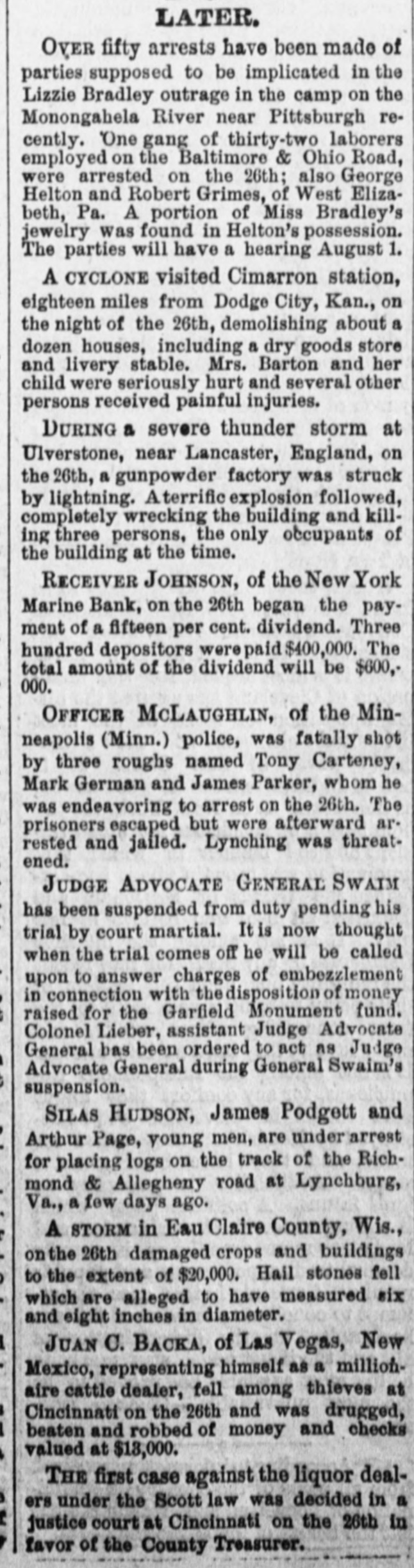
Receiver Johnston, of the Marine bank, began payment to-day of a 15 per cent. dividend. Three hundred depositors were paid $400,000.
Source
newspapers

Newspaper Articles (25)

Article from The Rock Island Argus, May 7, 1884

Click image to open full size in new tab

Article Text

The News at Chicago. CHICAGO, May 7.-The news of the suspension of the New York Marine bank had no serious effect here except to cause a weakening on the board of trade, and no evil effects are expected.


Article from New-York Tribune, May 7, 1884

Click image to open full size in new tab

Article Text

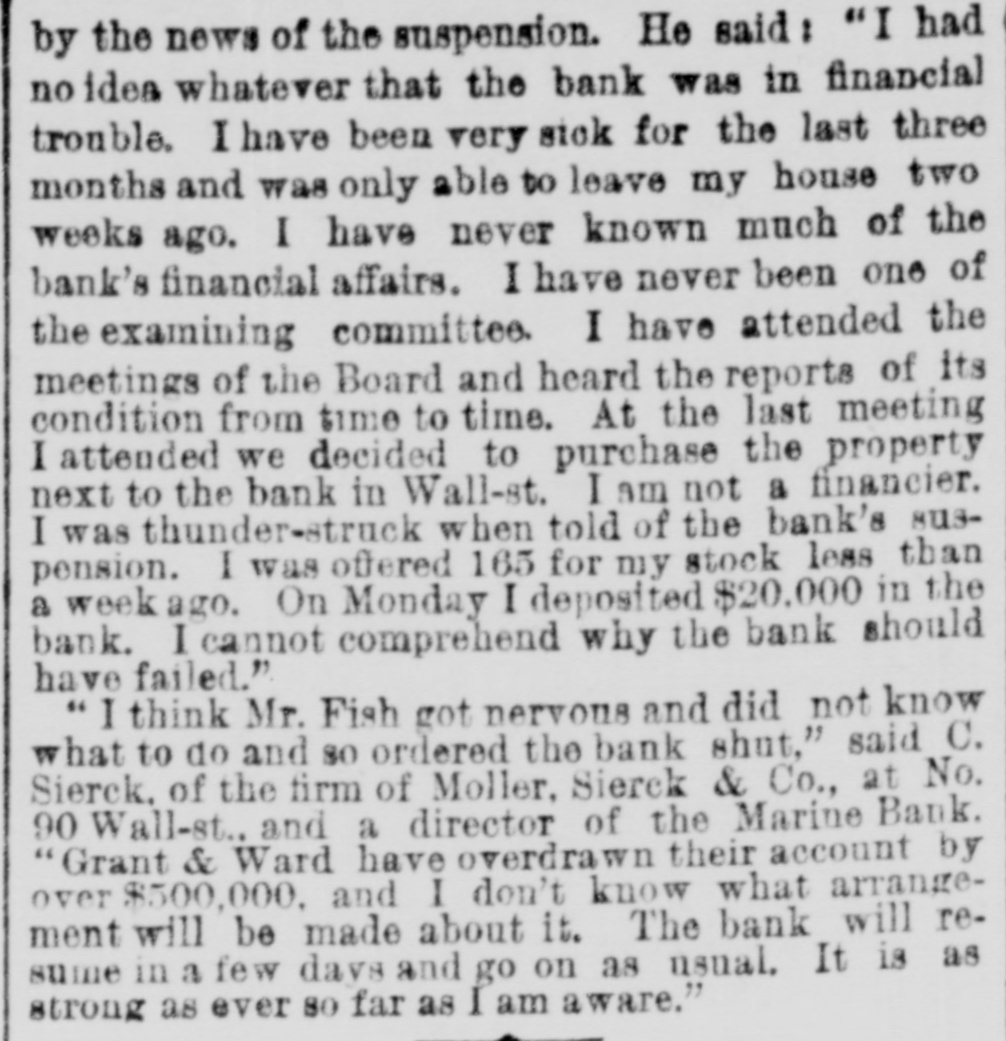
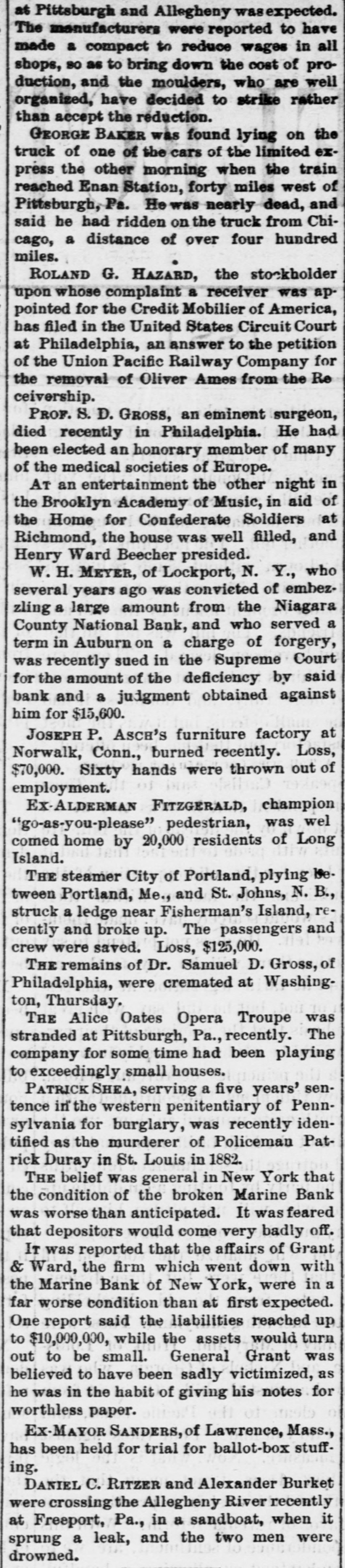
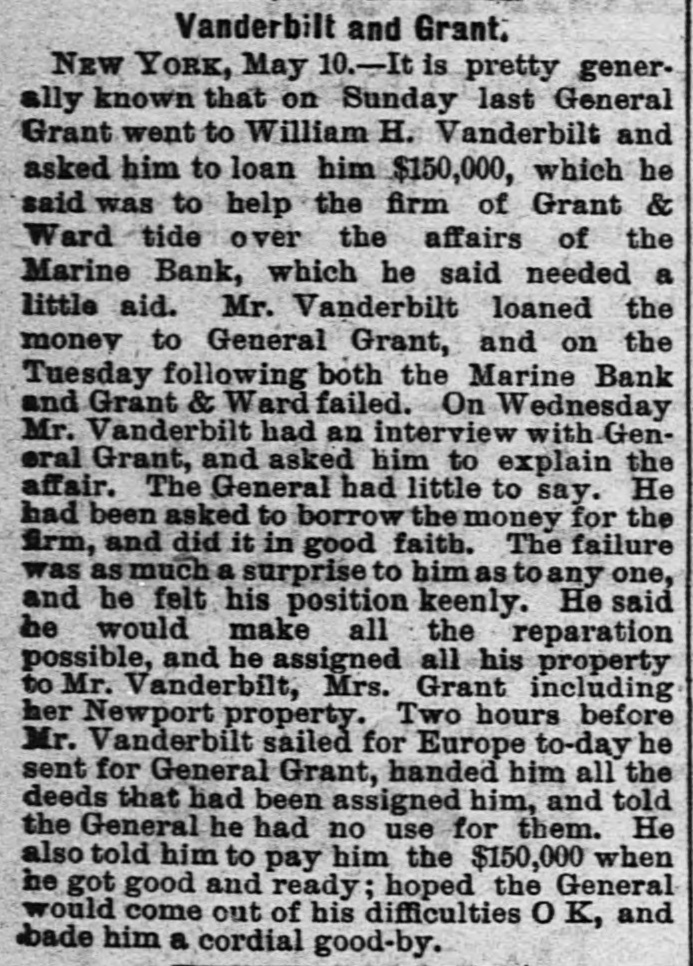
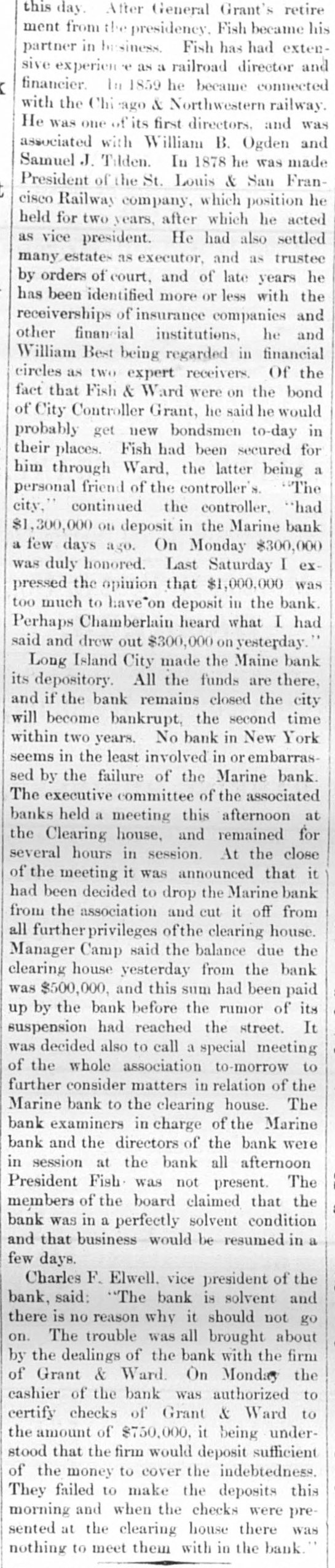
by the news of the suspension. He said: "I had no idea whatever that the bank was in financial trouble. I have been very sick for the last three months and was only able to leave my house two weeks ago. I have never known much of the bank's financial affairs. I have never been one of the examining committee. I have attended the meetings of the Board and heard the reports of its condition from time to time. At the last meeting I attended we decided to purchase the property next to the bank in Wall-st. I am not a financier. I was thunder-struck when told of the bank's suspension. I was offered 165 for my stock less than a week ago. On Monday I deposited $20,000 in the bank. I cannot comprehend why the bank should have failed." "I think Mr. Fish got nervous and did not know what to do and so ordered the bank shut," said C. Sierck. of the firm of Moller, Sierck & Co., at No. 90 Wall-st.. and a director of the Marine Bank. "Grant & Ward have overdrawn their account by over $500,000, and I don't know what arrangement will be made about it. The bank will resume in a few days and go on as usual. It is as strong as ever 80 far as I am aware."


Article from Daily Los Angeles Herald, May 8, 1884

Click image to open full size in new tab

Article Text

SAN FRANCISCO, May 7.-It is now learned that the Mariue Bank of New York, which has just suspended, asked for a loan of 8500,000 from the Nevada Bank, of this city, about three weeks ago, and that the request was declined.


Article from Fort Worth Daily Gazette, May 8, 1884

Click image to open full size in new tab

Article Text

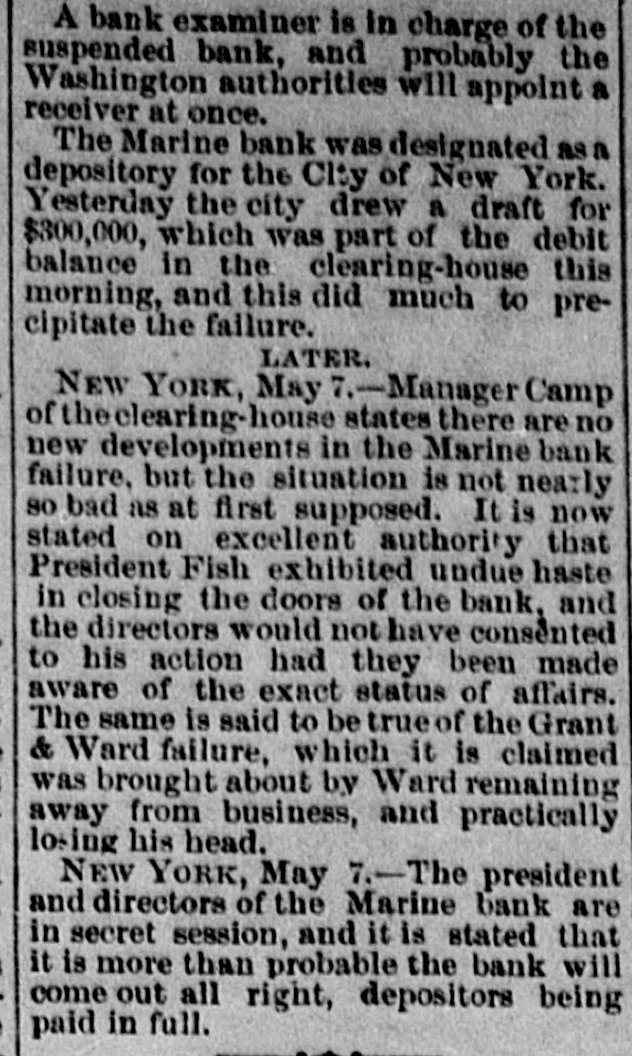
A bank examiner is in charge of the suspended bank, and probably the Washington authorities will appoint a receiver at once. The Marine bank was designated as a depository for the City of New York. Yesterday the city drew a draft for $300,000, which was part of the debit balance in the clearing-house this morning, and this did much to precipitate the failure. LATER. NEW YORK, May 7.-Manager Camp of theclearing-house states there are no new developments in the Marine bank failure, but the situation is not nearly so bad as at first supposed. It is now stated on excellent authority that President Fish exhibited undue haste in closing the doors of the bank, and the directors would not have consented to his action had they been made aware of the exact status of affairs. The same is said to be true of the Grant & Ward failure, which it is claimed was brought about by Ward remaining away from business, and practically losing his head. NEW YORK, May 7.-The president and directors of the Marine bank are in secret session, and it is stated that it is more than probable the bank will come out all right, depositors being paid in full.


Article from The Indianapolis Journal, May 8, 1884

Click image to open full size in new tab

Article Text

A Marine Bank Episode. SAN FRANCISCO, May 7.-It is learned today that the Marine Bank, lately suspended in New York, asked about three weeks ago the loan of half a million from the Nevada Bank, this city, which the managers declined.


Article from Daily Los Angeles Herald, May 9, 1884

Click image to open full size in new tab

Article Text

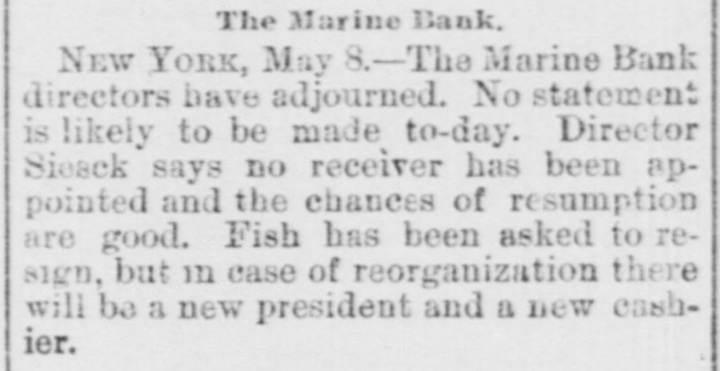
NEW YORK, May 8.-The Marine Bank Directors have adjourned. No statement is likely to be made to-day. Director Siesck says no receiver was appointed and the chances of resumption are good. Fish did not ask to resign, but in case of a reorganization there will be a new president and cashier.


Article from Burlington Weekly Free Press, May 9, 1884

Click image to open full size in new tab

Article Text

"The suspension was a complete surprise to the directors." So say the papers, in regard to the failure of the Marine bank of New York. So it seems that the St. Albans financiers didn't get a patent on their system of banking.


Article from The Semi-Weekly Miner, May 10, 1884

Click image to open full size in new tab

Article Text

Wouldn't be Caught. SAN FRANCISCA, May 7.-It is learned to-day that the Marine Bank, 'lately suspended in New York, asked about three weeks ago for a loan of half a in llion from the Nevada Bank of this city, which the managers doclined.


Article from The Daily Cairo Bulletin, May 10, 1884

Click image to open full size in new tab

Article Text

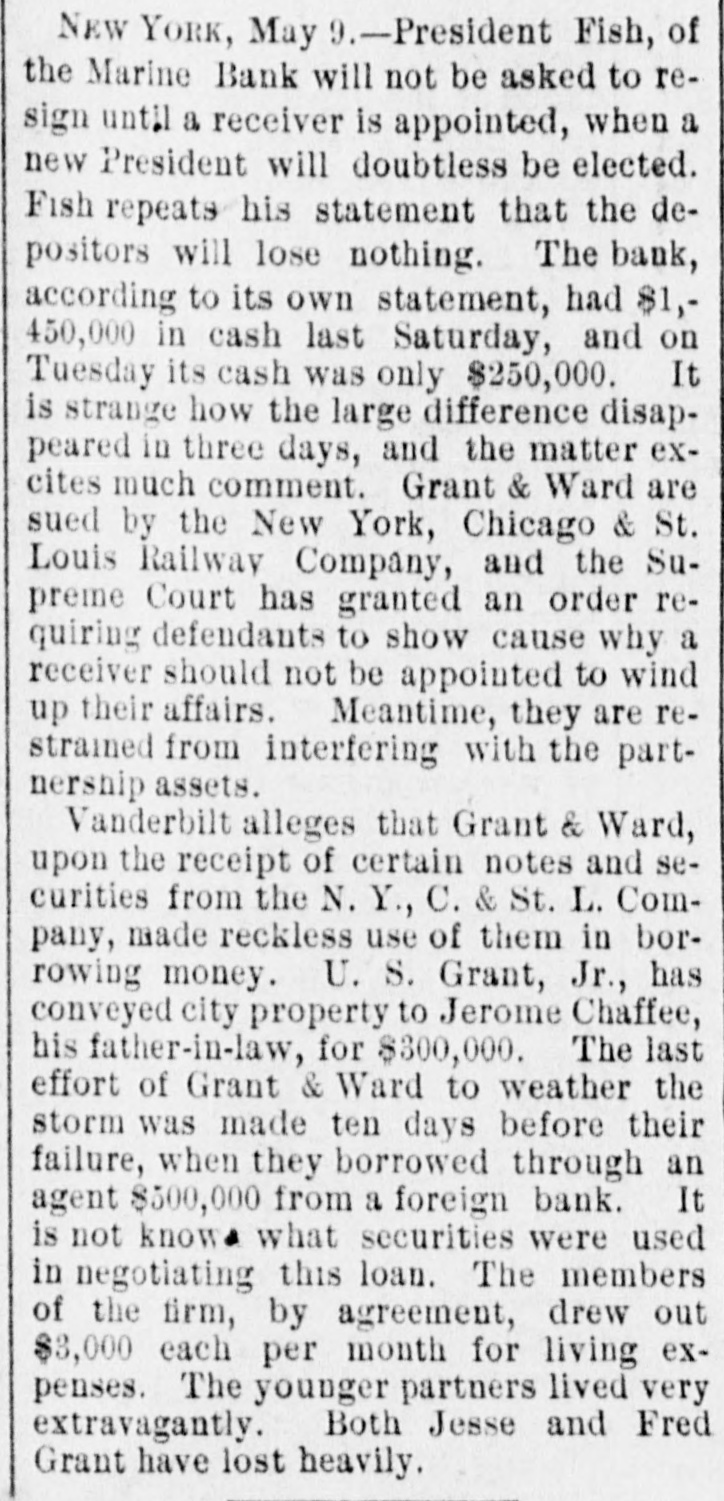
NEW York, May 9.-President Fish, of the Marine Bank will not be asked to resign until a receiver is appointed, when a new President will doubtless be elected. Fish repeats his statement that the depositors will lose nothing. The bank, according to its own statement, had $1,450,000 in cash last Saturday, and on Tuesday its cash was only $250,000. It is strange how the large difference disappeared in three days, and the matter excites much comment. Grant & Ward are sued by the New York, Chicago & St. Louis Railway Company, and the Supreme Court has granted an order requiring defendants to show cause why a receiver should not be appointed to wind up their affairs. Meantime, they are restrained from interfering with the partnership assets. Vanderbilt alleges that Grant & Ward, upon the receipt of certain notes and securities from the N. Y., C. & St. L. Company, made reckless use of them in borrowing money. U. S. Grant, Jr., has conveyed city property to Jerome Chaffee, his father-in-law, for $300,000. The last effort of Grant & Ward to weather the storm was made ten days before their failure, when they borrowed through an agent $500,000 from a foreign bank. It is not know. what securities were used in negotiating this loan. The members of the firm, by agreement, drew out $3,000 each per month for living expenses. The younger partners lived very extravagantly. Both Jesse and Fred Grant have lost heavily.


Article from Arizona Weekly Citizen, May 10, 1884

Click image to open full size in new tab

Article Text

The Marine Bank, NEW York, May 8.-The Marine Bank directors have adjourned. No statement is likely to be made to-day. Director Sieack says no receiver has been appointed and the chances of resumption are good. Fish has been asked to resign. but in case of reorganization there will be a new president and a new cashier.


Article from Iron County Register, May 15, 1884

Click image to open full size in new tab

Article Text

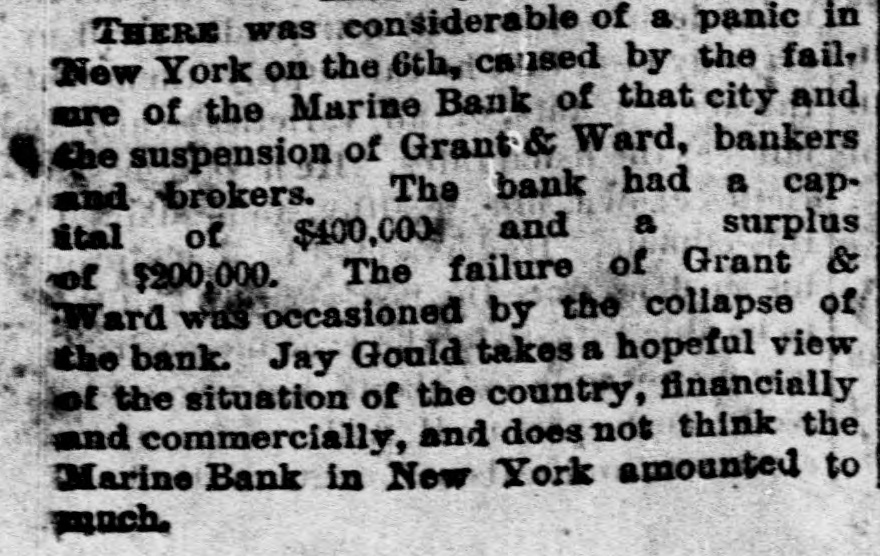
THERE was considerable of a panic in New York on the 6th, caused by the fail, are of the Marine Bank of that city and the suspension of Grant & Ward, bankers and brokers. The bank had a captital of $400,000 and a surplus of $200,000. The failure of Grant & Ward was occasioned by the collapse of the bank. Jay Gould takes a hopeful view of the situation of the country, financially and commercially, and does not think the Marine Bank in New York amounted to much.


Article from The Dawson Journal, May 15, 1884

Click image to open full size in new tab

Article Text

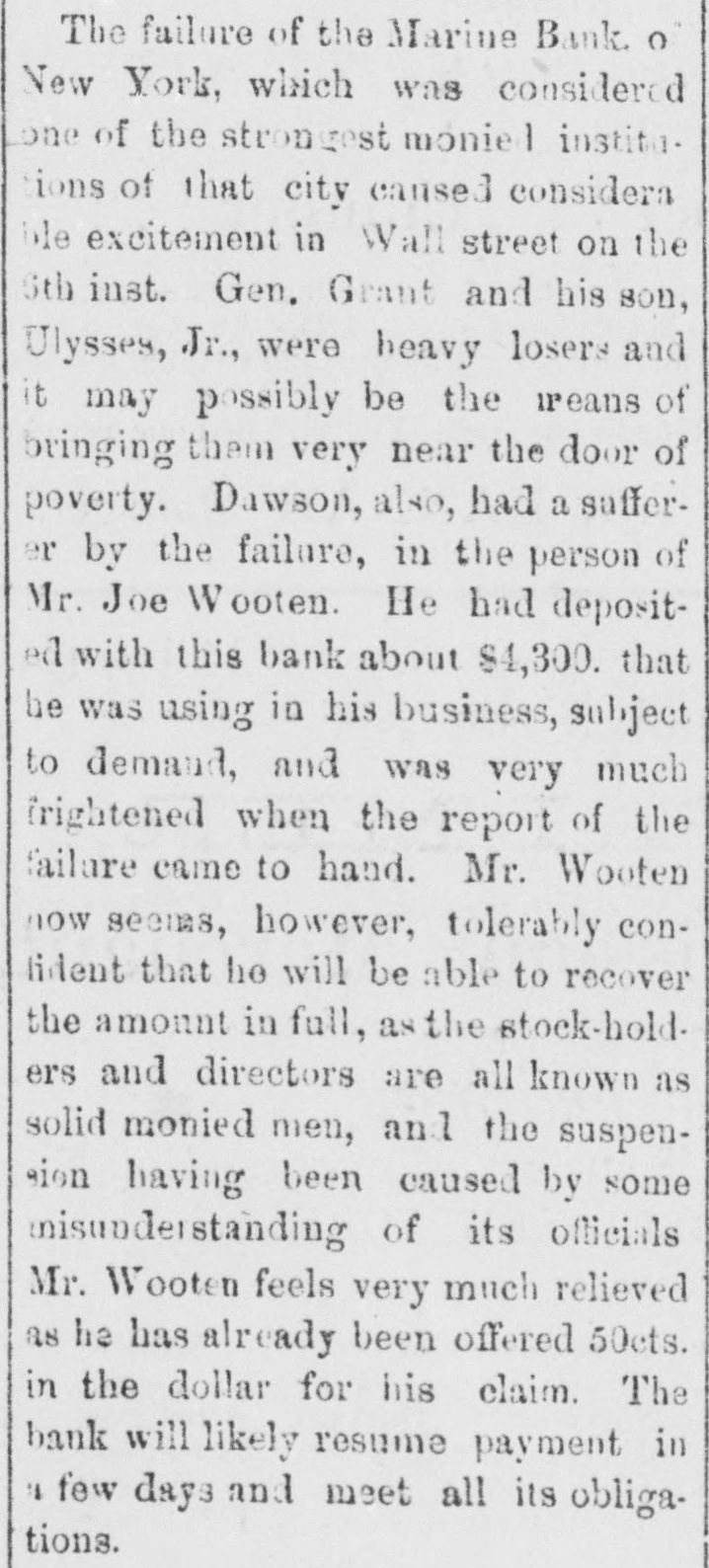
The failure of the Marine Bank. 0 New York, which was considered one of the strongest monied institutions of that city caused considera ble excitement in Wall street on the 5th inst. Gen. Grant and his son, Ulysses, Jr., were heavy losers and it may possibly be the ireans of bringing them very near the door of poverty. Dawson, also, had a sufferer by the failure, in the person of Mr. Joe Wooten. He had deposited with this bank about $4,300. that be was using in his business, subject to demand, and was very much frightened when the report of the failure came to hand. Mr. Wooten now seems, however, tolerably confident that he will be able to recover the amount in full, as the stock-hold. ers and directors are all known as solid monied men, and the suspension having been caused by some misunderstanding of its officials Mr. Wooten feels very much relieved as he has already been offered 50cts. in the dollar for his claim. The bank will likely resume payment in 1 few days and meet all its obligations.


Article from The Dallas Daily Herald, May 16, 1884

Click image to open full size in new tab

Article Text

From Quincy. QUINCY, ILL, May, 15.-The Union bank of this city opened doora this morning. When the Marine bank of New York failed the Union transferred its accounts to the Metropolitan, and the closing of doors by that bank yesterdav was given as the cause for their suspension.


Article from The Indianapolis Journal, May 16, 1884

Click image to open full size in new tab

Article Text

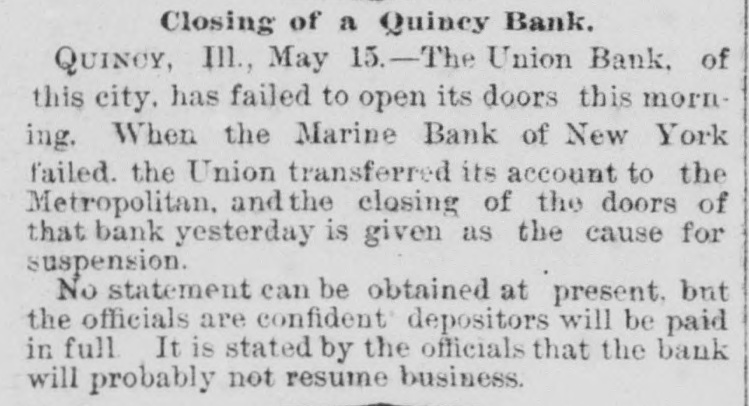
Closing of a Quincy Bank. QUINCY, III., May 15.-The Union Bank, of this city. has failed to open its doors this morning. When the Marine Bank of New York failed. the Union transferred its account to the Metropolitan. and the closing of the doors of that bank yesterday is given as the cause for suspension. No statement can be obtained at present. but the officials are confident depositors will be paid in full It is stated by the officials that the bank will probably not resume business.


Article from Morning Journal and Courier, May 16, 1884

Click image to open full size in new tab

Article Text

A Bank in Illinois Goes Down. QUINCY, III., May 15r-The Union bank of this city failed to open its doors this morning. When the Marine bank of New York failed the Union transferred its accounts to the Metropolitan, and the closing of that bank yesterday is given as the cause of the suspension


Article from Weekly Phoenix Herald, May 22, 1884

Click image to open full size in new tab

Article Text

AN ILLINOIS BANK SUSPENDS. CHICAGO, May 15.-The Journal's Quincy, III., special says: The Union Bank, of this city, has failed to open its doors this morning. When the Marine Bank, of New York, failed the Union transferred its accounts to the Metropolitan, and the closing of that bank yesterday caused its suspension.


Article from St. Landry Democrat, May 24, 1884

Click image to open full size in new tab

Article Text

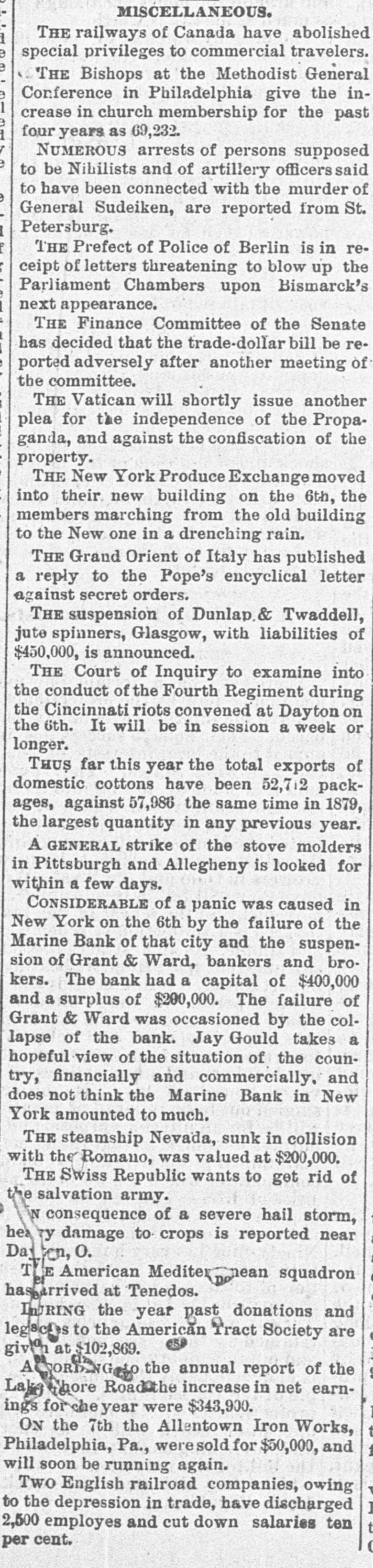
MISCELLANEOUS. THE railways of Canada have abolished special privileges to commercial travelers. THE Bishops at the Methodist General Conference in Philadelphia give the increase in church membership for the past four years as 69,232. NUMEROUS arrests of persons supposed to be Nibilists and of artillery officers said to have been connected with the murder of General Sudeiken, are reported from St. Petersburg. THE Prefect of Police of Berlin is in receipt of letters threatening to blow up the Parliament Chambers upon Bismarck's next appearance. THE Finance Committee of the Senate has decided that the trade-dollar bill be reported adversely after another meeting of the committee. THE Vatican will shortly issue another plea for the independence of the Propaganda, and against the confiscation of the property. THE New York Produce Exchange moved into their new building on the 6th, the members marching from the old building to the New one in a drenching rain. THE Grand Orient of Italy has published a reply to the Pope's encyclical letter against secret orders. THE suspension of Dunlap. & Twaddell, jute spinners, Glasgow, with liabilities of $450,000, is announced. THE Court of Inquiry to examine into the conduct of the Fourth Regiment during the Cincinnati riots convened at Dayton on the 6th. It will be in session a week or longer. THUS far this year the total exports of domestic cottons have been 52,712 packages, against 57,986 the same time in 1879, the largest quantity in any previous year. A GENERAL strike of the stove molders in Pittsburgh and Allegheny is looked for within a few days. CONSIDERABLE of a panic was caused in New York on the 6th by the failure of the Marine Bank of that city and the suspension of Grant & Ward, bankers and brokers. The bank had a capital of $400,000 and a surplus of $200,000. The failure of Grant & Ward was occasioned by the collapse of the bank. Jay Gould takes a hopeful view of the situation of the country, financially and commercially, and does not think the Marine Bank in New York amounted to much. THE steamship Nevada, sunk in collision with the Romano, was valued at $200,000. THE Swiss Republic wants to get rid of the salvation army. N consequence of a severe hail storm, hea y damage to crops is reported near Day O. T E American Mediter no nean squadron has arrived at Tenedos. InJRING the year past donations and legaches to the American Tract Society are S given at $102,869. A NORD Gato the annual report of the 9 Lake hore Road the increase in net earnings for che year were $343,900. ] ON the 7th the Allentown Iron Works, t Philadelphia, Pa., weresold for $50,000, and buts will soon be running again. Two English railroad companies, owing to the depression in trade, have discharged ] 2,500 employes and cut down salaries ten t per cent. (


Article from The Austin Weekly Statesman, July 31, 1884

Click image to open full size in new tab

Article Text

Bank Dividend. NEW YORK, July 26 - - Receiver Johnston, of the Marine bank, began payment to-day of a 15 per cent. dividend. Three hundred depositors were paid $400,000. Total amount of the dividend to be $600,000.


Article from The Stark County Democrat, July 31, 1884

Click image to open full size in new tab

Article Text

The receiver of the Marine bank 0 New York, 18 paying a dividend of 15 per cent., which will cause the disbursement of $600,000.


Article from Huntsville Gazette, August 2, 1884

Click image to open full size in new tab

Article Text

RECEIVER JOHNSON, of the Marine Bank, New York, began payment on the 26th of a fifteen per cent. dividend. Three hundred depositors were paid $400,000. The total amount of the dividend will be $600,000.


Article from Fair Play, August 2, 1884

Click image to open full size in new tab

Article Text

RECEIVER JOHNSON, of the Marine Bank, New York, began payment on the 26th of a fifteen per cent. dividend. Three hundred depositors were paid $400,000. The total amount of the dividend will be $600,000.


Article from The Louisiana Democrat, June 27, 1885

Click image to open full size in new tab

Article Text

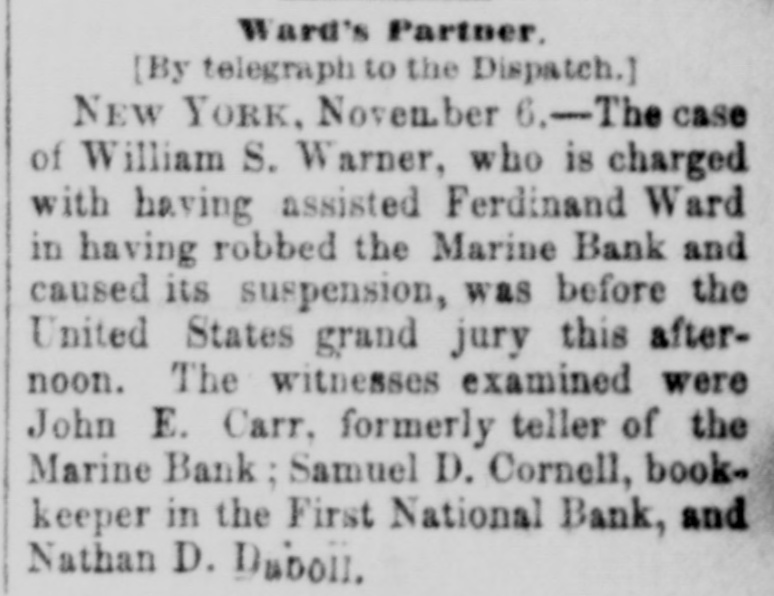
-THE receiver of the New York Marine Bank thinks that Ferdinand Ward has hidden away about $1,000,000.


Article from The Indianapolis Journal, October 16, 1885

Click image to open full size in new tab

Article Text

ashore. The matter has been investigated. and Mellus has been dismissed from the government service. FERD WARD'S FINANCERING. Ex-Comptroller Grant Tells of His Relations with Ward and the Marine Bank. NEW YORK, Oct. 15.-The Senate investigating committee met again to-day. Ex-Comptroller Grant was on the stand. Concerning his connection with Ferdinand Ward the witness said he had numerous relations with Ward for a period of ten years, and was indebted to him for a time covering his term of office. The witness refused to state the nature of this indebtedness, saying it was of a private nature. Ward was bondsman for him as comptroller, as was J. D. Fish, president of the Marine Bank. His business relations with Ward were still pending. When a large number of city bonds were offered for sale, outsiders were not refused the purchase of them. nor were they afterwards secured by Grant & Ward It was not through the witness's personal influence that Grant & Ward secured these bonds. It was not the custom of the witness to notify the firm of Grant & Ward of the applications made by other firms for city bonds. A few days before the failure of the Marine Bank the witness became alarmed in regard to the safety of the bank, because Ward had requested him to increase the deposit in that bank. The witness consulted Mayor Grace, and $600,000 was withdrawn. The city chamberlain drew the warrants for this amount, and they passed through the witness's hands for indorsement. Isaac Barrett, chief book-keeper in the comptroller's office, was recalled. He said that on three occasions he called Comptroller Grant's attention to the large amount of money on deposit in the Marine Bank. Mr. Grant denied that Barrett spoke to him about deposits.


Article from The Portland Daily Press, June 19, 1893

Click image to open full size in new tab

Article Text

The issue of clearing house certificates to relieve the financial situation in New York city, is a device that has been infrequently resorted to in times of disarrangement of the money market. The effect of these certificates is to unite the banks belonging to the clearing house association in a solid body which shall present a firm front. Thus the weakest bank is as strong as the united banks for the time being. The difficulty of a weak bank in time of trouble is the lack of ready money to meet the balances against it at the clearing house when at the end of each day's business the banks square up their debts to one another. To meet this difficulty clearing house certificates were invented. A committee of the clearing house association is appointed, who are empowered to receive from the several banks notes or other securities and issue therefrom certificates to the amount of 75 per cent. of the notes and securities so deposited. These certificates bear interest, and will be received at the clearing house in settlement of balances. So it happens that a weak bank which finds its cash low may take collateral to the committee and receive certificates which will serve in lieu of cash in such settlements. The advantages of 'this system are obvious. The solvency of the stronger banks is temporarily lent to the weaker, and the whole association stands together. It is on rare occasions, however, that this_device is resorted to. The first time in New York was in the height of the great panic of 1873; the second time was when Grant & Ward failed and the frauds in the Marine Bauk unsettled public confidence; the third case was when the Barings, a monument of financial strength for a century, in 1890 acknowledged themselves in difficulties; and the fourth case is now, when the demand for large sums of money by country banks to


Article from Potosi Journal, April 3, 1912

Click image to open full size in new tab

Article Text

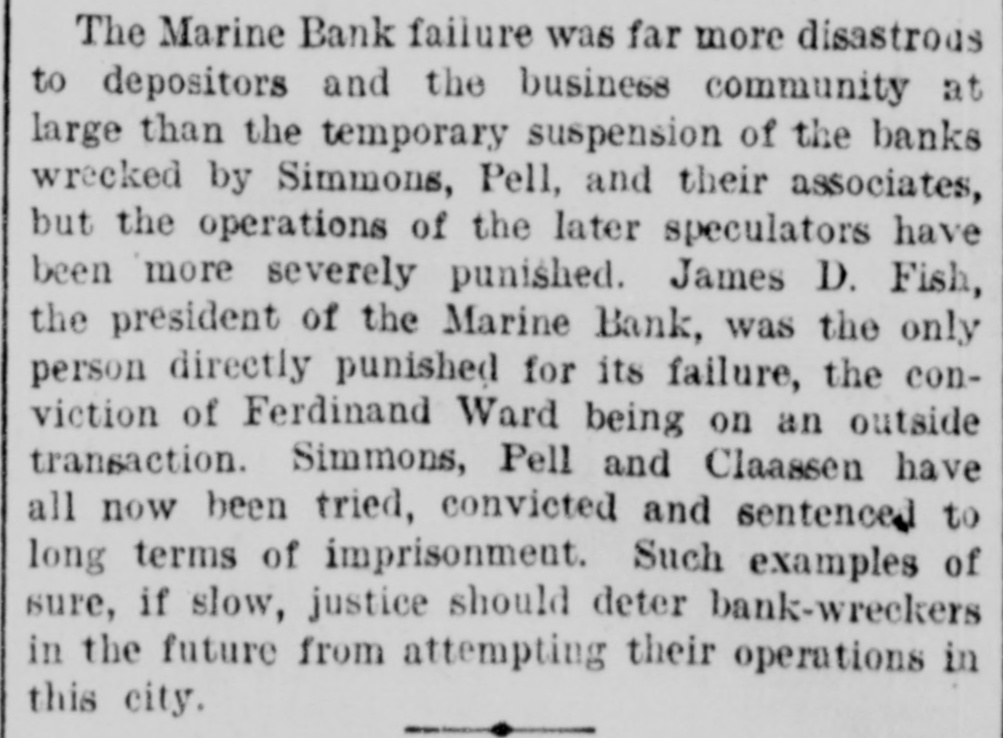
BANKRR WHO LOST GRANT'S CASH DIES JAMES DEAN FISH, WHOSE FAILURE CAUSED WALL STREET PANIC EXPIRES. WAS A DARING SPECULATOR Cleveland Pardoned Him and He Spent Rest of Life With Rare Col. lection of Books-Was Ninety. Three Years of Age. New York-The death in a secluded Brookiyn suburb of James Dean Fish, 93 years old, became known through nnouncements in the newspapers. Fish W.S president of the old Marine Bank, the failure of which in 1884 was marked by scenes of disorder never before equaled in Wall street. The closing of the bank swept away the savings of Gen. U. S. Grant and the investigation which followed sent Fish to Auburn prison and Ferdicand Ward. Grant's partner, to Sing Sing. Fish and Ward planned by a series of daring speculative operations to make the firm of Grant & Ward the most powerful financial institution in the country. The firm was originally composed of U. S. Grant. Jr., and Ward. Then Gen. Grant, who had retired from the presidency several years before, bought a share in the business. Gen. Grant, never a keen business man, was deceived and finally there came the fitful fizzle in Wall street, followed by the crash. After his release from prison on a pardon granted by President Cleveland Fish lived in strict seclusion and spent much of his time in his library. He had a rare collection of books and old prints.