Article Text
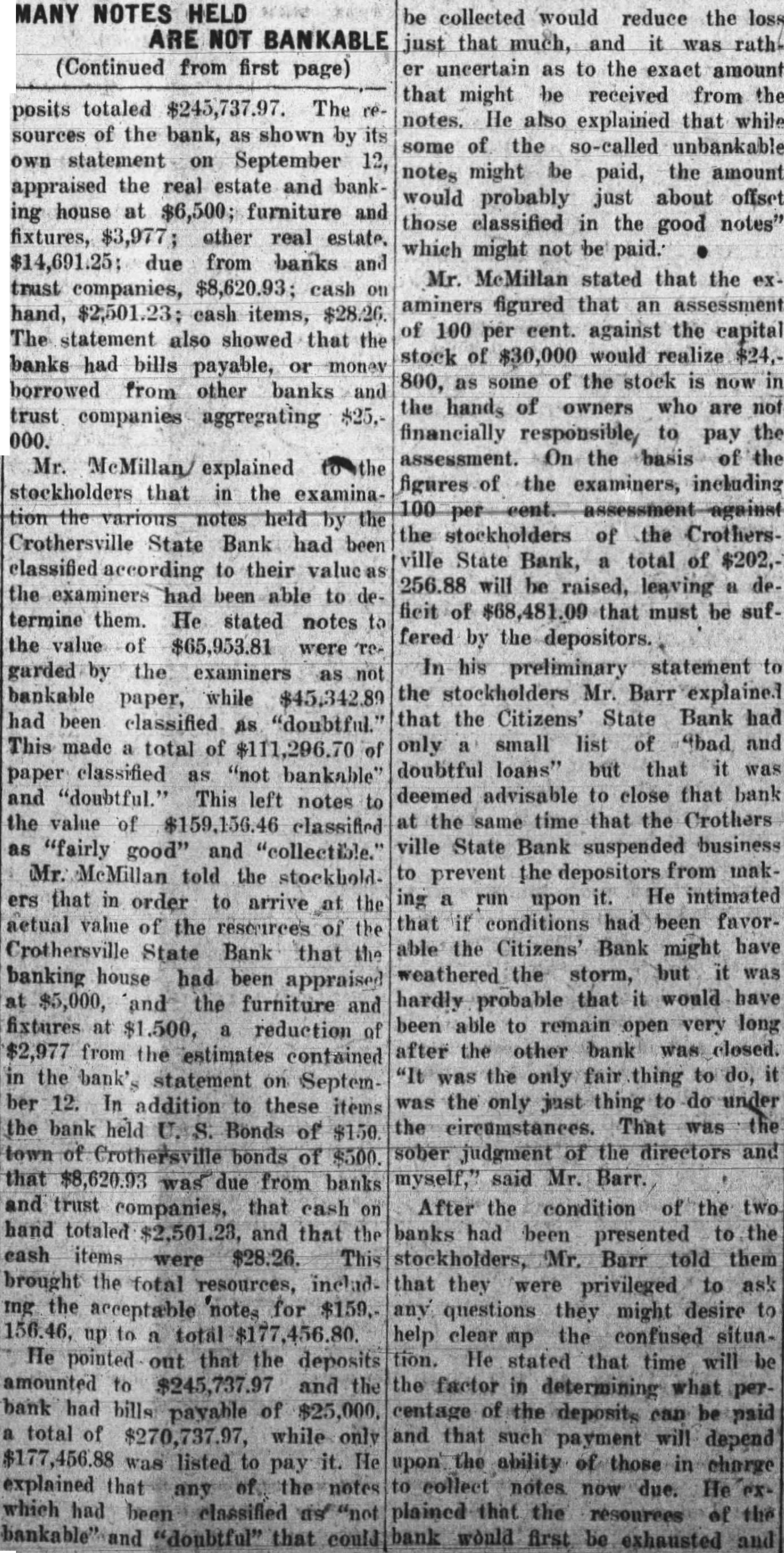
MANY NOTES HELD ARE NOT BANKABLE (Continued from first page)
posits totaled $245,737.97. The resources of the bank, as shown by its own statement on September 12, appraised the real estate and banking house at $6,500; furniture and fixtures, $3,977; other real estate, $14,691.25; due from banks and trust companies, $8,620.93; cash on hand, $2,501.23; cash items, $28.26. The statement also showed that the banks had bills payable, or money borrowed from other banks and trust companies aggregating $25,000.
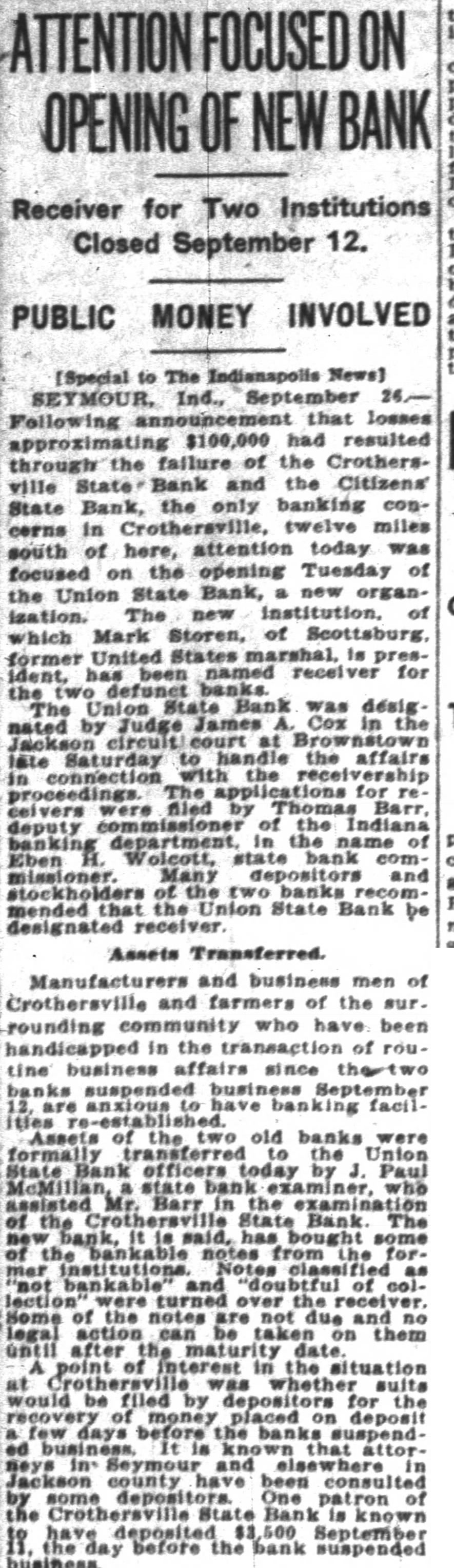
Mr. McMillan explained to the stockholders that in the examination the various notes held by the Crothersville State Bank had been classified according to their value as the examiners had been able to determine them. He stated notes to the value of $65,953.81 were regarded by the examiners as not bankable paper, while $45,342.89 had been classified as "doubtful." This made a total of $111,296.70 of paper classified as "not bankable" and "doubtful." This left notes to the value of $159,156.46 classified as "fairly good" and "collectible."
Mr. McMillan told the stockholders that in order to arrive at the actual value of the resources of the Crothersville State Bank that the banking house had been appraised at $5,000, and the furniture and fixtures at $1,500, a reduction of $2,977 from the estimates contained in the bank's statement on September 12. In addition to these items the bank held U. S. Bonds of $150, town of Crothersville bonds of $500, that $8,620.93 was due from banks and trust companies, that cash on hand totaled $2,501.23, and that the cash items were $28.26. This brought the total resources, including the acceptable notes for $159,156.46, up to a total $177,456.80.
He pointed out that the deposits amounted to $245,737.97 and the bank had bills payable of $25,000, a total of $270,737.97, while only $177,456.88 was listed to pay it. He explained that any of the notes which had been classified as "not bankable" and "doubtful" that could be collected would reduce the loss just that much, and it was rather uncertain as to the exact amount that might be received from the notes. He also explained that while some of the so-called unbankable notes might be paid, the amount would probably just about offset those classified in the good notes which might not be paid.
Mr. McMillan stated that the examiners figured that an assessment of 100 per cent. against the capital stock of $30,000 would realize $24,800, as some of the stock is now in the hands of owners who are not financially responsible to pay the assessment. On the basis of the figures of the examiners, including 100 per cent. assessment against the stockholders of the Crothersville State Bank, a total of $202,256.88 will be raised, leaving a deficit of $68,481.09 that must be suffered by the depositors.
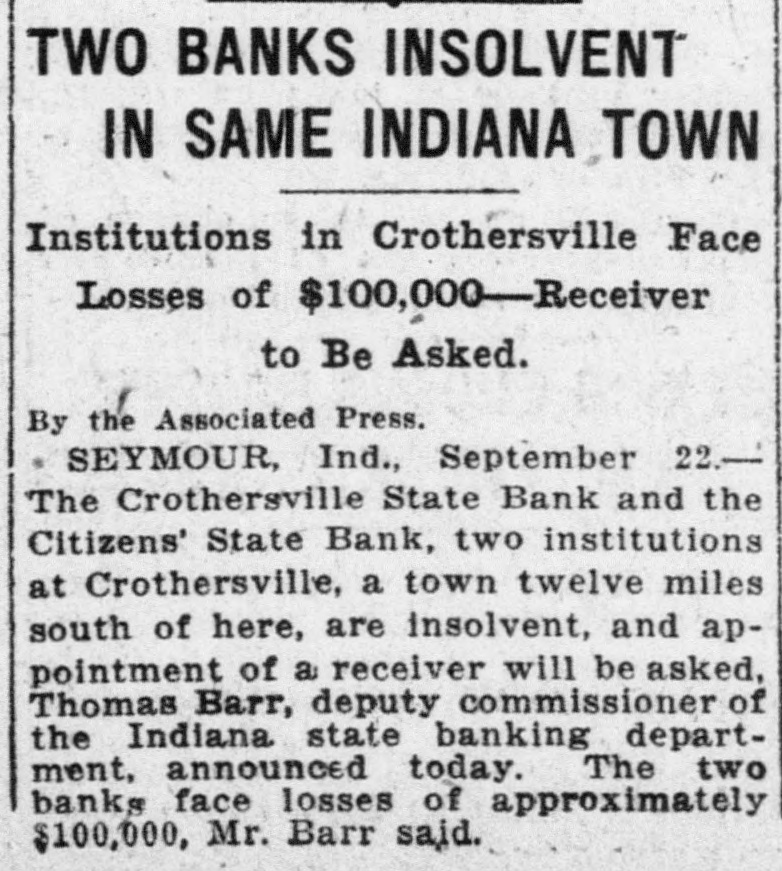
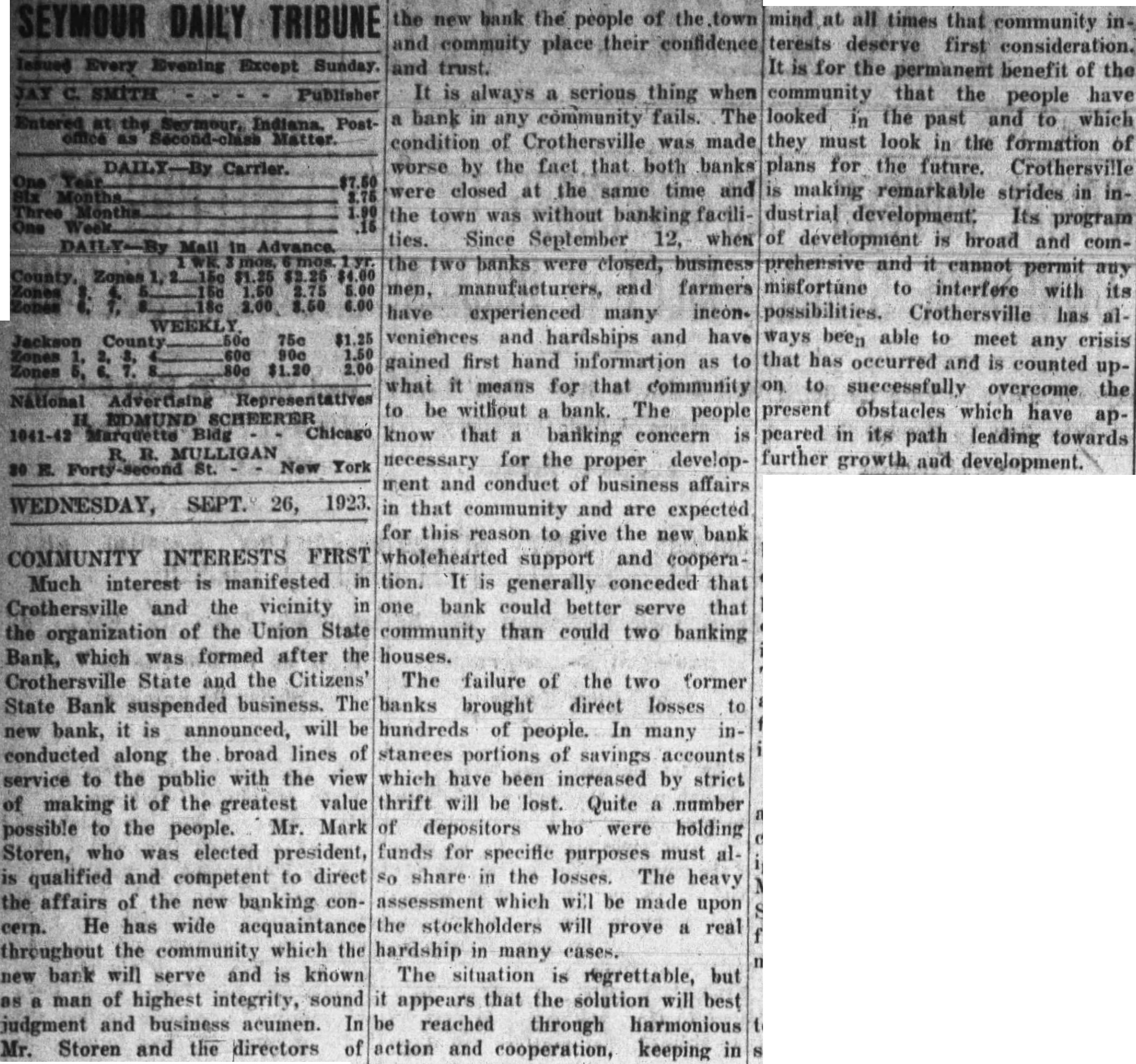
In his preliminary statement to the stockholders Mr. Barr explained that the Citizens' State Bank had only a small list of "bad and doubtful loans" but that it was deemed advisable to close that bank at the same time that the Crothersville State Bank suspended business to prevent the depositors from making a run upon it. He intimated that if conditions had been favorable the Citizens' Bank might have weathered the storm, but it was hardly probable that it would have been able to remain open very long after the other bank was closed. "It was the only fair thing to do, it was the only just thing to do under the circumstances. That was the sober judgment of the directors and myself," said Mr. Barr.
After the condition of the two banks had been presented to the stockholders, Mr. Barr told them that they were privileged to ask any questions they might desire to help clear up the confused situation. He stated that time will be the factor in determining what percentage of the deposits can be paid and that such payment will depend upon the ability of those in charge to collect notes now due. He explained that the resources of the bank would first be exhausted and