Empire City Bank (New York, NY)

Episode Information

Episode UID
7134077990658
Episode Type
Run β†’ Suspension β†’ Closure
Bank Type
state
Bank ID
713407799 hash
Start Date
October 12, 1854
Location
New York, New York (40.714, -74.006)

Metadata

Model
gpt-5-mini (chosen from majority vote of a three-model LLM ensemble)
Short Digest
7a9aca0b4cf6983b

Response Measures

None

Description

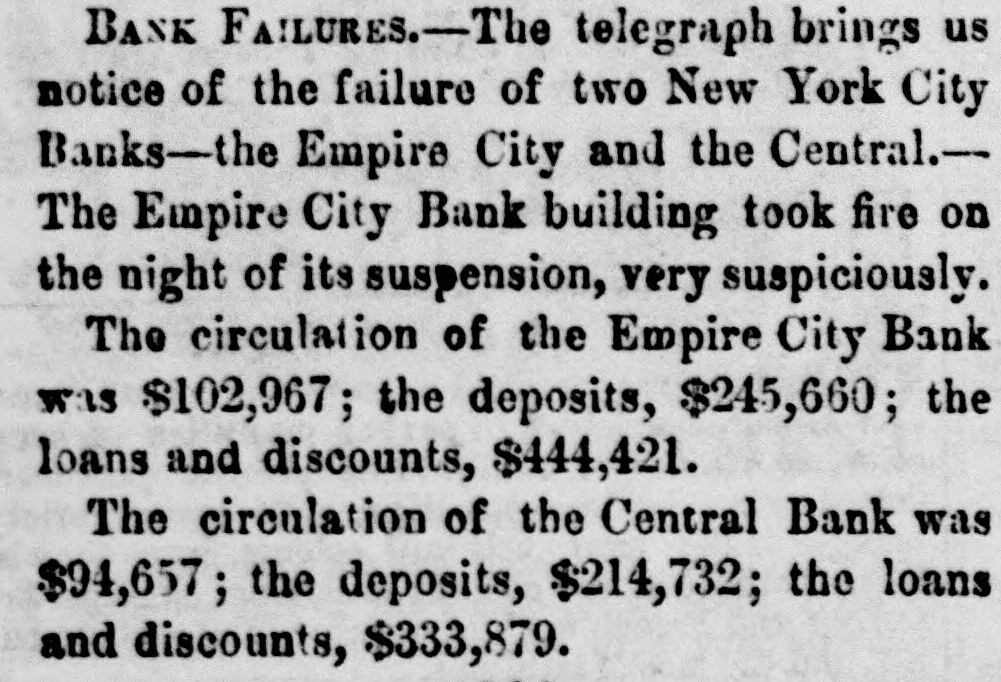
A suspicious fire at the bank on the night of suspension is reported in one paper.

Events (4)

1. October 12, 1854 Run
Cause
Rumor Or Misinformation
Cause Details
General panic among small up-town banks; runs provoked by rumors and 'tongue of rumor' rather than bank insolvency.
Measures
Paid depositors (bank paid up to 3 o'clock to meet redemptions).
Newspaper Excerpt
There was rather a serious run on the Empire City Bank this morning, but the bank paid up to 3 o'clock.
Source
newspapers
2. December 9, 1854 Suspension
Cause
Bank Specific Adverse Info
Cause Details
Failed to make good its clearing-house exchange / failed to pay the balance of the day's exchange; internal mismanagement and large bad loans discovered.
Newspaper Excerpt
You are notified that the Empire City Bank has been suspended from the privileges of the Clearing-House
Source
newspapers
3. December 19, 1854 Other
Newspaper Excerpt
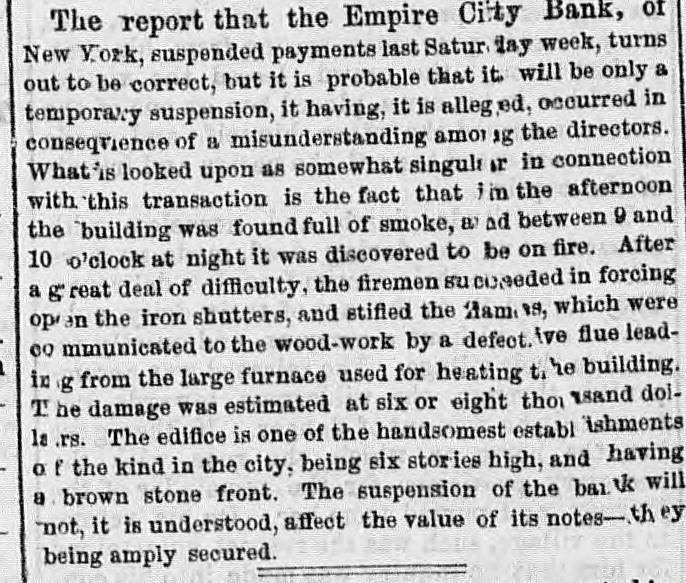
The report that the Empire City Bank, of New York, suspended payments last Saturday week ... the building was found full of smoke, and ... on fire the night of its suspension, very suspiciously.
Source
newspapers
4. February 2, 1855 Receivership
Newspaper Excerpt
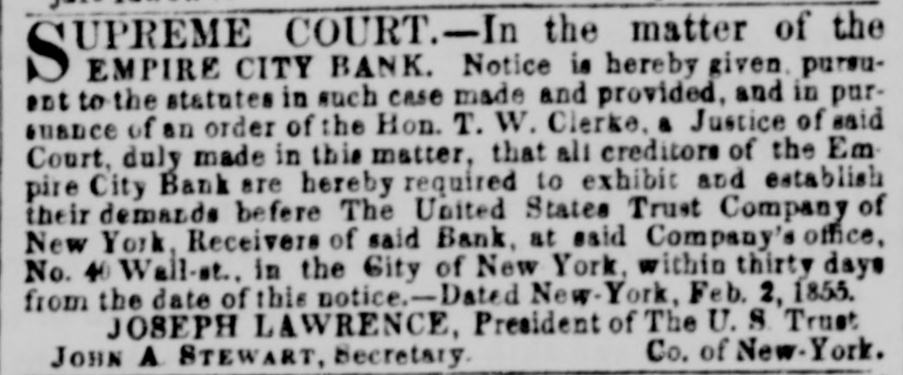
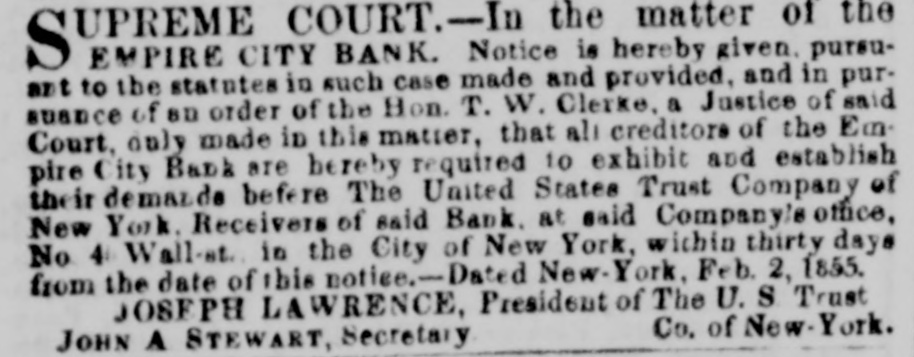
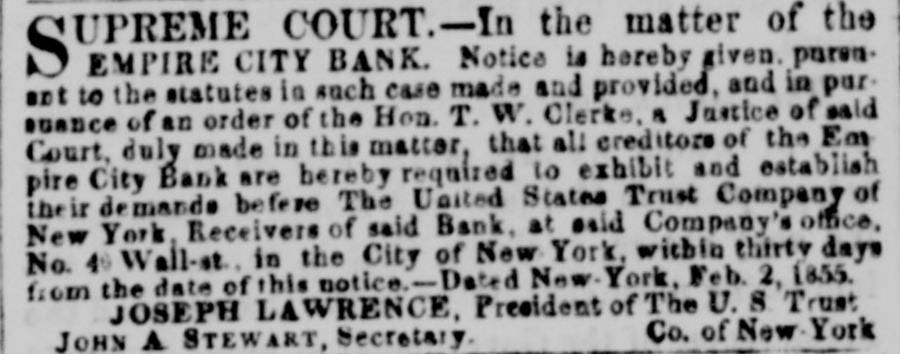
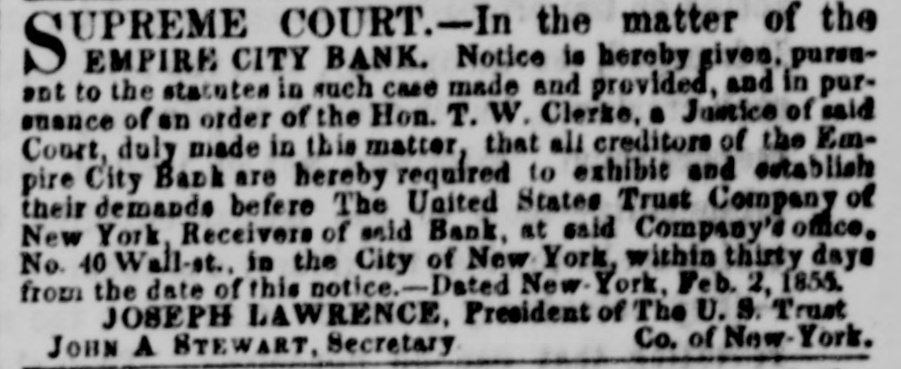
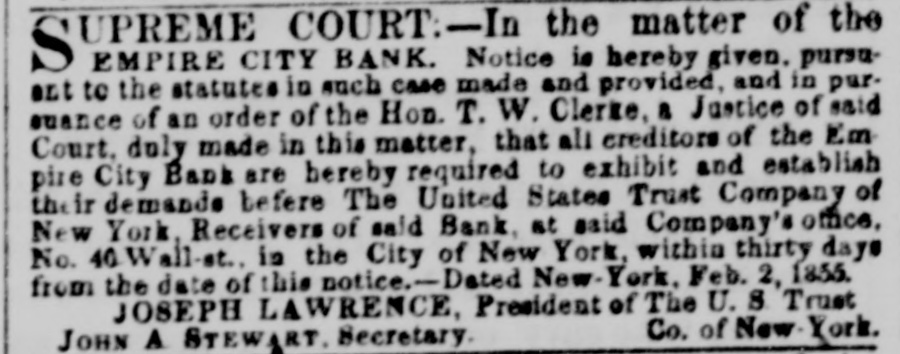
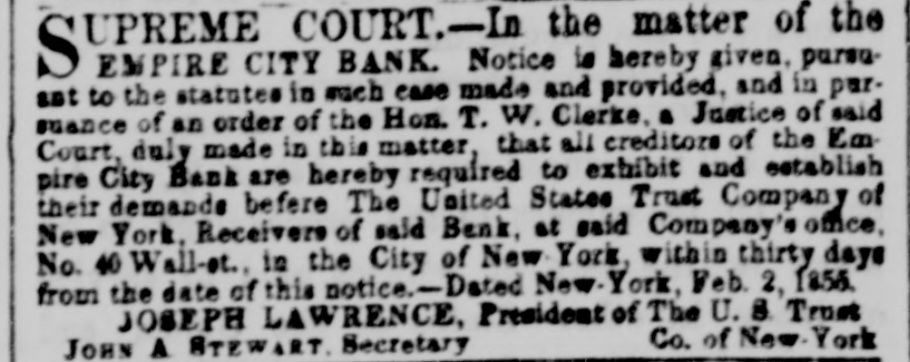
all creditors of the Empire City Bank are hereby required to exhibit and establish their demands before The United States Trust Company of New York, Receivers of said Bank, ... Dated New-York, Feb. 2, 1855.
Source
newspapers

Newspaper Articles (24)

Article from New-York Daily Tribune, October 13, 1854

Click image to open full size in new tab

Article Text

Thursday, Oct. 12-P. M. There was a much larger activity in the Stock market to-day and prices generally were buoyant, mainly through sympsthy with the rise in Erie. At the Secend Board there was less buoyancy and the market closed heavy. Erie was 45% about the closing price of yesterday. Reading has been stimulated by the large profits of its business and closed at 74, a further improvement of 1 P cent. Central improved to 91; Nicaragua 23, with good demand; Hudson River, 44. Cumberland closed at 30, showing a firm market. The Western Railroads are dull and generally heavy. In Railroad Bonds the business is $85,000, including New-York Central, 86%; Illinois Central, 681; Panama, 88; Erie, 1862, 73; 1871, 701; Incomes, 86; Saratoga and Sacketts Harbor, 88, &e. In Government Stocks there was nothing done; but a sale of North Carolinas was made at 102, and Californias at 85. The business in Exchangeis limited and the rates have a downward tendency. Sterling is 9@94, with some leading bankers' bills at9f P cent. in large bills. Francs, 5.13}@5.114. The supply of Commercial bills is quite light. From South there have been some France received, but we hear of but few remittances of Sterling. Freights arequiet. To Liverpool we hear of 50,000 bushels Grain at 3}@4d. in bulk; Cotton, d.; Dead-weight, 12/6. A charter was made for Malaga, but the terms did not transpire. To London, 350 bales Hops, 4d. The receipts at the Sub-Treasury are $92,334; paid, $60,485; balance, $5,876,174. The aggregate deposits at the Assay Office have been about $700,000 or $800,000. The first deposit was made by Mr. C. W. Thomas. From some unexplained delay at Philadelphia no bars have yet been received, but a pareel are expected to-night. The Exchanges at the Clearing House were large-$19,531,000. The shipments of gold by the Atlantic on Saturday promise to be nearly a million of dollars, of which $150,000 or more will be in Mexican silver. There is yet about a million of the Mexican fund remaining in Bank. The remainder of the seven millions, 88 far as can be ascertained, has been remitted to Europe. The money market continues without important change. The demand from merchants is large, and they pay high rates, but the stock houses are quite easy, and get what loans they want with facility at 7 P cent. The offerings at Bank are large, and increasing. The street rates for first-class paper are 10@12 P cent. The continuance of the large payments of the month, without important defalcations, is increasing the confidence of capitalists in commercial paper, and the demand for first-class paper is nearly equal to the supply. The multiplication of small banks with capital mainly paid up in notes renewable continually, and managed by parties having but little knowledge of banking, is producing its natural result. To the Eighth-av. and Knickerbocker Banks, already ebronicled as suspended, must now be added the Suffolk. The Suffolk has been in poor credit for some time past, having no arrangement for settlements through the Clearing-House. The capital is $250,000. The circulation is reduced to some $50,000, and will be redeemed by the Metropolitan Bank being secured amply by stocks in the Bank Department The deposits have been drawn down to about $40,000. It is thought the assets of the bank will yield enough very soon to pay their deposits. The dividend to the stockholders will not probably be a large one. There was rather a serious run on the Empire City Bank this morning, but the bank paid up to 3 o'clock. The circulation of this Bank is about $100,000, well secured by Stocks and the deposits about $240,000. There is a Sixpenny Savings Bank conrected with this institution, upon which there was also some run Nearly all the small up-town Banks suffered by the tongue of rumer to day. Most of the depositors in Savings Banks being of the uneducated classes, it is very easy to get up a panic in regard to them with very little distinction between the old established charter institutions and the new bogusdescription such 88 that connected with the Eighth-av. Bank. The depositsin all the Savings Banks will probably run down for awhile, but the excitement will gradually die away and they will run up again. There was some considerable demand for deposites at the Greenwich Saving *Bank to-day, but this institution having a million of dollars invested in Government and State Stocks, which are at any time available can stand any run. The Knickerbocker Bank made a strong attempt today to get aid to the extent of $100,000 with which to resume payment, but did not succeed. The securities in the Savings Bank connected with it are not, we hear, of the most reliable description. The Eighthav. Bank are endeavoring to negotiate their bonds and mortgages in the Bank Department, when they will commence redeeming their notes. There appears to be a determination upon the part of the managers of the Clearing House to purge the City banking system of all Banks the condition of which does not entitle them to full commission. Some half dozen banks outside the Clearing House have been living on from day to day by making their exchanges through some member of the House. Such Banks are to be discredited and forced into liquidation. Atleast such we understand is to be the future policy. No Banks are to be tolerated but such as have a bona fide paid up capital, and such as are prudently and skilfully conducted according to the rules of the Clearing House. The Banks at present members of the Clearing House are: Irving Bank, American Exchange Bank, Atlantic Bank Leather Manufacturers' Bank, Bank of New-York, Manhattan Company, Merchants' Bank. Bank of America, Butchers' & Drovers' Bank, Mechanics' Bank, Bank State of New York, Merchants' Exchange Bank, Bank of Commerce, Mechanics' & Traders' Bank

Article from The New York Herald, October 14, 1854

Click image to open full size in new tab

Article Text

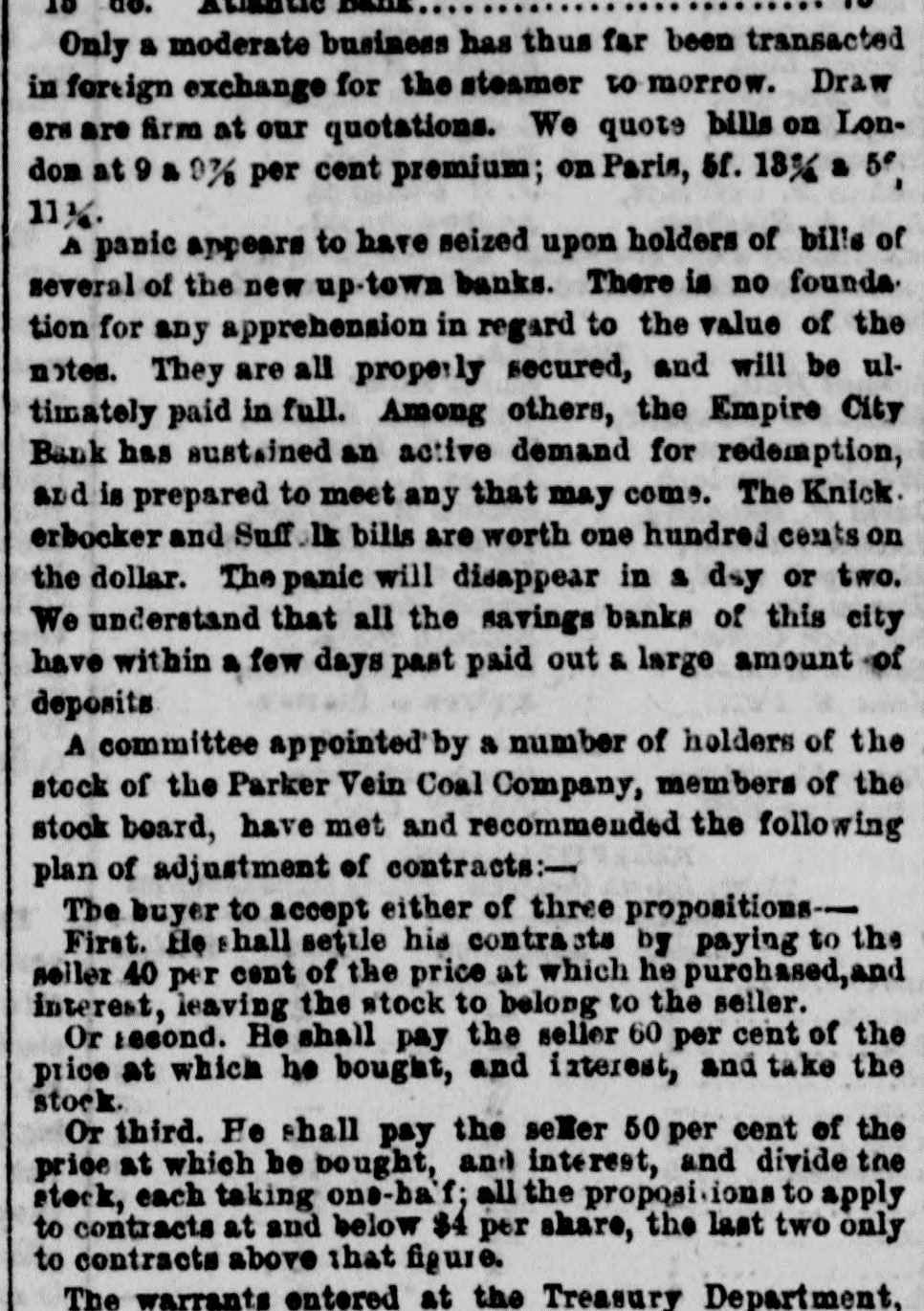
Only a moderate business has thus far been transacted in foreign exchange for the steamer to morrow. Draw ers are firm at our quotations. We quote bills on Londom at 9 a 03/2 per cent premium; on Paris, 5f. 18% a 5Β°, 11Β½. A panic appears to have seized upon holders of bills of several of the new up-town banks. There is no founds. tion for any apprehension in regard to the value of the notes. They are all properly secured, and will be ultimately paid in full. Among others, the Empire City Bank has sustained an active demand for redemption, and is prepared to meet any that may come. The Knick. erbocker and Suff lk bills are worth one hundred cents on the dollar. The panic will disappear in & day or two. We understand that all the savings banks of this city have within a few days past paid out & large amount of deposits A committee appointed by a number of holders of the stock of the Parker Vein Coal Company, members of the stock beard, have met and recommended the following plan of adjustment of contracts:β€” The buyer to accept either of three propositionsFirst. He shall settle his contras by paying to the seiler 40 per cent of the price at which he purchased,and interest, leaving the stock to belong to the seller. Or second. He shall pay the seller 60 per cent of the price at which he bought, and interest, and take the stock. Or third. Fe shall pay the seNer 50 per cent of the prioe at which be bought, and interest, and divide the stock, each taking one-half; all the proposi. to apply to contracts at and below $4 per share, the last two only to contracts above that figure. The warrants entered at the Treasury Department,


Article from The New York Herald, December 10, 1854

Click image to open full size in new tab

Article Text

Supreme Court of the United States. DEC. 7.-James Ridgway, Esq., of New York, was admitted an attorney and counsellor of this court. No. 5. Grey P. Webb and al., plaintiffs in error, vs. Polly Weatherhead's lessee. This cause was argued by Mr. Gillet for the plaintiff in error. No. 6. Marcelin Haydel, plaintiff in error, V8. FranΓ§ois Dufresne. This cause was argued by Mr. Janin for the plaintiff in error. No. S. Israel W. Raymond, appellant, VS. Wm. Tyson. The argument of this cause was commenced by Mr. Lord for the appellant, and continued by Mr. Cutting for the appellee. FINANCIAL AND COMMERCIAL. MONEY MARKET. SATURDAY, Dec. 9-5 P. M. The stock market to-day was somewhat depressed. The buoyancy of the past few days has been lost, and the probability is that prices will gradually fall off to the points they started from for the recent rise. At the first board to-day, Erie Income Bonds fell off 2 per cent; New York Central Bonds, Β½ Nicaragua Transit, 3/2 Cumberland Coal, %; Erie R. R., Β½; Reading R. R., %; Harlem R. R. %; Chicago and Rock Island R. R. M. The transactions in Erie and Reading R. R. were particularly large. Erie R. R. opened yesterday at the second board decline of 1% per at 37% per cent, and closed at 36 cent. This morning it opened at 36Β½ per cent-an advance of Β½ per cent on yesterday's closing prices, and closed at 35%-a decline of Β½ per cent during the board. These fluctuations show pretty clearly the condition of operators, and they also show that, with but 8 slight probability of any improvement of consequence, prices may fall off suddenly and largely, leaving recent buyers far above the market. New York Central Bonds, with guarantee of the regular payment of interest, are selling at prices just about equal to those for the stock, upon which there has been but one dividend paid in about eighteen months. The approaching dividend. if paid at all, will be in the company's bonds at their par value. This sort of financiering may do for a time, but no railroad company can stand it long, no matter what its resources may be. It is like a candle burning at both ends-must soon be consumed. The Erie Railroad Company used to feel as through there was no end to their means, and that standing a big shave here and there was of no consequence. Look at the result of that company's financial operations! The New York Central Company are no bet er off this moment than the Erie; but they may manage to hide their rottenness for a while longer. The worm has been at the core IL long time, and its ravages must soon appear. We are informed that the Empire City Bank bas been suspended from the privileges of the Clearing House. The suspension was in consequence of the failure of that bank to pay the balance resulting from the exchange of the day. This will not affect the value of its notes, as they reamply secured. A meeting of bank officers will be held on Monday, 11th inst., at 12 o'clock, at the Clearing House, called by order of the committee. The receipts at the office of the Assistant Treasurer of this port, to-day amounted to $156,357 03; payments, $63,647 11-balance, $6,772,837 35. Of the receipts to. day, $100,000 was a transfer. Paid for Assay Office, $247,952 43. After the adjournment of the board, the following sales of bonds and stocks were made at auction, by Albert H. Nicolay $5,000 NYork and NHaven RR. 7's 1866, Intadded 77 3622 5,000 Great West. Ills. RR. 10s 1st mort do 7189 28,000 Ohio and Mississippi RR. 2d mort do 16 70 shares Third Avenue Railroad %96 15 do American Express Co 98 Rund Handrer op OI 801 dued Childens, op 6+ The steamship North Star, at this port from Aspinwall, brings one week later news from California, and $1,884,005 in gold and gold dust. The commercial accounts continue about the same. The earnings of the Boston, Concord and Montreal $29,359 Railroad for October, 1854, were 2001818 1853 October Gain in October, 1854 over 1853 The Merrimac Manufacturing Co. have declared a di vidend of 5 per cent semi-annual, ($50 per share) payable on demand. Boston, Concord and Montreal Railroad, preferred stock, 3 per cent semi-annual, payable Dec. 11 to holders Nov. 1. An assessment of 25 cents per share has been laid the stock of the Winthrop Copper Co, and an assessment of $1 per share upon the Toltec Consolidated. The


Article from New-York Daily Tribune, December 11, 1854

Click image to open full size in new tab

Article Text

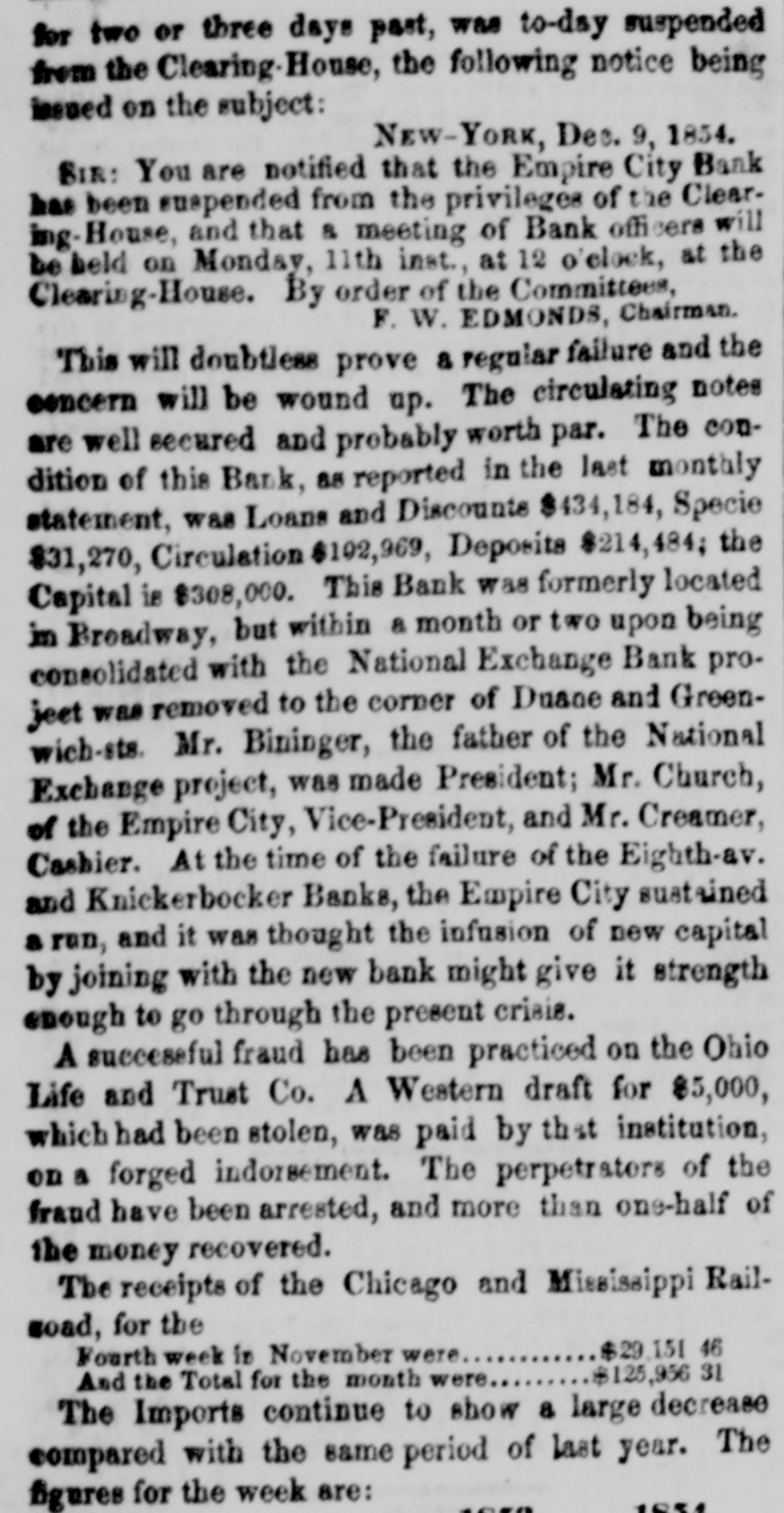
for two or three days past, was to-day suspended from the Clearing-House, the following notice being issued on the subject: NEW-YORK, Dec. 9, 1854. BIR: You are notified that the Empire City Bank has been suspended from the privileges of the Clearing-House, and that & meeting of Bank officers will be held on Monday, 11th inst., at 12 o'elock, at the Clearing-House. By order of the Committees, F. W. EDMONDS, Chairman. This will doubtless prove a regular failure and the concern will be wound up. The circulating notes are well secured and probably worth par. The condition of this Bank, as reported in the last monthly statement, was Loans and Discounts $434,184, Specie $31,270, Circulation $192,969, Deposits $214,484; the Capital is $308,000. This Bank was formerly located in Broadway, but within a month or two upon being consolidated with the National Exchange Bank projeet was removed to the corner of Duane and Greenwich-sts. Mr. Bininger, the father of the National Exchange project, was made President; Mr. Church, of the Empire City, Vice-President, and Mr. Creamer, Cashier. At the time of the failure of the Eighth-av. and Knickerbocker Banks, the Empire City sustained a run, and it was thought the infusion of new capital by joining with the new bank might give it strength enough to go through the present crisis. A successful fraud has been practiced on the Ohio Life and Trust Co. A Western draft for $5,000, which had been stolen, was paid by that institution, on a forged indorsement. The perpetrators of the fraud have been arrested, and more than one-half of the money recovered. The receipts of the Chicago and Mississippi Railmoad, for the $29,151 46 Fourth week in November were $125,956 31 And the Total for the month were The Imports continue to show a large decrease compared with the same period of last year. The 1851 1959 figures for the week are:


Article from New Orleans Daily Crescent, December 19, 1854

Click image to open full size in new tab

Article Text

The report that the Empire City Bank, of New York, suspended payments last Satur day week, turns out to be correct, but it is probable that it. will be only a temporary suspension, it having, it is alleg occurred in consequence of a misunderstanding amor 1g the directors. What's looked upon as somewhat singula sr in connection with this transaction is the fact that i in the afternoon the building was found full of smoke, a ad between 9 and 10 o'clock at night it was discovered to be on fire. After a g reat deal of difficulty, the firemen su exceded in forcing op an the iron shutters, and stifled the Name 19, which were 00 immunicated to the wood-work by a defect. ive flue leadin g from the large furnace used for heating t. he building. T he damage was estimated at six or eight tho usand dolla .rs. The edifice is one of the handsomest establ ishments o f the kind in the city, being six stories high, and having a brown stone front. The suspension of the bar v will "not, it is understood, affect the value of its notes-.. ey being amply secured.


Article from Burlington Tri-Weekly Hawk-Eye, December 19, 1854

Click image to open full size in new tab

Article Text

BANK FAILURES.-The telegraph brings us notice of the failure of two New York City Banks-the Empire City and the Central.The Empire City Bank building took fire on the night of its suspension, very suspiciously. The circulation of the Empire City Bank was $102,967; the deposits, $245,660; the loans and discounts, $444,421. The circulation of the Central Bank was $94,657; the deposits, $214,732; the loans and discounts, $333,879.


Article from The Daily Minnesota Pioneer, December 21, 1854

Click image to open full size in new tab

Article Text

NEWS ITEMS. The New York Tribune says, there are five hundred printers out of employment in that city. The Express mentions, that one principal Iron Work there recently discharged 500 men. The scarcity of money and the difficulty of closing contracts is referred to as the principal cause. Jackson, tried at St. Louis for the murder of Laidlaw, the theatrical scene painter, has been acquitted. We judge from the tone of the St. Louis papers, that the public opinion there condemns this verdict, and rightly. The Milwaukee Sentinel estimates the value of the exports of Wisconsin for the year 1854, at ten millions of Dollars. Of this sum, Five Millions of exports were sent from the port of Milwaukee. The Springfield Journal says, that the Farmers' and Mechanics' Bank of that city has gone into liquidation. John T. Stuart, Esq., has been appointed Receiver, and has entered upon his duties. The Mississippt is not yet closed at Galena. They continue to skiff it at Dubuque, with difficuly and danger. This state of things may continue for a month, though probably not more than a week or two longer. The City Sexton of Chicago reports the number of deaths in that city for the month of November at 200, of which number, 40 died of cholera. The Empire City Bank, New York City, did not make good its exchange at the clearing house on the 9th, instant, which is considered equivalent to a failure. Fisher, Democrat, has been elected President of the Iowa State Senate. Two of the Whigs voted Loco Foco. The steamer Baltic sailed from New York to Liverpool on the 9th, with thirty-five passengers and no specie. Counterfeit fives of the Casco Bank of Portland are in extensive circulation in the neighborhood of Boston. Kehee, who was convicted at Toronto for the murder of his wife, has been executed. The dogs in San Francisco must be as great a nuisance as they are in Constantinople. The last received Placer Times announces that "the Plaza is boarded up by order of the street commissioner on account of the depredations of a number of dogs on the grassplots. A little girl named Comery, of Lowell, Mass., a sister of one of the carriers of the News, a day or two since found a check on the Atlas Bank of Boston for $7,500, which she returned to the owner. He made her a present of a "thankee!"-and that was all. Fifty-three slaves, freed by the will of the late Dr. Charles Everett, of Virginia, have just left Petersburgh, Virginia, for Pennsylvania, where they are to be located with an outfit of one thousand five hundred dollars each. The Detroit Advertiser, in reply to the question "Who is Q. K. Philander Doesticks, P. B ?" says it is Mortimer M. Thompson, formerly of Ann Arbor and at present a clerk in a store in South Street, in Detroit. A Mexican, caught running away with a negro woman, was recently tried at Goliad, Texas, and sentenced to one hundred and fifty lashes, to be branded with the letter T on his forehead. The wife of William F. Thayer, of Gainesville, New York, committed suicide on Sunday afternoon last, by hanging herself in the wood-shed to her husbands house. No reason is assigned for the melancholy act. The editor of the Coutland county Whig, says he has been presented with an egg laid by a chicken of last spring, which weigh four ounces, whose smaller circumstances is 6 1-4 inches, and the longer 8 1-4 inches.


Article from The Daily Minnesota Pioneer, December 21, 1854

Click image to open full size in new tab

Article Text

NEWS ITEMS. The New York Tribune says, there are five hundred printers out of employment in that city. The Express mentions, that one principal Iron Work there recently discharged 500 men. The scarcity of money and the difficulty of closing contracts is referred to as the principal cause. Jackson, tried at St. Louis for the murder of Laidlaw, the theatrical scene painter, has been acquitted. We judge from the tone of the St. Louis papers, that the public opinion there condemns this verdict, and rightly. The Milwaukee Sentinel estimates the value of the exports of Wisconsin for the year 1854, at ten millions of Dollars. Of this sum, Five Millions of exports were sent from the port of Milwaukee. The Springfield Journal says, that the Farmers' and Mechanics' Bank of that city has gone into liquidation. John T. Stuart, Esq., has been appointed Receiver, and has entered upon his duties. The Mississippt is not yet closed at Galena. They continue to skiff it at Dubuque, with difficuly and danger. This state of things may continue for a month, though probably not more than a week or two longer. The City Sexton of Chicago reports the number of deaths in that city for the month of November at 200, of which number, 40 died of cholera. The Empire City Bank, New York City, did not make good its exchange at the clearing house on the 9th, instant, which is considered equivalent to a failure. Fisher, Democrat, has been elected President of the Iowa State Senate. Two of the Whigs voted Loco Foco. The steamer Baltic sailed from New York to Liverpool on the 9th, with thirty-five passengers and no specie. Counterfeit fives of the Casco Bank of Portland are in extensive circulation in the neighborhood of Boston. Kehee, who was convicted at Toronto for the murder of his wife, has been executed. The dogs in San Francisco must be as great a nuisance as they are in Constantinople. The last received Placer Times announces that "the Plaza is boarded up by order of the street commissioner on account of the depredations of a number of dogs on the grassplots. A little girl named Comery, of Lowell, Mass., a sister of one of the carriers of the News, a day or two since found a check on the Atlas Bank of Boston for $7,500, which she returned to the owner. He made her a present of a "thankee!"-and that was all. Fifty-three slaves, freed by the will of the late Dr. Charles Everett, of Virginia, have just left Petersburgh, Virginia, for Pennsylvania, where they are to be located with an outfit of one thousand five hundred dollars each. The Detroit Advertiser, in reply to the question "Who is Q. K. Philander Doesticks, P. B ?" says it is Mortimer M. Thompson, formerly of Ann Arbor and at present a clerk in a store in South Street, in Detroit. A Mexican, canght running away with a negro woman, was recently tried at Goliad, Texas, and sentenced to one hundred and fifty lashes, to be branded with the letter T on his forehead. The wife of William F.Thayer, of Gainesville, New York, committed suicide on Sunday afternoon last, by hanging herself in the wood-shed to her husbands house. No reason is assigned for the melancholy act. The editor of the Coutland county Whig, says he has been presented with an egg laid by a chicken of last spring, which weigh four ounces, whose smaller circumstances is 61-4 inches, and the longer 8 1-4 inches.


Article from Worcester Daily Spy, January 4, 1855

Click image to open full size in new tab

Article Text

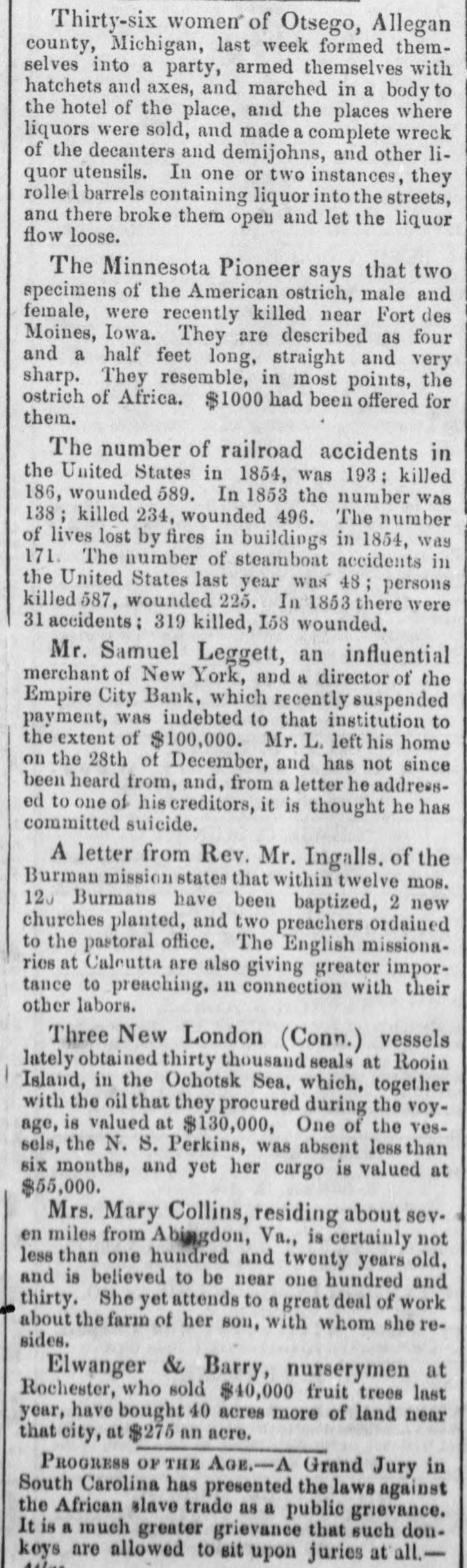
Thirty-six women of Otsego, Allegan county, Michigan, last week formed themselves into a party, armed themselves with hatchets and axes, and marched in a body to the hotel of the place, and the places where liquors were sold, and made a complete wreck of the decanters and demijohns, and other liquor utensils. In one or two instances, they rolled barrels containing liquor into the streets, and there broke them open and let the liquor flow loose. The Minnesota Pioneer says that two specimens of the American ostrich, male and female, were recently killed near Fort des Moines, Iowa. They are described as four and a half feet long, straight and very sharp. They resemble, in most points, the ostrich of Africa. $1000 had been offered for them. The number of railroad accidents in the United States in 1854, was 193; killed 186, wounded 589. In 1853 the number was 138; killed 234, wounded 496. The number of lives lost by fires in buildings in 1854, was 171. The number of steamboat accidents in the United States last year was 48; persons killed 587, wounded 225. In 1853 there were 31 accidents; 319 killed, 158 wounded. Mr. Samuel Leggett, an influential merchant of New York, and a director of the Empire City Bank, which recently suspended payment, was indebted to that institution to the extent of $100,000. Mr. L. left his home on the 28th of December, and has not since been heard from, and, from a letter he address-ed to one of his creditors, it is thought he has committed suicide. A letter from Rev. Mr. Ingalls, of the Burman mission states that within twelve mos. 12 Burmans have been baptized, 2 new churches planted, and two preachers ordained to the pastoral office. The English missiona-ries at Calcutta are also giving greater importance to preaching, in connection with their other labors. Three New London (Conn.) vessels lately obtained thirty thousand seals at Rooin Island, in the Ochotsk Sea, which, together with the oil that they procured during the voyage, is valued at $130,000, One of the vessels, the N. S. Perkins, was absent less than six months, and yet her cargo is valued at $55,000. Mrs. Mary Collins, residing about seven miles from Abingdon, Va., is certainly not less than one hundred and twenty years old, and is believed to be near one hundred and thirty. She yet attends to a great deal of work about the farm of her son, with whom she resides. Elwanger & Barry, nurserymen at Rochester, who sold $40,000 fruit trees last year, have bought 40 acres more of land near that city, at $275 an acre. # PROGRESS OF THE AGE A Grand Jury in South Carolina has presented the laws against the African slave trade as a public grievance. It is a much greater grievance that such donkeys are allowed to sit upon juries at all.


Article from New-York Daily Tribune, January 4, 1855

Click image to open full size in new tab

Article Text

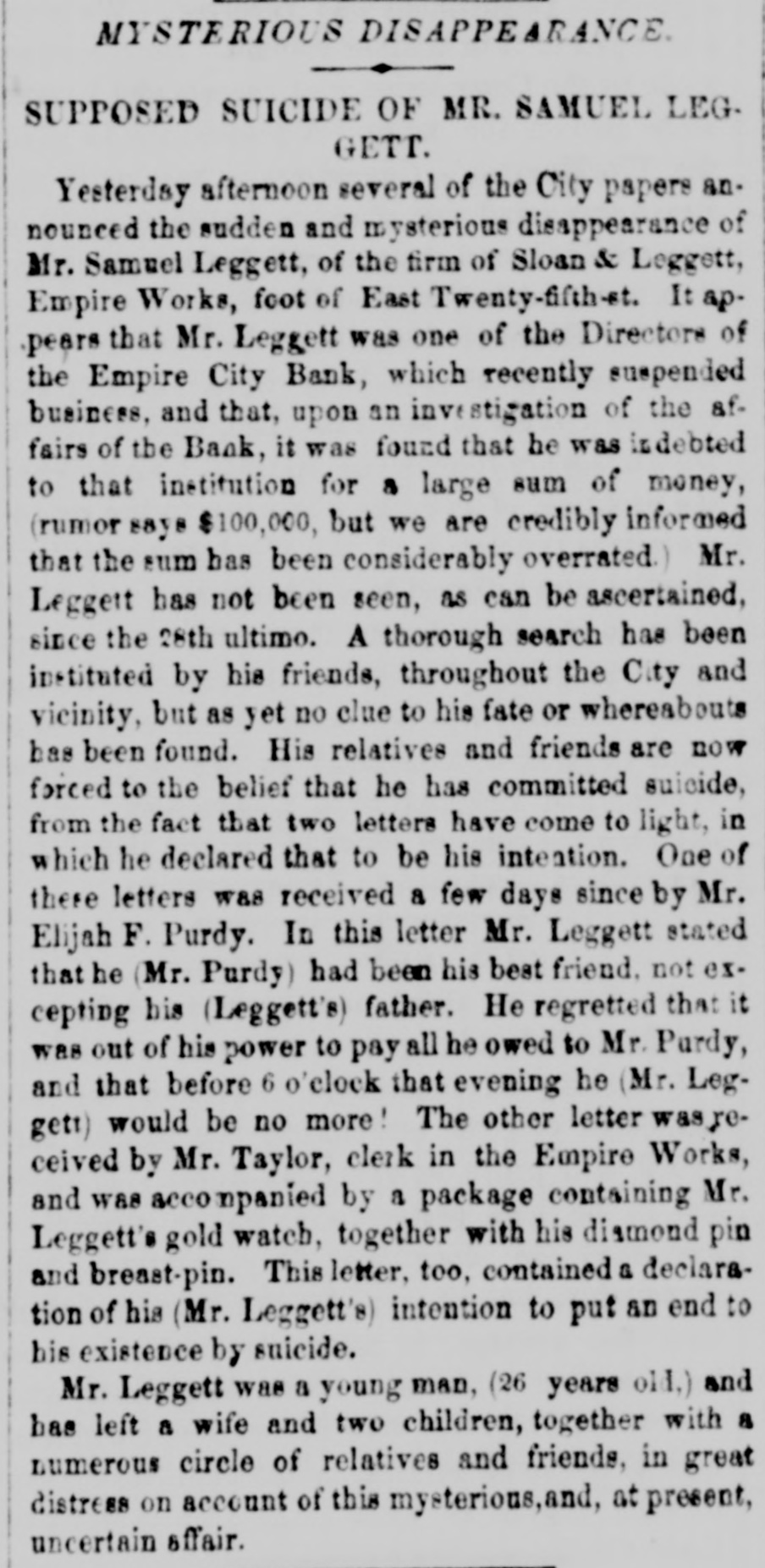
MYSTERIOUS DISAPPEARANCE. SUPPOSED SUICIDE OF MR. SAMUEL LEG. GETT. Yesterday afternoon several of the City papers announced the sudden and mysterious disappearance of Mr. Samuel Leggett, of the firm of Sloan & Leggett, Empire Works, foot of East Twenty-fifth-st. It ap. pears that Mr. Leggett was one of the Directors of the Empire City Bank, which recently suspended business, and that, upon an investigation of the affairs of the Bank, it was found that he was indebted to that institution for a large sum of money, (rumor says $100,000, but we are credibly informed that the sum has been considerably overrated.) Mr. Leggett has not been seen, as can be ascertained, since the 28th ultimo. A thorough search has been instituted by his friends, throughout the City and vicinity, but as yet no clue to his fate or whereabouts has been found. His relatives and friends are now forced to the belief that he has committed suicide, from the fact that two letters have come to light, in which he declared that to be his intention. One of there letters was received a few days since by Mr. Elijah F. Purdy. In this letter Mr. Leggett stated that he (Mr. Purdy) had been his best friend. not excepting his (Leggett's) father. He regretted that it was out of his power to pay all he owed to Mr. Purdy, and that before 6 o'clock that evening he (Mr. Leggett) would be no more! The other letter was received by Mr. Taylor, clerk in the Empire Works, and was impanied by a package containing Mr. Leggett's gold watch, together with his dismond pin and breast-pin. This letter, too, contained a declaretion of his (Mr. Leggett's) intention to put an end to his existence by suicide. Mr. Leggett was a young man, (26 years old,) and has left a wife and two children, together with a numerous circle of relatives and friends, in great distress on account of this mysterious,and, at present, uncertain affair.


Article from The Weekly Portage Sentinel, January 10, 1855

Click image to open full size in new tab

Article Text

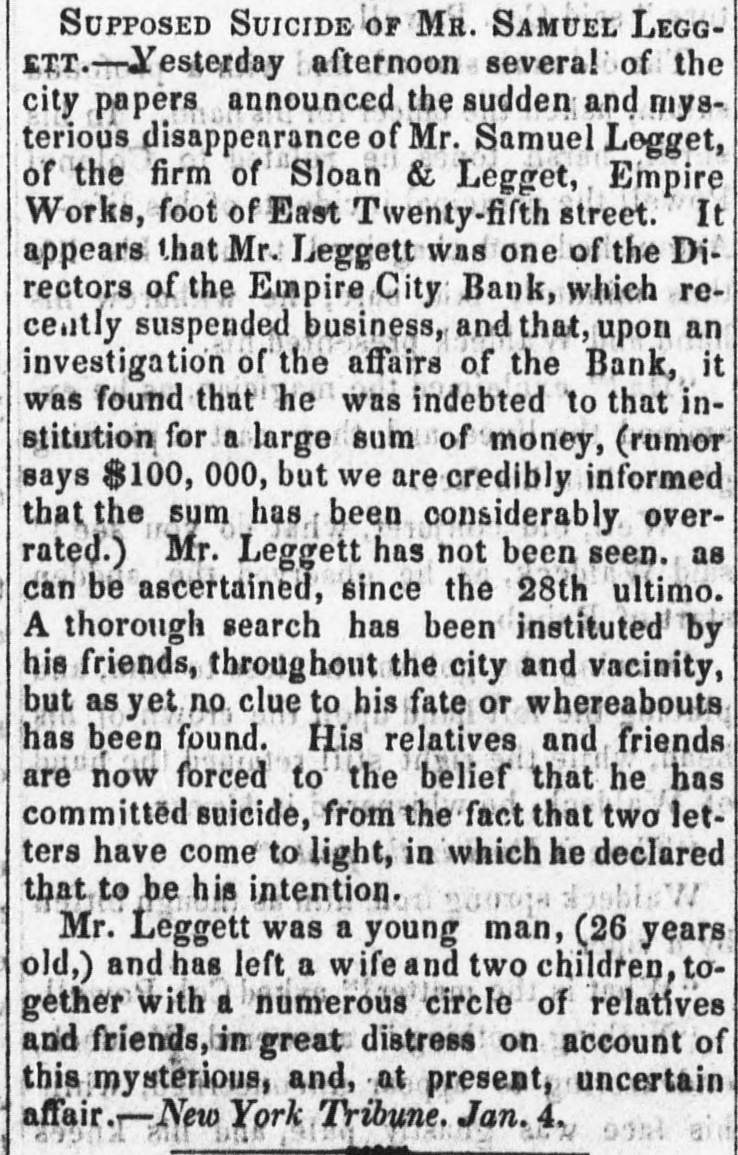
SUPPOSED SUICIDE OF MR. SAMUEL LEGGETT. Yesterday afternoon several of the city papers announced the sudden and mysterious disappearance of Mr. Samuel Legget, of the firm of Sloan & Legget, Empire Works, foot of East Twenty-fifth street. It appears that Mr. Leggett was one of the Directors of the Empire City Bank, which receatly suspended business, and that, upon an investigation of the affairs of the Bank, it was found that he was indebted to that institution for a large sum of money, (rumor says $100, 000, but we are credibly informed that the sum has been considerably overrated.) Mr. Leggett has not been seen. as can be ascertained, since the 28th ultimo. A thorough search has been instituted by his friends, throughout the city and vacinity, but as yet no clue to his fate or whereabouts has been found. His relatives and friends are now forced to the belief that he has committed suicide, from the fact that two letters have come to light, in which he declared that to be his intention. Mr. Leggett was a young man, (26 years old,) and has left a wife and two children, together with a numerous circle of relatives and friends, in great distress on account of this mysterious, and, at present, uncertain affair Bill New York Tribune. Jan. 4,


Article from The Weekly Lancaster Gazette, January 11, 1855

Click image to open full size in new tab

Article Text

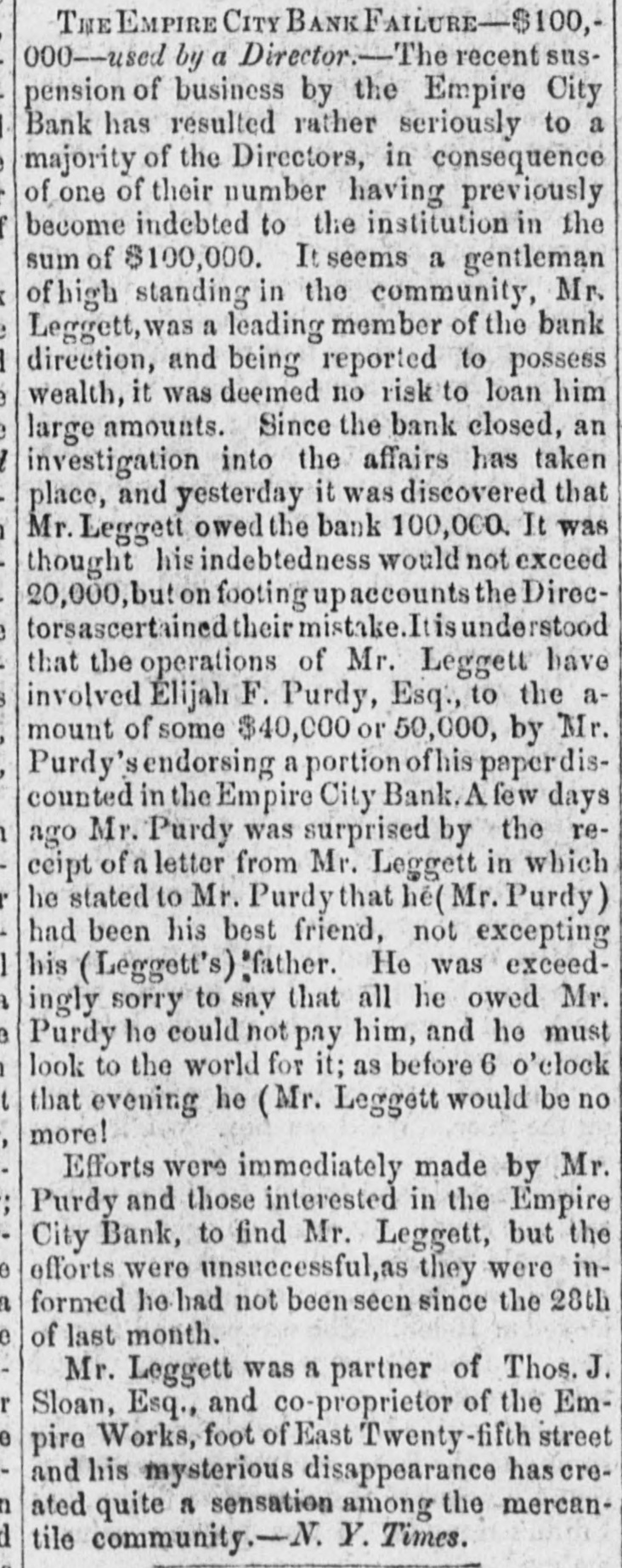
# THE EMPIRE CITY BANK FAILURE-$100,000--used by a Director. The recent suspension of business by the Empire City Bank has resulted rather seriously to a majority of the Directors, in consequence of one of their number having previously become indebted to the institution in the sum of $100,000. It seems a gentleman of high standing in the community, Mr. Leggett, was a leading member of the bank direction, and being reported to possess wealth, it was deemed no risk to loan him large amounts. Since the bank closed, an investigation into the affairs has taken place, and yesterday it was discovered that Mr. Leggett owed the bank 100,000. It was thought his indebtedness would not exceed 20,000, but on footing up accounts the Directors ascertained their mistake. It is understood that the operations of Mr. Leggett have involved Elijah F. Purdy, Esq., to the amount of some $40,000 or 50,000, by Mr. Purdy's endorsing a portion of his paper discounted in the Empire City Bank. A few days ago Mr. Purdy was surprised by the receipt of a letter from Mr. Leggett in which he stated to Mr. Purdy that he (Mr. Purdy) had been his best friend, not excepting his (Leggett's) father. He was exceedingly sorry to say that all he owed Mr. Purdy he could not pay him, and he must look to the world for it; as before 6 o'clock that evening he (Mr. Leggett would be no more! Efforts were immediately made by Mr. Purdy and those interested in the Empire City Bank, to find Mr. Leggett, but the efforts were unsuccessful, as they were informed he had not been seen since the 28th of last month. Mr. Leggett was a partner of Thos. J. Sloan, Esq., and co-proprietor of the Empire Works, foot of East Twenty-fifth street and his mysterious disappearance has created quite a sensation among the mercantile community. -N. Y. Times.


Article from The New York Herald, January 20, 1855

Click image to open full size in new tab

Article Text

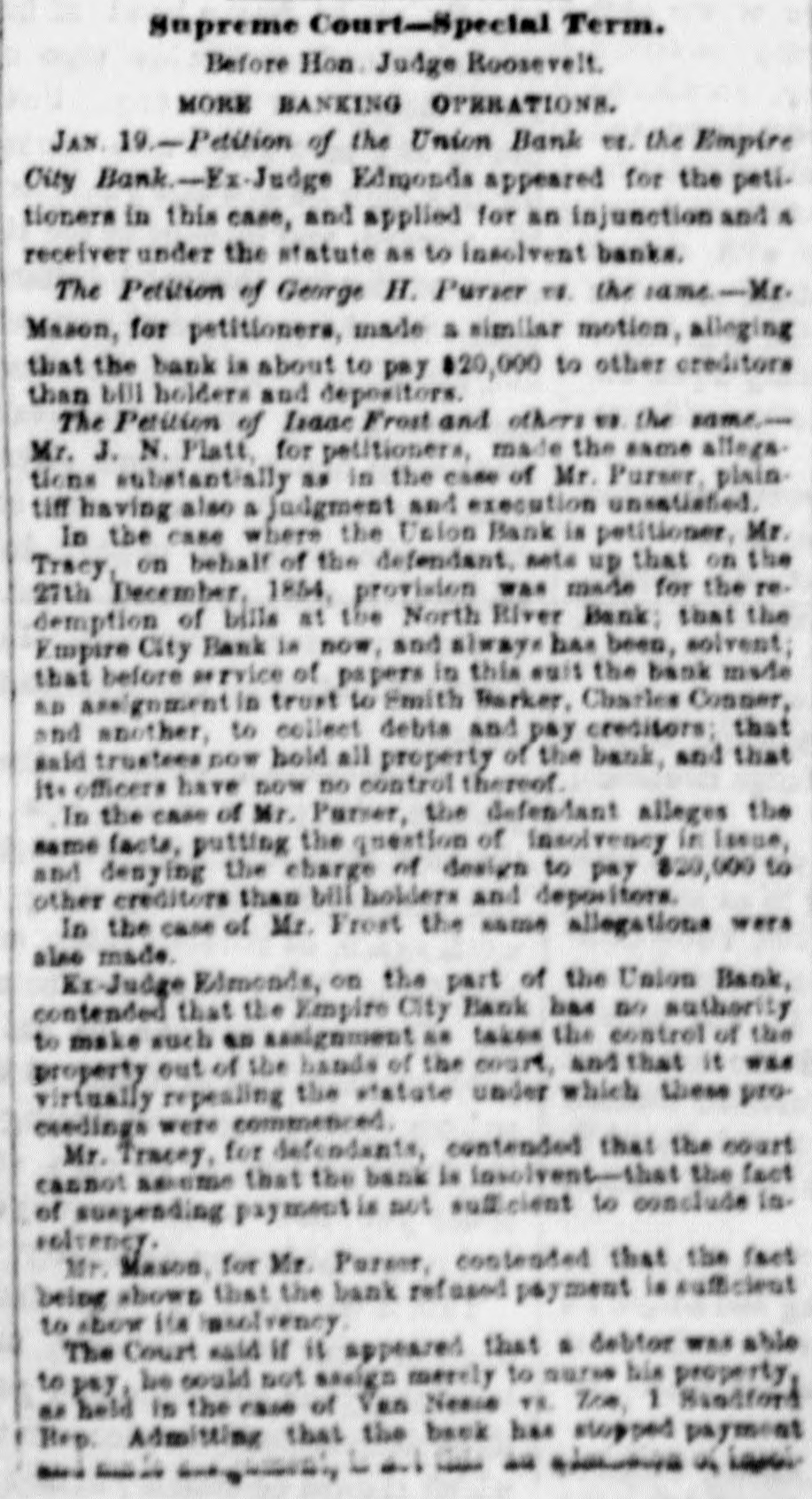
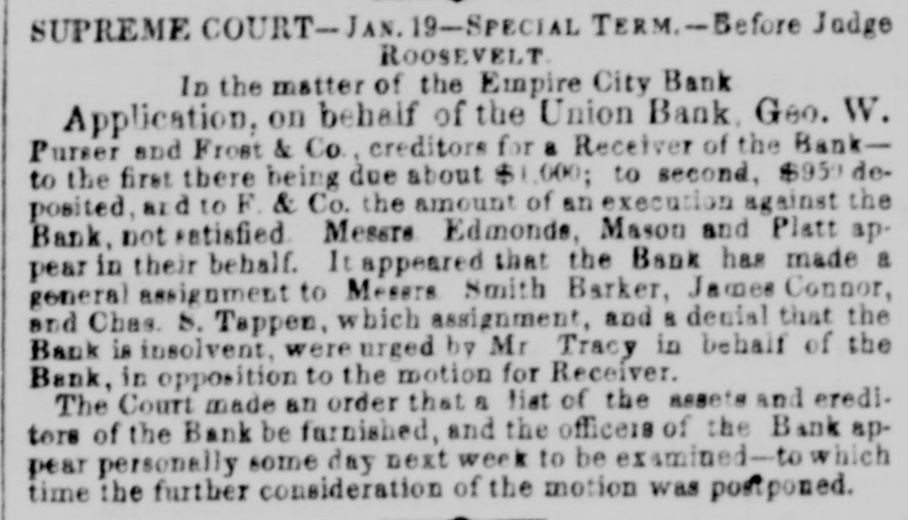
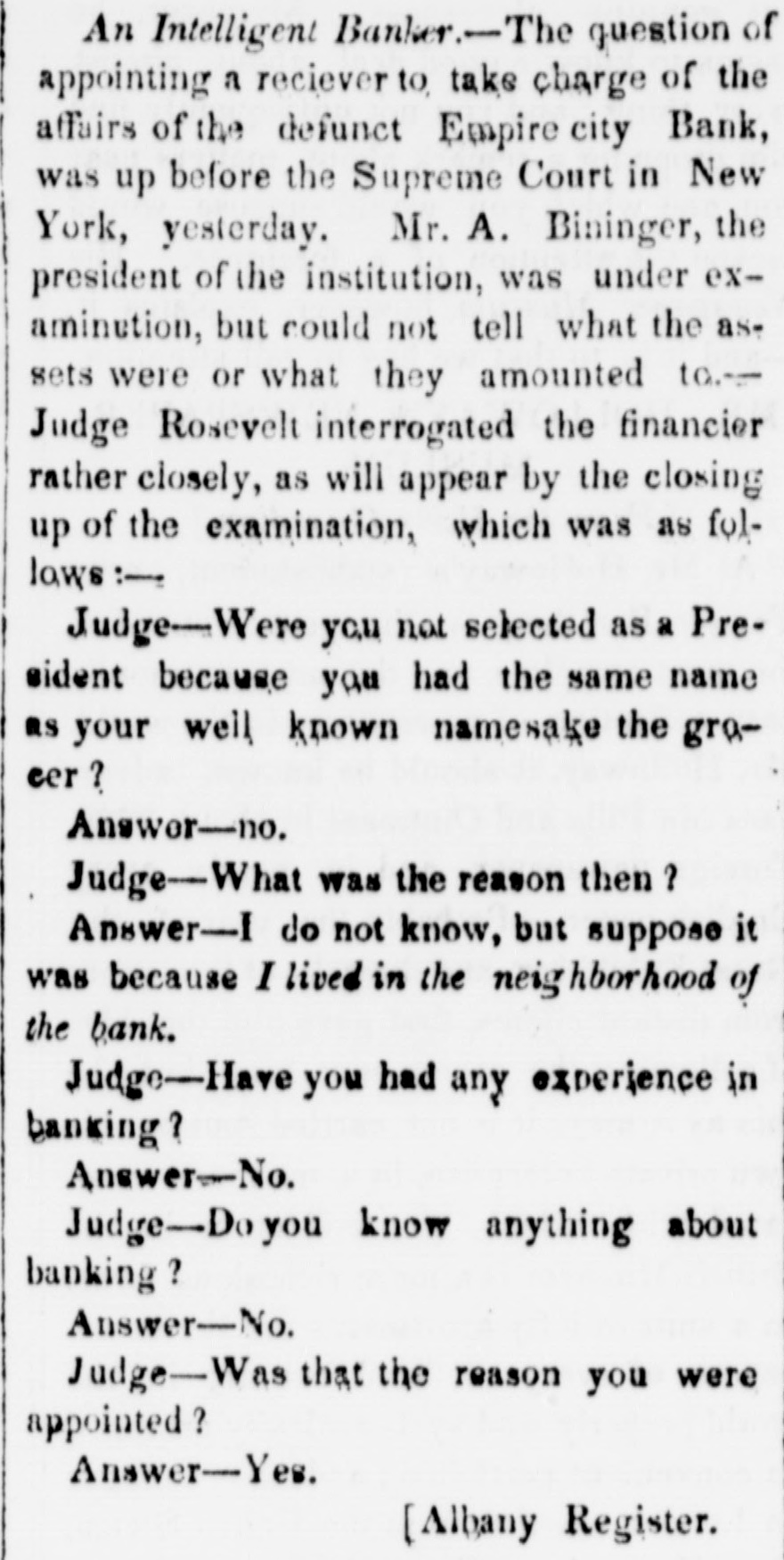
Supreme Court-Special Term. Before Hon. Judge Roosevelt. MORE BANKING OPERATIONS. JAN. 19.-Petition of the Union Bank or. the Empire City Bank.-Ex-Judge Edmonds appeared for the petitioners in this case, and applied for an injunction and n receiver under the statute as to insolvent banks. The Petition of George H. Purser Y/. the same-Mr. Mason, for petitioners, made a similar motion, alleging that the bank is about to pay $20,000 to other creditors than 601 holders and depositors. The Petition of Isaac Frost and others ww. the sameMr. J. N. Platt, for petitioners, made the same allega. tions substantially SP in the case of Mr. Purser, plain. tiff having also a judgment and execution unsatisfied. In the case where the Union Bank is petitioner, Mr. Tracy, on behalf of the defendant. sets up that on the 27th December, 1854, provision was made for the redemption of bills at the North River Bank: that the Empire City Bank in now, and always has been, solvent; that before service of papers is this eait the bank made SD assignment in trust to Smith Barker, Charles Conner, and another, to collect debta and pay creditors; that said trustees DOW hold all property of the bank, and that it. officers have now no control thereof. In the case of Mr. Parser, the defendant alleges the same facts, putting the question of insolvency in issue, and denying the charge of design to pay $20,000 to other creditors than bill holders and depositors. In the case of Mr. Frost the same allegations were also made. Ex-Judge Edmonds, on the part of the Union Bank, contended that the Empire City Bank has DO authority to make such - assignment as takes the control of the property out of the hands of the court, and that it was virtually repealing the statute under which these procaedings were commenced. Mr. Tracey, for defendants, contended that the court cannot assume that the bank is insolvent-that the fact of surgending payment is not sufficient to conclude insolvency. Mr. Mason, for Mr. Purser, contended that the fact being shown that the bank refused payment is sufficient to show its insolvency. The Court said if it appeared that a debtor was able to gay, be could not assign merely to nurse his property, as held is the case of Van Nesse vs. Zip, 1 Hundford Rep. Admitting that the back has stopped payment - L at - - 4 inci-


Article from New-York Daily Tribune, January 25, 1855

Click image to open full size in new tab

Article Text

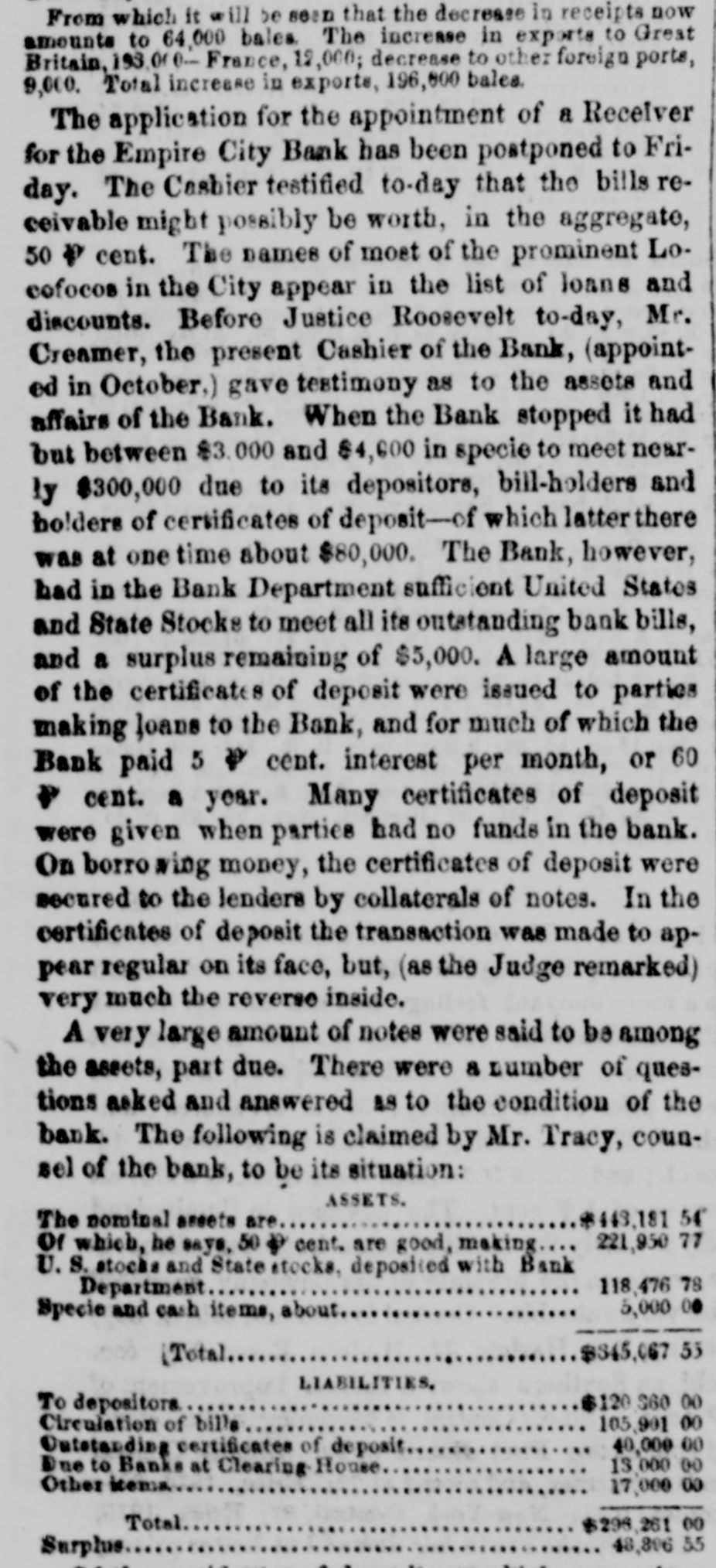
From which it will be seen that the decrease in receipts now amounts to 64,000 bales. The increase in exports to Great Britain, 193,000-- France, 12,000; decrease to other foreign ports, 9,000. Total increase in exports, 196,000 bales. The application for the appointment of a Receiver for the Empire City Bank has been postponed to Friday. The Cashier testified to-day that the bills receivable might possibly be worth, in the aggregate, 50 P cent. The names of most of the prominent Loeofocos in the City appear in the list of loans and discounts. Before Justice Roosevelt to-day, Mr. Creamer, the present Cashier of the Bank, (appointed in October,) gave testimony as to the assets and affairs of the Bank. When the Bank stopped it had but between $3.000 and $4,000 in specie to meet nearly $300,000 due to its depositors, bill-holders and holders of certificates of deposit-of which latter there was at one time about $80,000. The Bank, however, had in the Bank Department sufficient United States and State Stocks to meet all its outstanding bank bills, and a surplus remaining of $5,000. A large amount of the certificates of deposit were issued to parties making loans to the Bank, and for much of which the Bank paid 5 cent. interest per month, or 60 P cent. a year. Many certificates of deposit were given when parties had no funds in the bank. On borro wing money, the certificates of deposit were secured to the lenders by collaterals of notes. In the certificates of deposit the transaction was made to appear regular on its face, but, (as the Judge remarked) very much the reverse inside. A very large amount of notes were said to be among the assets, part due. There were a number of questions asked and answered as to the condition of the bank. The following is claimed by Mr. Tracy, counsel of the bank, to be its situation: ASSETS. The nominal assets are $443,181 54' 221,950 Of which, he says, 50 cent. are good, making U. S. stocks and State stocks, deposited with Bank 118,476 78 Department 5,000 Specie and cash items, about $345,067 55 [Total liabilities. $120,860 00 To depositors Circulation of bills 105,901 00 40,000 Outstanding certificates of deposit 13,000 00 Due to Banks at Clearing House Other items 17,000 Total $296,261 48,806 55 Surplus


Article from New-York Daily Tribune, February 7, 1855

Click image to open full size in new tab

Article Text

UPREME COURT.-In the matter of the EMPIRE CITY BANK. Notice is hereby given. pursuent to the statutes in such case made and provided, and in pursuance of an order of the Hon. T. W. Clerke. a Justice of said Court, duly made in this matter, that all creditors of the Empire City Bank are hereby required to exhibit and establish their demands before The United States Trust Company of New York, Receivers of said Bank, at said Company's office, No. 40 Wall-st.. in the City of New York, within thirty days from the date of this notice.-Dated New-York, Feb. 2, 1855. JOSEPH LAWRENCE, President of The U.S. Trust Co. of New-York. JOHN A. STEWART, Secretary.


Article from New-York Daily Tribune, February 8, 1855

Click image to open full size in new tab

Article Text

UPREME COURT.-In the matter of the EMPIRE CITY BANK. Notice is hereby given. pursuant to the statutes in such case made and provided, and in pursuance of 80 order of the Hon. T. W. Clerke, a Justice of said Court, only made in this matter, that all creditors of the Empire City Bank are hereby required to exhibit and establish their demands before The United States Trust Company of New York. Receivers of said Bank. at said Company's office, No 4 Wall-st. in the City of New York, wichin thirty days from the date of this notice.-Dated New-York, Feb. 2, 1855. JOSEPH LAWRENCE, President of The U.S. Trust Co. of New-York. JOHN A STEWART, Secretary


Article from New-York Daily Tribune, February 10, 1855

Click image to open full size in new tab

Article Text

UPREME COURT.-In the matter of the EMPIRE CITY BANK. Notice is hereby given. purenant to the statutes in such case made and provided, and in pursuance of an order of the Hon. T. W. Clerke, a Justice of said Court, duly made in this matter, that all creditors of the Em pire City Bank are hereby required to exhibit and establish their demande before The United States Trust Company of New York, Receivers of said Bank, at said Company's office, No. 40 Wall-st., in the City of New York, within thirty days from the date of this notice.-Dated New- York, Feb. 2, 1855. JOSEPH LAWRENCE, President of The U. 8. Trust Co. of New York JOHN A STEWART, Secretary.


Article from New-York Daily Tribune, February 17, 1855

Click image to open full size in new tab

Article Text

UPREME COURT.-In the matter of the EMPIRE CITY BANK. Notice is hereby given, pursuant to the statutes in such case made and provided, and in pursuance of an order of the Hon. T. W. Clerke, a Justice of said Court, duly made in this matter, that ali creditors of the Empire City Bank are hereby required to exhibit and outablish their demands before The United States Trust Company of New York, Receivers of said Bank, at said Company's office. No. 40 Wall-st., in the City of New York, within thirty days from the date of this notice.-Dated New York, Feb. 2, 1855. JOSEPH LAWRENCE, President of The U. S. Trust Co. of New-York. JOHN A STEWART, Secretary


Article from New-York Daily Tribune, February 21, 1855

Click image to open full size in new tab

Article Text

UPREME COURT:-In the matter of the EMPIRE CITY BANK. Notice is hereby given. pursuant to the statutes in such case made and provided, and in pursuance of an order of the Hon. T. W. Clerke, a Justice of said Court, duly made in this matter, that all creditors of the Empire City Bank are hereby required to exhibit and establish their demands before The United States Trust Company of New York, Receivers of said Bank, at said Company's office, No. 40 Wall-st., in the City of New York, within thirty days from the date of this notice.-Dated New-York, Feb. 2, 1855. JOSEPH LAWRENCE, President of The U. 8. Trust Co. of New York. JOHN A STEWART. Secretary.


Article from New-York Daily Tribune, March 7, 1855

Click image to open full size in new tab

Article Text

UPREME COURT.-In the matter of the EMPIRE CITY BANK. Notice to hereby given, parenast to the statutes is such case made and provided, and is par. suance of an order of the Hon. T. W. Clerke, . Justice er said Court, duly made in this matter, that all creditors of the EmDire City Bank are hereby required to exhibit and estab lisb their demands before The United States Trust Company of New York, Receivers of said Bank. at said Company's office, No. w Wall-ot, in the City of New York, within thirty days from the date of this notice.-Dated Dated New-York, Feb. 2, 1855. JOSEPH LAWRENCE, President of The U. 8. Trust Co. of New-York. Jonn s STEWART, Becretary.


Article from New-York Daily Tribune, March 8, 1855

Click image to open full size in new tab

Article Text

President of the U.S. Trust Co., of New York. JOHN A. STEWART. Secretary. UPREME COURT.-In the matter of the EMPIRE CITY BANK. Notice is hereby given, pursuant to the statutes in such care made and provided, and in pursuance of RD order of the Hon. T. W. Clerke, s Justice of said Court, duly made in this matter, that all creditors of the Empire City Bank are bereby required to exhible and establish their demande before The United States Trust Company of New York, Receivers of said Bank, at said Company's office, No. 40 Wall-et. in the City of New York, within thirty days from the date of this notice.-Dated New-York, Feb. 2, 1855. JOSEPH LAWRENCE, President of The U. 8. Trust Co. of New. York 10HN A STEWART Secretary


Article from New-York Daily Tribune, March 9, 1855

Click image to open full size in new tab

Article Text

UPREME COURT.-In the matter of the EMPIRE CITY BANK. Notice is hereby given, pursuS ant to the statutes in such case made and provided, and in parsuance of an order of the Hon. T. W. Clerke, a Justice of said Court, duly made in this matter, that all creditors of the Empire City Bank are hereby required to exhibit and establish their demands before The United States Trust Company of New York, Receivers of said Bank, at said Company's office, No. 40 Wall-et., in the City of New York, within thirty days from the date of this notice.-Dated New-York, Feb. 2, 1855. JOSEPH LAWRENCE, President of The U. 8. Trust Co. of New. York JOHN A STEWART. Secretary


Article from The New York Herald, May 1, 1855

Click image to open full size in new tab

Article Text

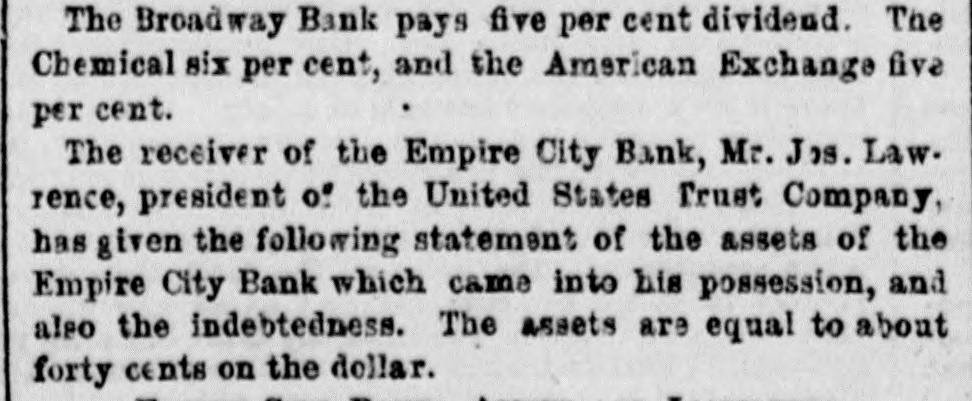
The Broadway Bank pays five per cent dividend. The Chemical six per cent, and the American Exchange five per cent. The receiver of the Empire City Bank, Mr. Jos. Law. rence, president of the United States Trust Company, has given the following statement of the assets of the Empire City Bank which came into his possession, and also the indebtedness. The assets are equal to about forty cents on the dollar.


Article from New-York Daily Tribune, May 1, 1855

Click image to open full size in new tab

Article Text

Northern Indiana Railroad Companies, in pursuance of laws of the States of Michigan and Indiana, have just perfected a consolidation of their chartered rights and properties into one corporation, to be called the Michigan Southern and Northern Indiana Railroad Company. The stockholders of the Michigan Company met at Adrian on the 25th ult., and those of the Indiana Company at Laporte on the 26th ult. at which meetings they agreed upon the articles of consolidation. These articles 6 the name of the new Corporation, the number of Directors, the time for holding the first election, the time and place for the annual meetings of the stockholders, and names the first Board of Directors, with many other provisions in detail, as required by the laws under which the consolidation was effected. There was & very large majority of the stock of each Company represented, and the vote upon the adoption of the articles was entirely unanimous. The DirectOIB of the consolidated Company are John B. Jervis, Edwin C. Litchfield, Charles Butler, John Stryker, Elisha C. Litchfield, John S. Barry, Hugh White, Ezekiel Morrison, John Wilkinson, Ed D. Morgan, Thomas Barron, Hamilton White and Daniel B. St. John, who continue until the first annual meeting of stockholders, which will be held at Adrian, in the State of Michigan, on the fourth Wednesday of April, 1856. The new Board met at Laporte on the 26th ultimo, and organized by the appointment of John Wilkinson as President, and Edwin C. Litchfield as Treasurer of the Consolidated Company. Mr Jervis, the former President, continues in the service of the Company 88 Chief Engineer. Mr. Wilkinson, the new President, is well known as a man of ability and of railroad experience. He was for many years President of the Ution and Syracuse Railroad Company, before its consolidation as a part of the New-York Central line. The successful management of the very large and rapidly increasing business of the Michigan Southern and Northern Indiana Railroad Company demands energy and capscity of a high order, qualities which Mr. Wilkinson is understood to bring to the discharge of his ne 7 duties. The receipts of the Galena and Chicago Road for $125,736 March, were 75,065 March, 1854 $50,671 Increase All the Western Roads are doing an immense basizess. The receipts of the Southern Michigan in the first three weeks of April were about $178,000, against about $170,000 in the whole month last year, and the receipts of the Cleveland and Toledo for the same period were $76,000, against $73,000 in the whole month last year. The United States Trust Company, as Receiver of the suspended Empire City Bank, has made a report to the Court of the condition of that concern, which we annex: STATEMENT of the assets of the Empire City Bank which came into the possessi n of the United States Trust Company of New York, Receiver of said Bank 84.55