Central Bank (Wickenburg, AZ)

Episode Information

Episode UID
91010171455
Episode Type
Run โ†’ Suspension โ†’ Closure
Bank Type
state
Bank ID
9101017 routing
Routing Number
91-0101
Start Date
March 23, 1921
Location
Wickenburg, Arizona (33.969, -112.730)

Metadata

Model
gpt-5-mini (chosen from majority vote of a three-model LLM ensemble)
Short Digest
9e32ba189e7ff930

Response Measures

None

Description

Suspension was voluntary after false telegraphed report; receiver was later appointed.

Events (3)

1. March 23, 1921 Run
Cause
Rumor Or Misinformation
Cause Details
A false telegraphed story reported the Wickenburg bank had suspended, triggering an inevitable run.
Random Run
Yes
Random Run Snippet
False telegraphed report that the Wickenburg bank had suspended
Measures
Placed notice of voluntary suspension and turned affairs over to state auditor; state examiners placed in charge.
Newspaper Excerpt
The closing of the Wickenburg bank was precipitated by a story telegraphed ... that the Wickenburg bank had suspended, though it had not done so ... the run was inevitable
Source
newspapers
2. March 23, 1921 Suspension
Cause
Rumor Or Misinformation
Cause Details
Voluntary suspension instituted after the run provoked by the false telegraphed story; affairs placed in hands of state auditor/examiners.
Newspaper Excerpt
Before time to open this morning each of the three placed a notice on the front door stating that the bank had voluntarily suspended and that its affairs were in the hands of Charles W. Fairfield, state auditor
Source
newspapers
3. April 1, 1921 Receivership
Newspaper Excerpt
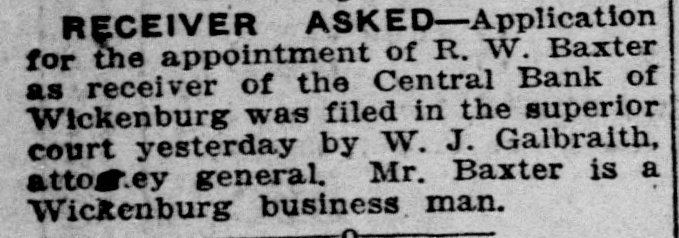
W. J. Galbraith, state's attorney general, today filed an application ... asking for the appointment of R. W. Baxter as receiver of the Central bank of Wickenburg. Baxter is a Wickenburg business man. The bank recently voluntarily suspended business.
Source
newspapers

Newspaper Articles (21)

Article from The Evening Herald, March 23, 1921

Click image to open full size in new tab

Article Text

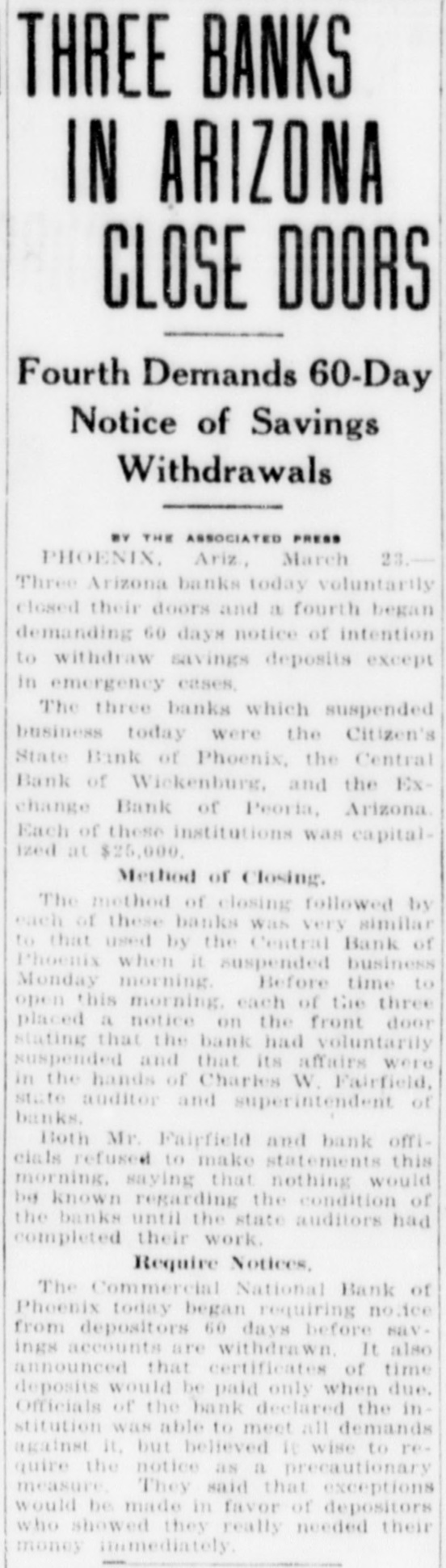
THREE BANKS IN ARIZONA CLOSE DOORS Fourth Demands 60-Day Notice of Savings Withdrawals BY THE ASSOCIATED PRESS PHOENIX Ariz, March 23.Three Arizona banks today voluntarily closed their doors and a fourth began demanding 60 days notice of intention to withdraw savings deposits except in emergency cases The three banks which suspended business today were the Citizen's State Bank of Phoenix, the Central Bank of Wickenburg, and the Exchange Bank of Peoria, Arizona Each of these institutions was capitalized at $25,000. Method of Closing. The method of closing followed by each of these banks was very similar to that used by the Central Bank of Phoenix when it suspended business Monday morning Before time to open this morning each of the three placed a notice on the front door stating that the bank had voluntarily suspended and that its affairs were in the hands of Charles W. Fairfield, state auditor and superintendent of banks Both Mr. Fairfield and bank officials refused to make statements this morning, saying that nothing would be known regarding the condition of the banks until the state auditors had completed their work. Require Notices The Commercial National Bank of Phoenix today began requiring notice from depositors 60 days before savings accounts are withdrawn It also announced that certificates of time deposits would be paid only when due. Officials of the bank declared the institution was able to meet all demands against it. but believed 10 wise to require the notice as a precautionary measure They said that exceptions would be made in favor of depositors who showed they really needed their money immediately
Article from The Wheeling Intelligencer, March 24, 1921

Click image to open full size in new tab

Article Text

ARIZONA BANKS CLOSE Phoenix Ariz Mar 23 Three Antz ona banks today voluntarily closed their doors and is fourth began demanding SINCE days notice of intention to with draw savings deposits except :11 emergood cases The three banks which suspended business were the Citizens' State bank of Phoenix the Central Bank of Wick enbury and the Exchange Bank of Peor11t Arizona Each was capitalized at $ 20 000 The Commercial National Bank of Phoenix today began requiring notice from depositors sixty days before sav accounts are withdrawn


Article from Bisbee Daily Review, March 24, 1921

Click image to open full size in new tab

Article Text

3 MORE BANKS IN STATE CLOSE PHOENIX, March 23.-Suspension of business by three Arizona banking institutions today overwhelmed the state banking department. in the of. fice of State Auditor Charles W. Fairfield, with work. The department was without enough examiners to take charge of the closed institutions so Mr. Fairfield appointed two temporary examiners. The banks closed and the men placed in charge of each were: The Citizens State Bank of Phoenix, with H. M. Moritz, deputy bank examiner in charge: the Exchange Bank of Peoria, with K. G. Freeland/ formerly assistant cashier of the Central Bank of Phoenix. in charge: and the Central Bank of Wickenburg, with E. L. Riggle in charge. The general appropriation bill passed at the last session of the legislature provides funds for two more deputy bank examiners but this. money will not be available until July first. The state has funds in all of the institutions which closed, but the money is said to be amply secured by bonds.


Article from Arizona Republican, March 24, 1921

Click image to open full size in new tab

Article Text

THREE BANKS IN THE COUNTYFAIL TOOPEN DOORS YESTERDAY Three banks, one in Phoenix, the Citizens of Five Points, the Central Bank of Wickenburg and the Exchange Bank of Peoria, suspended operations yesterday morning from different causes, all of them more or less related to the closing of the Central Bank of Phoenix last Monday. The closing of the Wickenburg bank was precipitated by a story telegraphed to the Journal-Miner of Prescott on Monday in which it was stated that the Wickenburg bank had suspended, though it had not done so, and there was no probability that it would. It was well within the legal reserve, but the run was inevitable and yesterday morning after a conference with the state bank examiner it was decided not to reopen the bank for business. The Citizens bank of Five Points had also been subjected to a disastrous run on Tuesday. It too was well within the legal reserve and was in a prosperous condition, but without means to withstand the steady and heavy drain of a day upon it. The state banking department found itself overwhelmed with business and without provision for the employment of enough examiners for the closed institutions. Accordingly, K. G. Freeland, former assistant cashier of the Central bank, was sent by State Auditor Fairfield to take charge of the Peoria bank: E. L. Riggle is temporarily est charge of the Wickenburg bank, and H. M. Moritz, deputy bank examiner, of the Citizens bank. The general appropriation bill passed in the late legislative session provides for two more deputy bank examiners, but the funds appropriated will not be available before July 1. The state has funds in all of these institutions, all amply secured by bonds. There were wild rumors throughout the day of the suspension of other small banks in this county and of two outside the county, but there was no confirmation of them at the office of the state auditor. o


Article from The Copper Era and Morenci Leader, March 25, 1921

Click image to open full size in new tab

Article Text

3 MORE BANKS IN STATE SHUT DOWN BUSINESS Phoenix, March 23,-Three Arizona banks today voluntarily closed their doors and a fourth began demanding sixty days' notice of intention to withdraw savings deposits except in emergency cases. The three banks which suspended today were the Citizens State Bank of Phoenix, the Central Bank of Wickenburg, and the Exchange Bank of Peoria, Arizona. Each of these institutions was capitalized at $25,000. The method of closing followed by each of these banks was very similar to that used by the Central bank of Phoenix when it suspended business Monday morning. Before the time to open this morning, each of the three placed a notice on the front door stating that the bank had virtually suspended and that its affairs were in the hands of Charles W. Fairfield, state auditor and superintendent of banks. Both Mr. Fairfield and bank officials refused to make statements this morning, saying that nothing would. be known regarding the condition of the banks until the state auditors had completed their work. The Commercial National bank of Phoenix today began requiring notice from depositors sixty days before savings accounts are, withdrawn. it is also announced that certificates of time deposits would be paid only when due. Officials or the bank declared the institution was able to meet all demands against it, but believed it was wise to require the notice as a precautionary measure. They said that exeptions would be made in favor of depositors who Shimmed they really needed their money immediately.


Article from Arizona Republican, March 26, 1921

Click image to open full size in new tab

Article Text

CITIZENS AND PEORIA BANKS TO OPEN SOON Reorganization Of Two Institutions Which Suspended Business AnnouncedDepositors Will Not Lose a Cent Reorganization of the Citizen's Bank at Five Points and the Exchange Bank of Peoria without loss of a cent to the depositors was the optomistic news given out yesterday by Charles F. Fairfield, state superintendent of banks. Mr. Fairfield declared that a resumption of business would be the matter of a short time as the banking department was at present working out a plan which he was confident would be effective in the reopening of the banks which closed their doors a few days ago. Mr. Fairfield said officers and directors of both institutions were cooperating with the state banking officials for the benefit and protection of the depositors who in turn were leading support to the plan which, in his opinion, will result in the opening of the banks within a brief period. The bank at Five Points and that in Peoria voluntarily suspended business on Wednesday when they turned over their affairs to Mr. Fairfield. The state bank superintendent immediately placed deputies in charge and has worked day and night himself to get the affairs of the bank in shape that plans might be made for the resumption of business, Mr. Fairfield not only believes that the banks will be opened soon but that the institutions will be stronger than ever before. That financial weakness did not cause the suspension of business is demonstrated by the quick manner in which the readjustment is being made, largely, it is said, through the efforts of Mr. Fairfield, Attorney General Galbraith said yesterday that he would institute proceedings in the superior court early in the week for the appointment of a receiver in the Central Bank of Wickenburg. Yesterday he received formal notice from the bank superintendent of the voluntary suspension of 0 business of the bank on Wednesday.


Article from Tombstone Epitaph, March 27, 1921

Click image to open full size in new tab

Article Text

3 MORE BANKS IN STATE CLOSE PHOENIX. March 23.-Suspension of business by three Arizona banking institutions today overwhelmed the state banking department, in the office of State Auditor Charles W. Fairfield. with work. The department was without enough examiners to take charge of the closed institutions so Mr. Fairfield appointed two temporary examiners. The banks closed and the men placed in charge of each were: The Citizens State Bank of Phoenix, with H. M. Moritz, deputy bank examiner in charge; the Exchange Bank of Peoria, with K. C. Freeland, formerly assistant cashier of the Central Bank of Phoenix, in charge; and the Central Bank of Wickenburg. with E. L. Riggle in charge. The general appropriations bill passed at the last session of the leg. islature provides funds for two more deputy bank examiners but this money will not be available until July first. The state has funds in all of the institutions which closed, but the mony is said to ze amply secured by bonds.


Article from Bisbee Daily Review, April 2, 1921

Click image to open full size in new tab

Article Text

ASKS FOR RECEIVER PHOENIX, Aprtil 1.-W. J. Gal braith, state's attorney general, today filed an application in superior court asking for the appointment of R. W. Baxter as receiver of the Central bank of Wickenburg. Baxter is a Wickenburg business man. The bank recently voluntarily suspended business.


Article from Arizona Republican, April 2, 1921

Click image to open full size in new tab

Article Text

RECEIVER ASKED-Application for the appointment of R. W. Baxter as receiver of the Central Bank of Wickenburg was filed in the superior court yesterday by W. J. Galbraith, attogrey general. Mr. Baxter is a Wickenburg business man.


Article from Arizona Republican, May 25, 1921

Click image to open full size in new tab

Article Text

INCREASED RESERVES REPORTED BY BANKS Reports of state and national banks of Arizona at the close of business April 28 showed an increase in reserve over the February call. The April call gives the reserve at 28 per cent. while that of February was placed at 26 per cent. There is a decrease in loans over a year ago, the amount for April, 1921, being $35.982 160.93, or $3,838,910.44 less than the loans of 1920 during the call ending May 4. The banks shown in previous statements not included in the recent call were the Central Bank of Phoenix (reorganization pending): Central Bank of Wickenburg (in receivership) : Somerton State Bank (in receivership), and the Security Trust and Savings Bank, Tucson, absorbed by the Tucson National Bank.


Article from Arizona State Miner, August 6, 1921

Click image to open full size in new tab

Article Text

A letter from Attorney Weldon J. Bailev of the 3d to our editor, brings to public notice the following petition as a last desperate move of Sprunger et als. to infiuence Judge Jenckes, who is in charge of Judge Stanford's Department of the Superior Court, to retain the deposed cashier and Receiver Baxter, in charge of the books, assets and accounts of the defunct Wickenburg Central Bank. It was filed on last Monday, the very day when the hearing was had for removal of Sprunger and his receiver on the petition of H. B. Watson, representing the depositors of said bank. It will be noticed that the usual "camouflage" of ringing in the chamber of commerce (?) of which the cashier was the directing head and secretary, the fire department, the mayor and Welfare Fund, and some obsolete firms now out of business, who in reality are debtors to the bank and morally oblicated to the depressed cashier for past favors. The petition was not presented in court, but was possibly intended as a clinching argument along with certain letters doubtless obtained on the "dollar for dollar" avowal, to influence the court, at the critical moment by the receiver's attorney. Right here it is only just. to state that several persons interviewed state that they signed the petition misapprenensively and others deny it altogether, which facts are to be presented the court if it ever sees the light of day there which is doubtful because it actually nullifies itself, and is without signature designating it as a properly endorsed court document: THAT ALL MAY KNOW In the Superior court of Maricopa County, State of Arizona. State of Arizona, plaintiff, vs. Central Bank of Wickenburg, et al., defendent. No. 14039. Petition of depositors. Come now the following depositors of the Central Bank of Wickenburg, in personam, and file herein their petition that the Receiver and His Assistant, continue to have charge of the affairs of said bank for the best interests of all concerned: Aguila Cattle Co. per V. A. Powell Brayton Com. Co. G. C. Wentworth Upton Oil Co., pr J. Campbell James Wickenburg Chamber of Commerce, pr R. K. Baxter Frank Tarbutton. Merchant, per Frank Tarbutton Blue Ribbon Bakery, per Floyd Kellis. Wickenburg Branch American Red Cross, per Allie M. Paul, secy. Hassayampa Invest. & Dev. Co. per W. S. Massey Town of Wickenburg per W E. Paul, Mayor Hyder Bros. Garage, per Chas, Hyder. Wickenburg Drug Co. per A. Gray, Mgr. N. B. Caldwell Meat Market per N. B, Caldwell Wickenburg Welfare Fund per Mrs. B. J. Witherlay Consolidated Vanadium Co. per W. S. Greene, Supt. Abe Lincoln Copper Co. per Ed W. Getten


Article from Tombstone Epitaph, August 7, 1921

Click image to open full size in new tab

Article Text

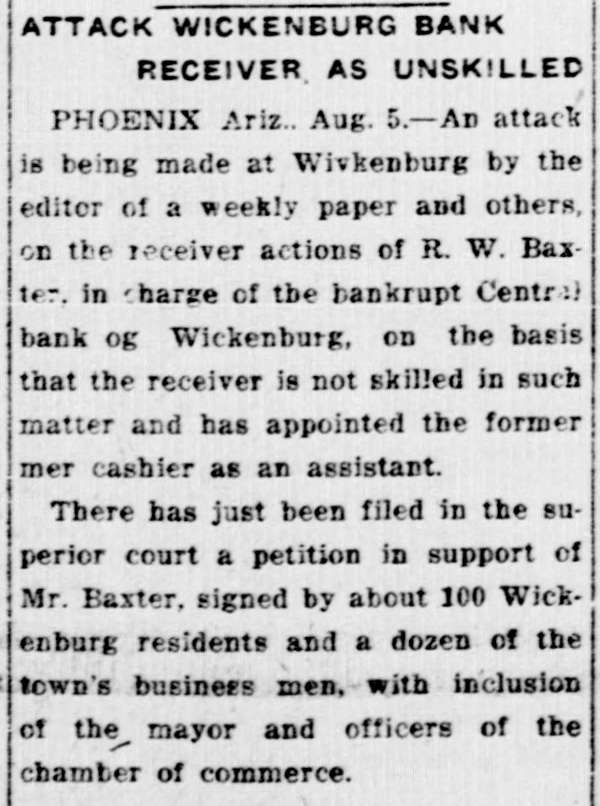
ATTACK WICKENBURG BANK RECEIVER AS UNSKILLED PHOENIX Ariz.. Aug. 5.-An attack is being made at Wivkenburg by the editor of a weekly paper and others, on the receiver actions of R. W. Baxtex. in charge of the bankrupt Central bank og Wickenburg, on the basis that the receiver is not skilled in such matter and has appointed the former mer cashier as an assistant. There has just been filed in the superior court a petition in support of Mr. Baxter, signed by about 100 Wickenburg residents and a dozen of the town's business men, with inclusion of the mayor and officers of the chamber of commerce.


Article from Arizona Republican, August 10, 1921

Click image to open full size in new tab

Article Text

On Saturday R. W. Baxter, receiver for the Central bank of Wickenburg. filed a report in the superior court of Maricopa county showing the condition of the bank when he took over its assets and accounting for his receivership up to August 1. According to Mr. Baxter's report, the assets of the bank are involved in the affairs of its president, P. K. Lewis, and it is alleged that large and unjustifiable loans were made to friends of the president and to companies in which he was interested. It is stated that while the status of much of the paper of the bank is uncertain, the


Article from Weekly Journal-Miner, November 23, 1921

Click image to open full size in new tab

Article Text

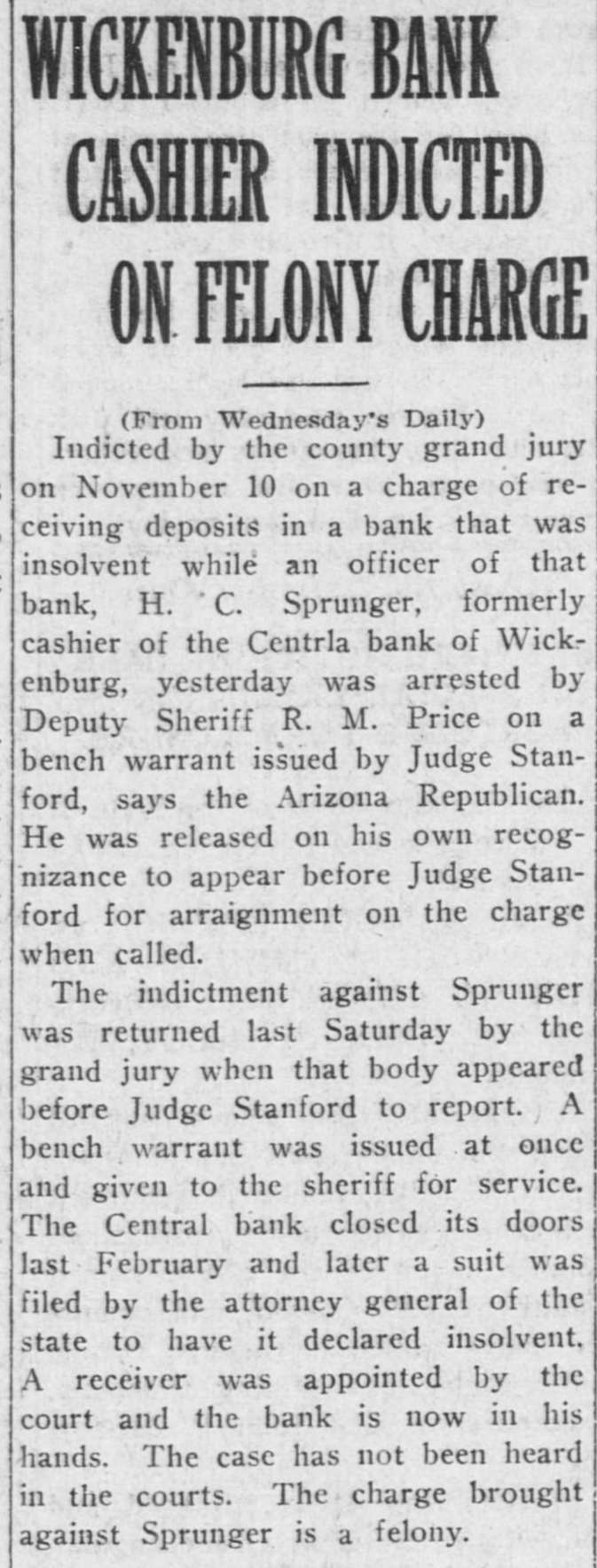
WICKENBURG BANK CASHIER INDICTED ON FELONY CHARGE (From Wednesday's Daily) Indicted by the county grand jury on November 10 on a charge of receiving deposits in a bank that was insolvent while an officer of that bank, H. C. Sprunger, formerly cashier of the Centrla bank of Wickenburg, yesterday was arrested by Deputy Sheriff R. M. Price on a bench warrant issued by Judge Stanford, says the Arizona Republican. He was released on his own recognizance to appear before Judge Stanford for arraignment on the charge when called. The indictment against Sprunger was returned last Saturday by the grand jury when that body appeared before Judge Stanford to report. A bench warrant was issued at once and given to the sheriff for service. The Central bank closed its doors last February and later a suit was filed by the attorney general of the state to have it declared insolvent. A receiver was appointed by the court and the bank is now in his hands. The case has not been heard in the courts. The charge brought against Sprunger is a felony.


Article from Arizona Republican, June 27, 1922

Click image to open full size in new tab

Article Text

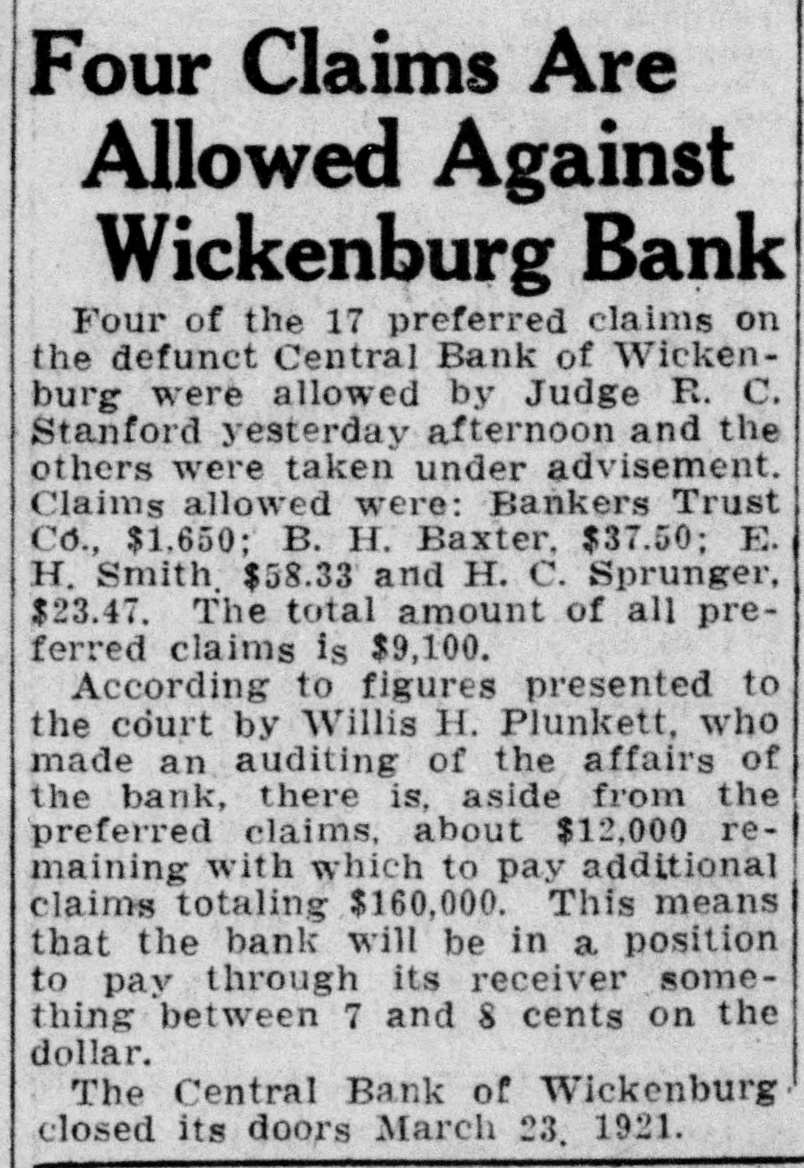
Four Claims Are Allowed Against Wickenburg Bank Four of the 17 preferred claims on the defunct Central Bank of Wickenburg were allowed by Judge R. C. Stanford yesterday afternoon and the others were taken under advisement. Claims allowed were: Bankers Trust Co., $1,650; B. H. Baxter, $37.50; E. H. Smith $58.33 and H. C. Sprunger, $23.47. The total amount of all preferred claims is $9,100. According to figures presented to the court by Willis H. Plunkett, who made an auditing of the affairs of the bank, there is, aside from the preferred claims, about $12,000 remaining with which to pay additional claims totaling $160,000. This means that the bank will be in a position to pay through its receiver something between 7 and 8 cents on the dollar. The Central Bank of Wickenburg closed its doors March 23. 1921.


Article from Graham Guardian, July 4, 1922

Click image to open full size in new tab

Article Text

and BANK OF PHOENIX (formerly Central Bank of Phoenix), a corporation, and R. W. BAXTER, as Receiver for the Central Bank of Wickenburg, a corporation,


Article from Graham Guardian, July 18, 1922

Click image to open full size in new tab

Article Text

BANK OF PHOENIX (formerly Central Bank of Phoenix), a corporation, and R. W. BAXTER, as Receiver for the Central Bank of Wickenburg, a corporation,


Article from Graham Guardian, July 25, 1922

Click image to open full size in new tab

Article Text

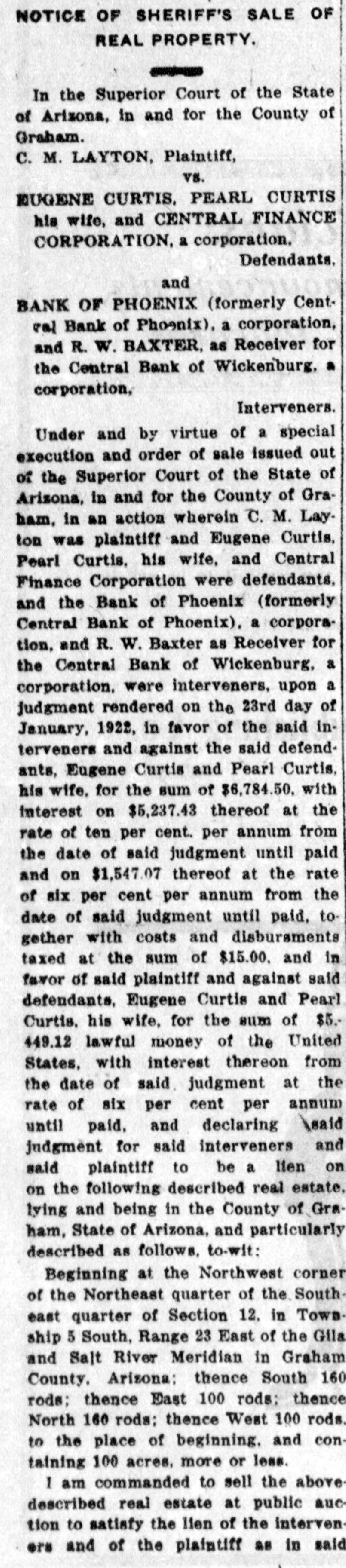
BANK OF PHOENIX (formerly Central Bank of Phoenix), a corporation, and R. W. BAXTER, as Receiver for the Central Bank of Wickenburg, a corporation, Under and by virtue of a special execution and order of sale issued out of the Superior Court of the State of Arizona, in and for the County of Graham, in an action wherein C. M. Layton was plaintiff and Eugene Curtis, Pearl Curtis, his wife, and Central Finance Corporation were defendants, and the Bank of Phoenix (formerly Central Bank of Phoenix), a corpora-


Article from Tombstone Epitaph, November 5, 1922

Click image to open full size in new tab

Article Text

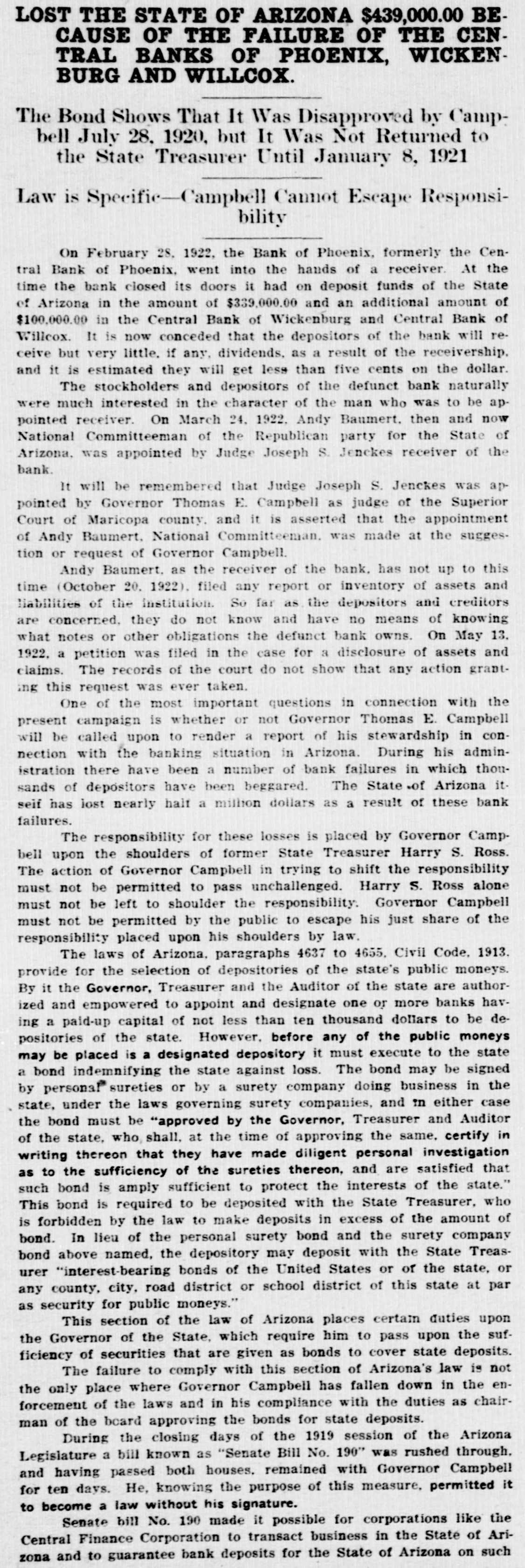
LOST THE STATE OF ARIZONA $439,000.00 BECAUSE OF THE FAILURE OF THE CENTRAL BANKS OF PHOENIX, WICKENBURG AND WILLCOX. The Bond Shows That It Was Disapproved by Campbell July 28, 1920, but It Was Not Returned to the State Treasurer Until January 8, 1921 Law is Specific-Campbell Cannot Escape Responsibility On February 28, 1922, the Bank of Phoenix, formerly the Central Bank of Phoenix, went into the hands of a receiver. At the time the bank closed its doors it had on deposit funds of the State of Arizona in the amount of $339,000.00 and an additional amount of $100,000.00 in the Central Bank of Wickenburg and Central Bank of Willcox. It is now conceded that the depositors of the bank will receive but very little. if any, dividends, as a result of the receivership. and it is estimated they will get less than five cents on the dollar. The stockholders and depositors of the defunct bank naturally were much interested in the character of the man who was to be appointed receiver. On March 24, 1922. Andy Baumert. then and now National Committeeman of the Republican party for the State of Arizona. was appointed by Judge Joseph S. Jenckes receiver of the bank. It will be remembered that Judge Joseph S. Jenckes was appointed by Governor Thomas E. Campbell as judge of the Superior Court of Maricopa county. and it is asserted that the appointment of Andy Baumert, National Committeeman. was made at the suggestion or request of Governor Campbell. Andy Baumert, as the receiver of the bank. has not up to this time (October 20. 1922). filed any report or inventory of assets and liabilities of the institution. So far as the depositors and creditors are concerned. they do not know and have no means of knowing what notes or other obligations the defunct bank owns. On May 13. 1922. a petition was filed in the case for a disclosure of assets and claims. The records of the court do not show that any action granting this request was ever taken. One of the most important questions in connection with the present campaign is whether or not Governor Thomas E. Campbell will be called upon to render a report of his stewardship in connection with the banking situation in Arizona. During his administration there have been a number of bank failures in which thousands of depositors have been beggared. The State of Arizona it. seif has lost nearly half a million dollars as a result of these bank failures. The responsibility for these losses is placed by Governor Campbell upon the shoulders of former State Treasurer Harry S. Ross. The action of Governor Campbell in trying to shift the responsibility must not be permitted to pass unchallenged. Harry S. Ross alone must not be left to shoulder the responsibility. Governor Campbell must not be permitted by the public to escape his just share of the responsibility placed upon his shoulders by law. The laws of Arizona, paragraphs 4637 to 4655. Civil Code, 1913. provide for the selection of depositories of the state's public moneys. By it the Governor, Treasurer and the Auditor of the state are authorized and empowered to appoint and designate one or more banks having a paid-up capital of not less than ten thousand dollars to be depositories of the state. However, before any of the public moneys may be placed is a designated depository it must execute to the state a bond indemnifying the state against loss. The bond may be signed by personal* sureties or by a surety company doing business in the state, under the laws governing surety companies, and in either case the bond must be "approved by the Governor, Treasurer and Auditor of the state, who shall, at the time of approving the same, certify in writing thereon that they have made diligent personal investigation as to the sufficiency of the sureties thereon, and are satisfied that such bond is amply sufficient to protect the interests of the state." This bond is required to be deposited with the State Treasurer, who is forbidden by the law to make deposits in excess of the amount of bond. In lieu of the personal surety bond and the surety company bond above named, the depository may deposit with the State Treasurer "interest-bearing bonds of the United States or of the state, or any county, city, road district or school district of this state at par as security for public moneys." This section of the law of Arizona places certain duties upon the Governor of the State, which require him to pass upon the sufficiency of securities that are given as bonds to cover state deposits. The failure to comply with this section of Arizona's law is not the only place where Governor Campbell has fallen down in the enforcement of the laws and in his compliance with the duties as chairman of the board approving the bonds for state deposits. During the closing days of the 1919 session of the Arizona Legislature a bill known as "Senate Bill No. 190" was rushed through. and having passed both houses. remained with Governor Campbell for ten days. He, knowing the purpose of this measure, permitted it to become a law without his signature. Senate bill No. 190 made it possible for corporations like the Central Finance Corporation to transact business in the State of Arizona and to guarantee bank deposits for the State of Arizona on such


Article from Arizona State Miner, July 21, 1923

Click image to open full size in new tab

Article Text

Phoenix, we are informed, is no excuse and no reason why obligations to the Central Bank of Wickenburg should not be collected and added to the assets of that concern so the Receiver may close up the business. The fact that the books are in Phoenix is a matter of convenience only.


Article from Arizona State Miner, July 21, 1923

Click image to open full size in new tab

Article Text

No Reason Why Collections Should Not Be Pressed. Depositors of the Wickenburg Central Bank are informed that the books of that concern have been out of the custody and control of the court for several months; but Mr. Plunkett, who audited the accounts for the court, still has possession of the books and papers for and on behalf of the Receiver, and is holding the books for him. The fact that the books and papers are in