Bank of Phoenix (Phoenix, AZ)

Episode Information

Episode UID
695995891455
Episode Type
Suspension β†’ Closure
Bank Type
state
Bank ID
69599589 hash
Start Date
March 21, 1921
Location
Phoenix, Arizona (33.448, -112.074)

Metadata

Model
gpt-5-mini (chosen from majority vote of a three-model LLM ensemble)
Short Digest
d1ccbed921efe8e9

Response Measures

None

Events (4)

1. March 21, 1921 Suspension
Cause
Voluntary Liquidation
Cause Details
Voluntary suspension of the Central Bank of Phoenix on March 21, 1921
Newspaper Excerpt
the Central Bank of Phoenix, which suspended voluntarily about three months ago
Source
newspapers
2. July 1, 1921 Reopening
Newspaper Excerpt
The Bank of Phoenix ... was opened to business at 10 o'clock yesterday morning.
Source
newspapers
3. February 28, 1922 Suspension
Cause
Government Action
Cause Details
State banking department took over affairs after bank failed to open on Feb. 28, 1922
Newspaper Excerpt
The Bank of Phoenix failed to open its doors today ... the state banking department to take over the bank's affairs
Source
newspapers
4. March 24, 1922 Receivership
Newspaper Excerpt
Andrew Baumert, Jr., today was appointed receiver of the Bank of Phoenix, which closed its doors February 28.
Source
newspapers

Newspaper Articles (19)

Article from Arizona Republican, July 2, 1921

Click image to open full size in new tab

Article Text

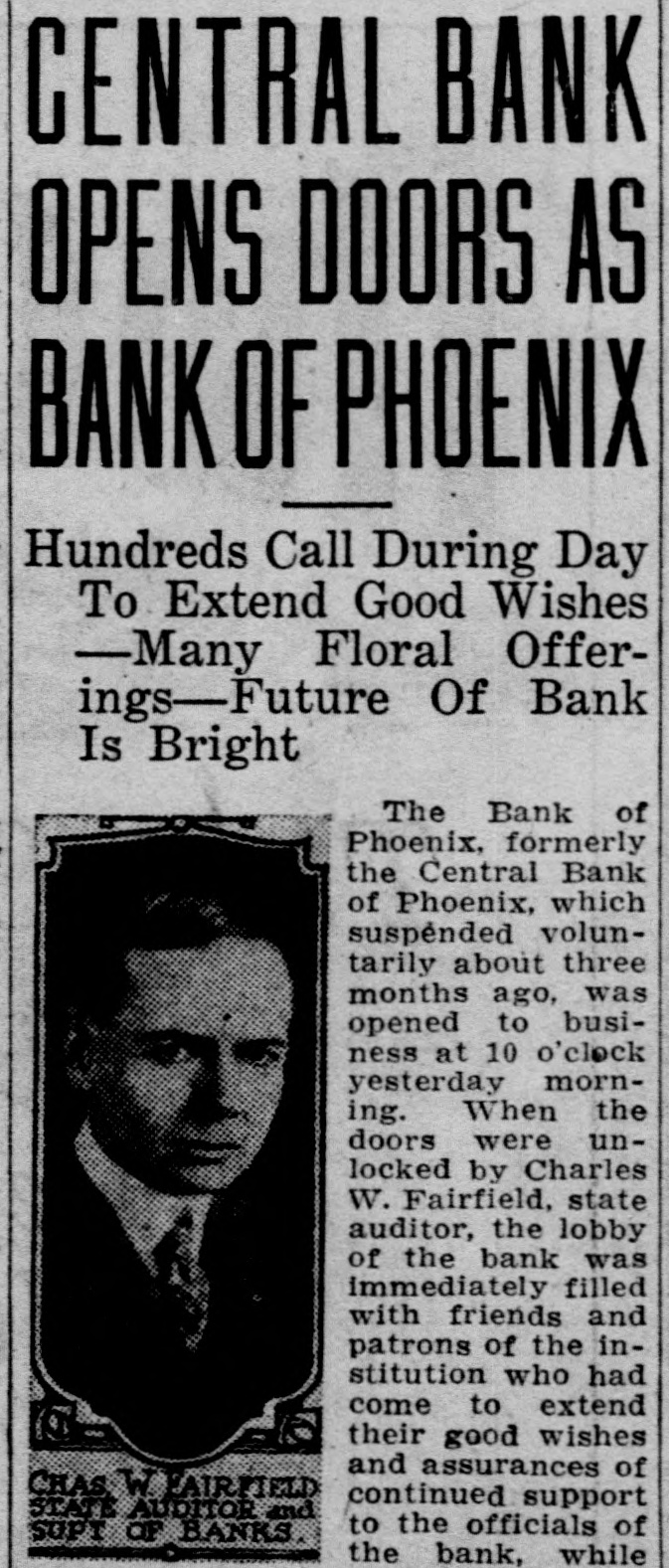
CENTRAL BANK OPENS DOORS AS BANK OF PHOENIX Hundreds Call During Day To Extend Good Wishes -Many Floral Offerings-Future Of Bank Is Bright The Bank of Phoenix, formerly the Central Bank of Phoenix, which suspended voluntarily about three months ago, was opened to business at 10 o'clock yesterday morning. When the doors were unlocked by Charles W. Fairfield, state auditor, the lobby of the bank was immediately filled with friends and patrons of the institution who had come to extend their good wishes and assurances of CHAS EAIRFIELD continued support AUDITOR and to the officials of SUPT OF BANKS. the bank, while


Article from Arizona Republican, July 2, 1921

Click image to open full size in new tab

Article Text

scores of floral sets from the other banks of the city and from various individuals carried messages of congratulation and co-operation. During the day it was estimated that more than 2,500 visitors entered the bank, and even with this the business conducted was said to have marked the day as a real work-day for the officers and their assistants. E. A. Tovrea, the new chairman of the board of directors of the bank, who has been in Bisbee, came to Phoenix especially for the opening, and spent the day in greeting his friends. Among the many visitors who called to express their good will were officials of other banks. Throughout the day hundreds of congratulatory telegrams and letters were received by the officers of the bank, paralleling the expressions of good-will that came verbally from hundreds of Phoenicians. In speaking of the re-opening of the bank, Arthur T. Esgate, cashier of the Valley bank, said: Proof of Valley Spirit "The reopening of the Bank of Phoenix is a splendid proof of the spirit of the Salt River valley. It is impossible to estimate the amount of good that will be done by the reopening of the bank, not only as a business proposition but for the community as a whole. It means increased stability, better business feeling and a firmer faith in this section of the Southwest." Charles F. Solomon, president of the National Bank of Arizona, expressed his good wishes in the following words: "I consider the reopening of the Bank of Phoenix-the reorganized Central bank-as one of the best indications of the stability of the Salt River valley-an indication which seems to emphasize what we know is already the case, that conditions are gradually getting better. The fundamentals of the valley, so to speak, are in excellent condition. We have the products, we have people showing the right spirit, and we are coming back. This is the spirit which helped to open the bank and has made its present good condition possible." Another expression of good-will came from William H. Thomson, vice president of the Phoenix National bank, who said: "The reopening of the bank means much to the depositors and the community. It has our sincere good wishes for the future." General Rejoicing With the reopening of the old Central Bank of Phoenix under the name of the Bank of Phoonix, with its capital stock raised from $100,000 to $200,000, there is general rejoicing over the fact that a costly receivership has been averted, and that the dawn of a newer, broader and more conservative prosperity has arrived. The opening of this bank, which closed its doors March 21, 1921, brings a sigh of relief to the Salt River valley and the state in general, for it has long been realized that the appointment of a receiver would result in a financial disaster of such overwhelming proportions that it would take years to recover from it.


Article from Bisbee Daily Review, March 1, 1922

Click image to open full size in new tab

Article Text

PHOENIX BANK CLOSES DOORS Re-Organized Phoenix Bank, Capitalized at $100,000, Suspends Business PHOENIX, Ariz., Feb. 28. - The Bank of Phoenix failed to open its doors today. The institution formerly was the Central Bank, which suspended business on March 21. 1921. and was re-organized three months later as the bank of Phoenix. A recent statement listed the capitalization at $100,000 and deposits aggregating $1,537,485. "Unforseen conditions, making impossible the anticipated liquidation, have made it necessary for the state banking department to take over the bank's affairs," said a statement by State Superintendent of Banks Fairfield.


Article from Albuquerque Morning Journal, March 1, 1922

Click image to open full size in new tab

Article Text

PHOENIX BANK FAILS TO OPEN ITS DOORS Phoenix, Ariz., Feb. 28.-The Bank of Phoenix failed to open its doors today. The institution formerly was the Central bank, which suspended business on March 21, 1921, and was re-opened three months later as the Bank of Phoe nix, A recent statement listed the capitalization at $100,000 and dep sits aggregating $1,537,485. "Unforseen conditions, making impossible the anticipated liquidation, have made it necessary for the state banking department to take over the bank's affairs." said a statement by State Superintendent of Banks Fairfield.


Article from Weekly Journal-Miner, March 1, 1922

Click image to open full size in new tab

Article Text

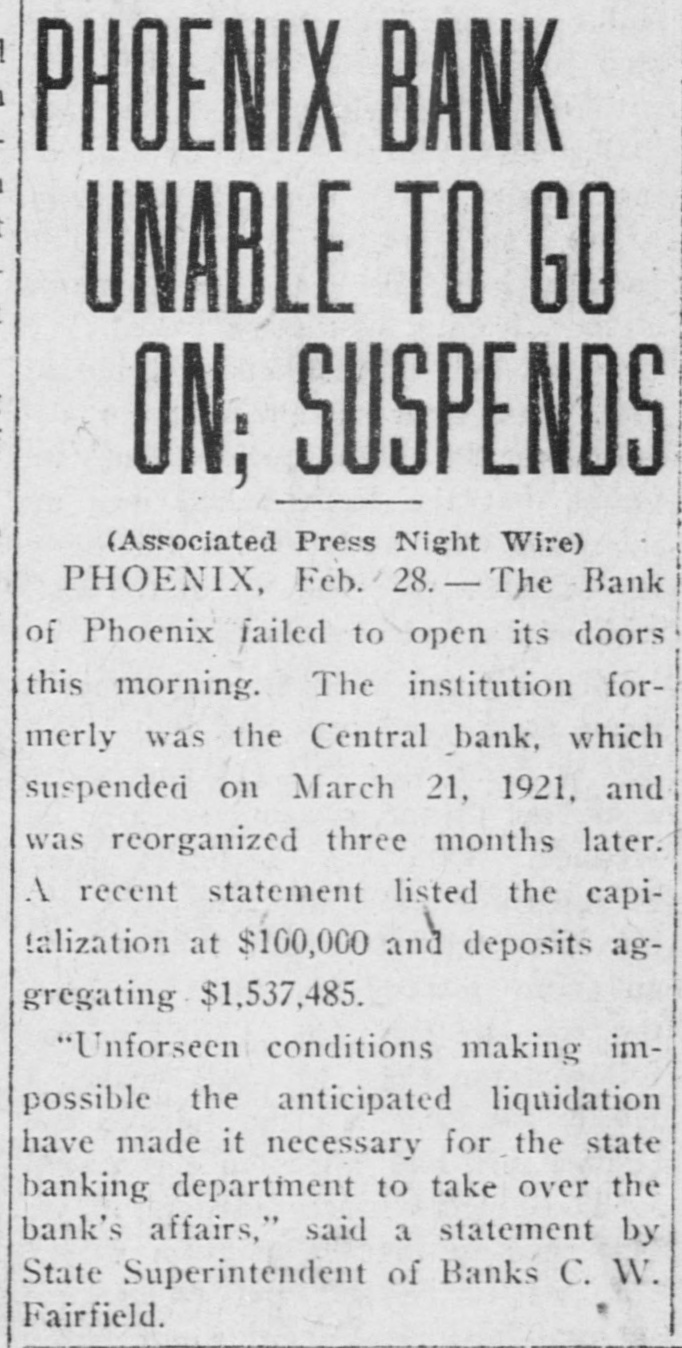
PHOENIX BANK UNABLE TO GO ON; SUSPENDS (Associated Press Night Wire) PHOENIX, Feb. / 28. - The Bank of Phoenix failed to open its doors this morning. The institution formerly was the Central bank, which suspended on March 21, 1921, and was reorganized three months later. \ recent statement listed the capitalization at $100,000 and deposits aggregating $1,537,485. "Unforseen conditions making impossible the anticipated liquidation have made it necessary for the state banking department to take over the bank's affairs," said a statement by State Superintendent of Banks C. W. Fairfield.


Article from Arizona Republican, March 1, 1922

Click image to open full size in new tab

Article Text

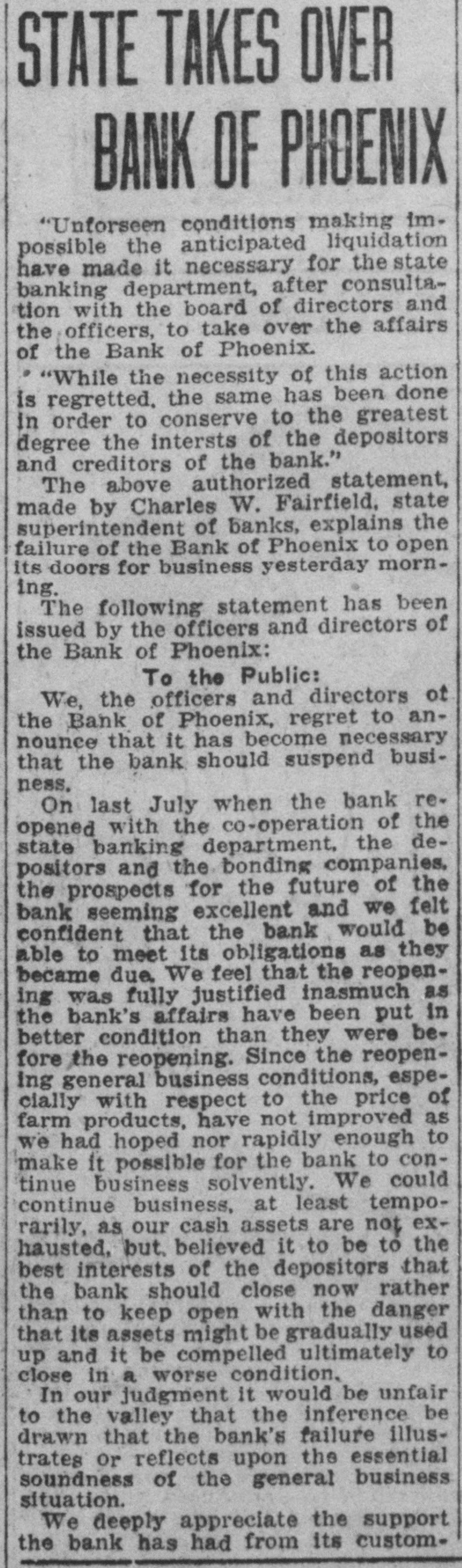
STATE TAKES OVER BANK OF PHOENIX "Unforseen conditions making impossible the anticipated liquidation have made it necessary for the state banking department, after consultation with the board of directors and the officers, to take over the affairs of the Bank of Phoenix. "While the necessity of this action is regretted, the same has been done in order to conserve to the greatest degree the intersts of the depositors and creditors of the bank." The above authorized statement, made by Charles W. Fairfield, state superintendent of banks, explains the failure of the Bank of Phoenix to open its doors for business yesterday morning. The following statement has been issued by the officers and directors of the Bank of Phoenix: To the Public: We, the officers and directors ot the Bank of Phoenix, regret to announce that it has become necessary that the bank should suspend business. On last July when the bank reopened with the co-operation of the state banking department, the dethe for the positors the prospects and bonding future companies, of the bank seeming excellent and we felt confident that the bank would be able to meet its obligations as they became due. We feel that the reopening was fully justified inasmuch as the bank's affairs have been put in better condition than they were before the reopening. Since the reopening general business conditions, especially with respect to the price of farm products, have not improved as we had hoped nor rapidly enough to make it possible for the bank to continue business solvently. We could continue business, at least temporarily, as our cash assets are not exhausted, but, believed it to be to the best interests of the depositors that the bank should close now rather than to keep open with the danger that its assets might be gradually used up and it be compelled ultimately to close in a worse condition, In our judgment it would be unfair to the valley that the inference be drawn that the bank's failure illustrates or reflects upon the essential soundness of the general business situation. We deeply appreciate the support the bank has had from its custom-


Article from Tombstone Epitaph, March 5, 1922

Click image to open full size in new tab

Article Text

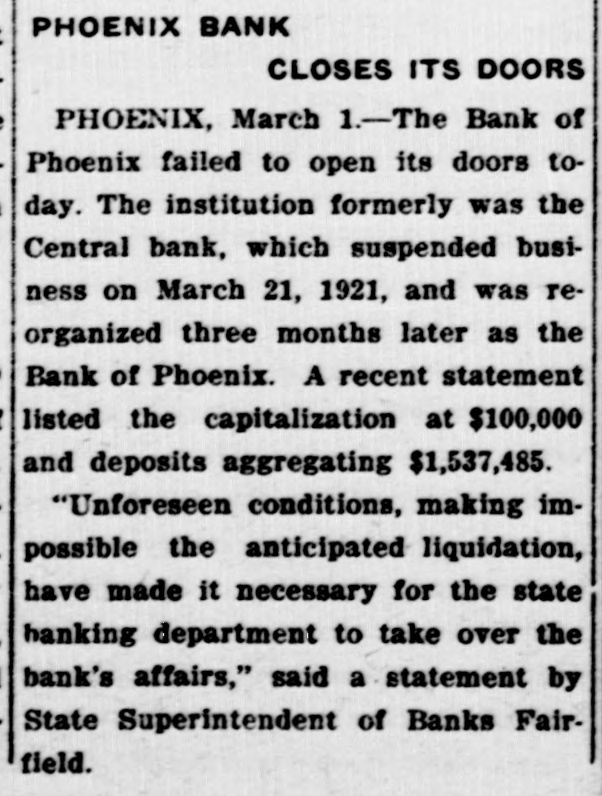
PHOENIX BANK CLOSES ITS DOORS PHOENIX, March 1.-The Bank of Phoenix failed to open its doors today. The institution formerly was the Central bank, which suspended business on March 21, 1921, and was reorganized three months later as the Bank of Phoenix. A recent statement listed the capitalization at $100,000 and deposits aggregating $1,537,485. "Unforeseen conditions, making impossible the anticipated liquidation, have made it necessary for the state hanking department to take over the bank's affairs," said a statement by State Superintendent of Banks Fairfield.


Article from The Snowflake Herald, March 17, 1922

Click image to open full size in new tab

Article Text

Southwest News From All Over New Mexico and Arizona (Western Newspaper Union News Service.) Final plans have been made for the to afiliated with the Clovis baseball West team Texas become League. Plans are under way for the erection of a new unit of the New armory Mexico building National for Guard the of Mountainair, N. M. basketball by at The Bisbee team, High defeating School Girls' Mesa Tucson by a score of 33 to 20, won the state championship for this year. As a result of the opening of the copper mines in the southern part of New Mexico there are now nearly 400 men employed in the big smelter at El Paso. Lon C. Harmon, heading what was known as the Taxpayers ticket, was of at a drew in ballot elected that mayor Phoenix the heaviest primary vote the city's history. number of are to Las to A going large Vegas Texas attend-the cattlemen annual convention of the New Mexico Cattle and Horse Growers' Association, March 20 and 21. Mohave county in Arizona is taking steps to build a good road from Chloride to the Boulder canon damsite, in the Grand Canon. This road will run by way of White Hills. A number of mining men recently to make the of the iron near Capoperation visited Carrizozo mines plans for in the mountains. Considerable itan development Capitan work months is planned. For the first time in a night shift, composed of a foreman, three shift bosses and about fifty men, is again working at the Junction shaft of the Calumet and Arizona Mining Company's Bisbee property. G. W. P. Hunt, former governor of and MΓ’rcus A. States senator Arizona, United from State Smith, Arizona, Legisla- former recently addressed the in session. other state were presbell ture and joint officials Governor Camp- to ent. The House gallery was filled capacity. Reorganization of the school system state at Florence, is being worked out the of Governor E. direction Ariz., at the penitentiary Thomas under with the view of the bars a better Campbell behind giving opportunity their those reto become good citizens on lease from prison. The Bank of Phoenix has closed. The formerly was the Central which suspended and was March Bank, institution 21, 1921, business reorganized on three months later as the Bank of Phoenix. A recent statement listed the capitalization at $100,000 and deposits aggregating $1,537,485. J. P. Parker, ranchman living east of Farwell, Texas, died from a bullet the stomach said to have by H. E. of State Bank, been wound the inflicted Farwell in Guy, and president of the State Bank, of the latter and Farmers' mayor Texico, taken city. N. place The M., shooting is said to have the bank as a result a fidifference. Guy was nancial outside claims arrested of selfand released on bond. He defense. What is considered the largest figuring in the liability column individual voluntary filed in years was bankruptcy amount of any petition record- clerk's in United States district at Santa FΓ©, when stockman office ed Wiley in the Jernigan, of William in Lulu, his Otero county, N. M., sent petition to be adjudged a bankrupt. Mr. Jernigan states that he owes the sum of $744,329 and his assets are $306,460. His main creditor is the El Paso Cattle Loan Company, for $345,000. Senator Charles E. Burton of Yavacounty, Arizona, has introduced in pai the Senate two bills proposing to $6,- increase the governor's salary from 500 a year to $12,000, and to raise the pay of legislators from $7 a day to $12. Representatives of the Chamber of Commerce who have been making an inspection of the wheatcrop of the valand the East Grand Plains district, ley report that the crop is in splendid condition and there is every indication a that the next year's crop will be bumper. The acreage is about the same as that of last year but the yield will be much better. Interest in the Vaughn, N. M., oil field is growing in leaps and bounds, inquiries are coming in from all parts of the United States, and some from be Canada. That this field will now thoroughly prospected and developed to longer a guess, nor is the field is no rated as a "wildcat" as the showing be oil in several wells drilled for and waof have proven that oil is there be ter guide in spotting wells to is drilled a for oil which almost assures production in commercial quantities trail of bad checks all the way A the continent was left by at C. Champ, arrested Ariz., according to detectives. They declared across Winslow, Charles recently Pinkerton Champ of is for swindling two hanks wanted


Article from Bisbee Daily Review, March 25, 1922

Click image to open full size in new tab

Article Text

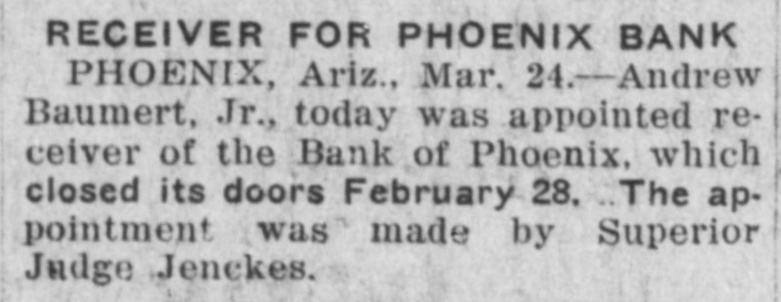
RECEIVER FOR PHOENIX BANK PHOENIX, Ariz., Mar. 24.-Andrew Baumert, Jr., today was appointed receiver of the Bank of Phoenix, which closed its doors February 28. The appointment was made by Superior Judge Jenckes.


Article from Arizona Republican, March 25, 1922

Click image to open full size in new tab

Article Text

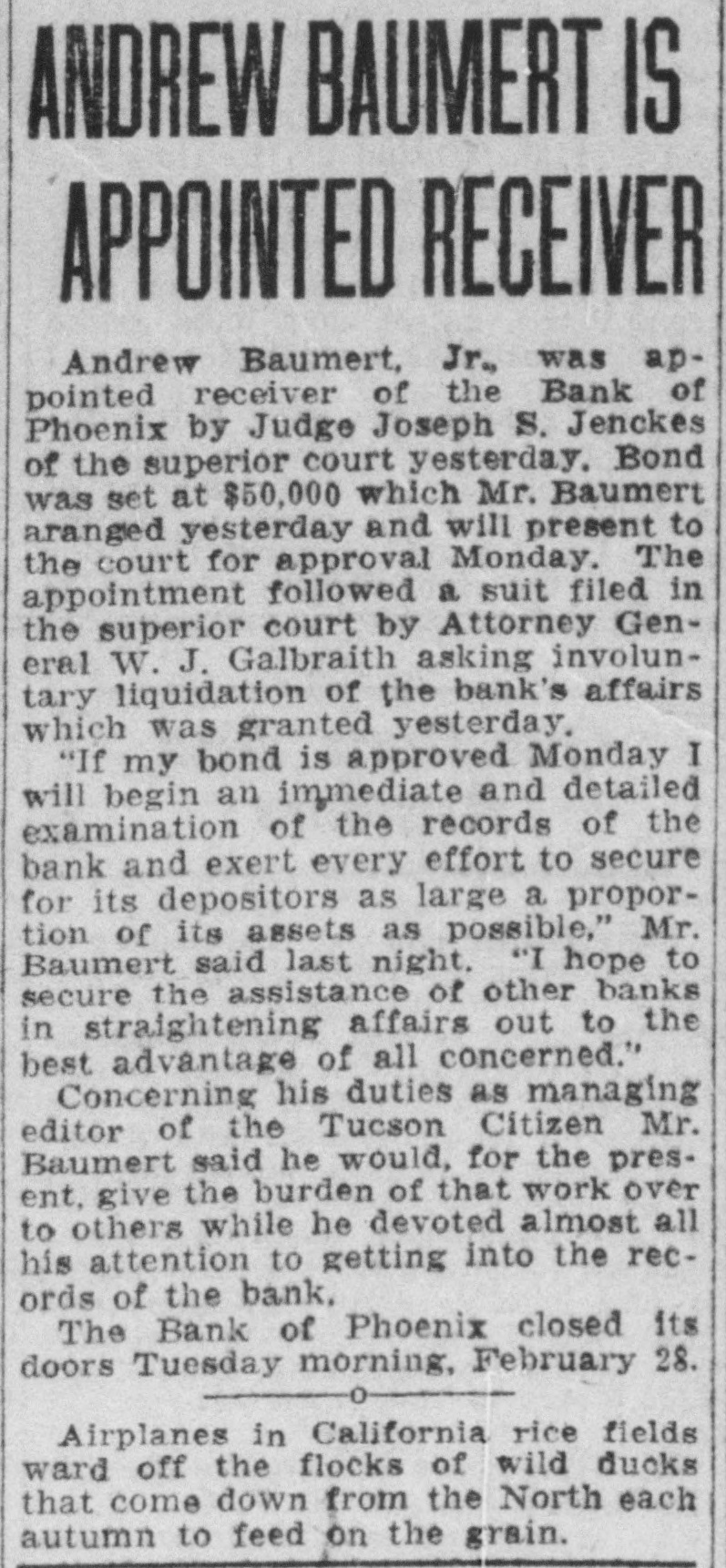
ANDREW BAUMERT IS APPOINTED RECEIVER Andrew Baumert, Jr., was appointed receiver of the Bank of Phoenix by Judge Joseph S. Jenckes of the superior court yesterday. Bond was set at $50,000 which Mr. Baumert aranged yesterday and will present to the court for approval Monday. The appointment followed a suit filed in the superior court by Attorney General W. J. Galbraith asking involuntary liquidation of the bank's affairs which was granted yesterday. "If my bond is approved Monday I will begin an immediate and detailed examination of the records of the bank and exert every effort to secure for its depositors as large a proportion of its assets as possible," Mr. Baumert said last night. "I hope to secure the assistance of other banks in straightening affairs out to the best advantage of all concerned." Concerning his duties as managing editor of the Tucson Citizen Mr. Baumert said he would, for the present. give the burden of that work over to others while he devoted almost all his attention to getting into the records of the bank. The Bank of Phoenix closed its doors Tuesday morning, February 28. Airplanes in California rice fields ward off the flocks of wild ducks that come down from the North each autumn to feed on the grain.


Article from Arizona Republican, April 14, 1922

Click image to open full size in new tab

Article Text

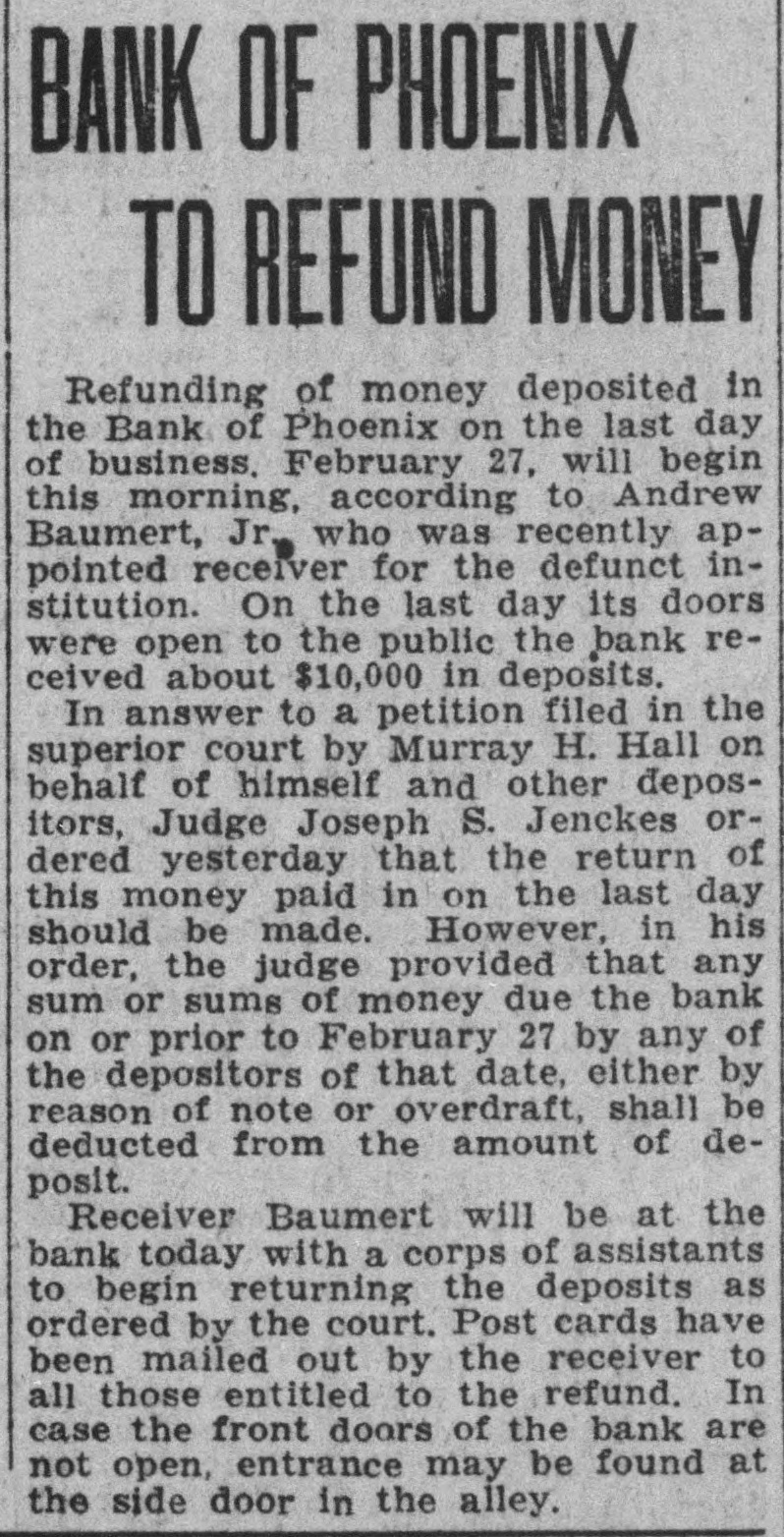
BANK OF PHOENIX TO REFUND MONEY Refunding of money deposited in the Bank of Phoenix on the last day of business, February 27, will begin this morning, according to Andrew Baumert, Jr. who was recently appointed receiver for the defunct institution. On the last day its doors were open to the public the bank received about $10,000 in deposits. In answer to a petition filed in the superior court by Murray H. Hall on behalf of himself and other depositors, Judge Joseph S. Jenckes ordered yesterday that the return of this money paid in on the last day should be made. However, in his order, the judge provided that any sum or sums of money due the bank on or prior to February 27 by any of the depositors of that date, either by reason of note or overdraft, shall be deducted from the amount of deposit. Receiver Baumert will be at the bank today with a corps of assistants to begin returning the deposits as ordered by the court. Post cards have been mailed out by the receiver to all those entitled to the refund. In case the front doors of the bank are not open, entrance may be found at the side door in the alley.


Article from Arizona Republican, May 14, 1922

Click image to open full size in new tab

Article Text

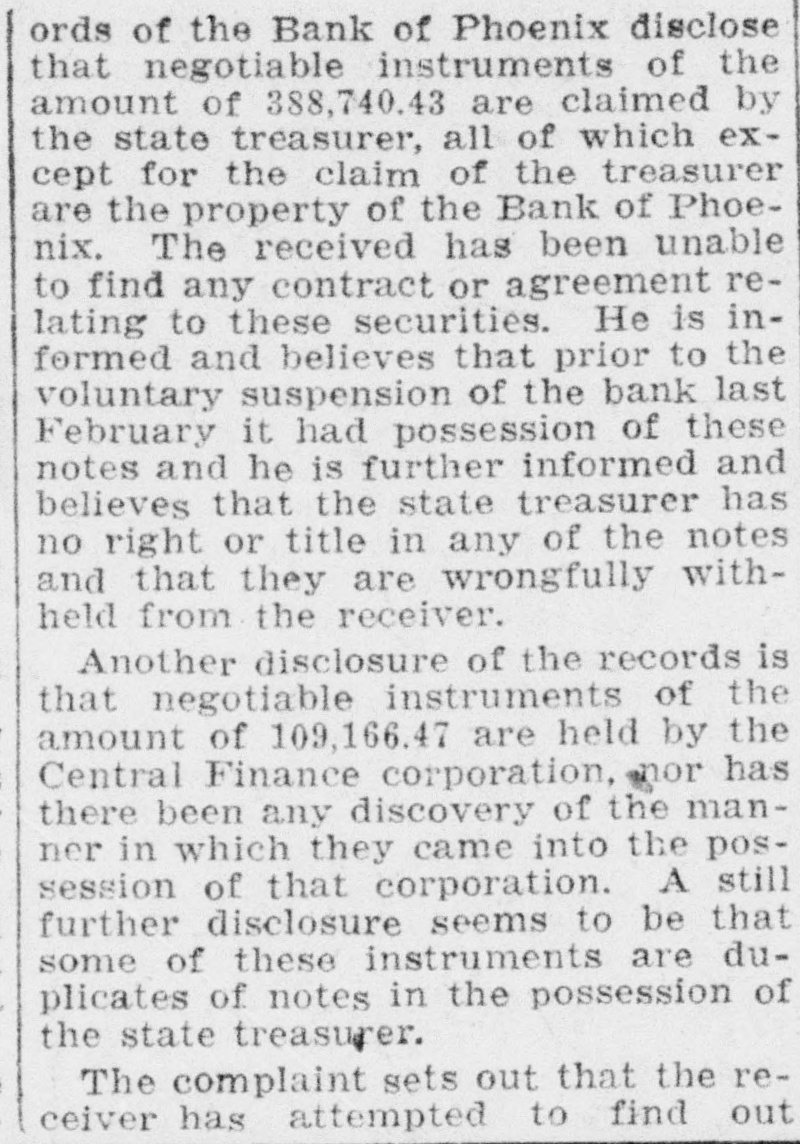
ords of the Bank of Phoenix disclose that negotiable instruments of the amount of 388,740.43 are claimed by the state treasurer, all of which except for the claim of the treasurer are the property of the Bank of Phoenix. The received has been unable to find any contract or agreement relating to these securities. He is informed and believes that prior to the voluntary suspension of the bank last February it had possession of these notes and he is further informed and believes that the state treasurer has no right or title in any of the notes and that they are wrongfully withheld from the receiver. Another disclosure of the records is that negotiable instruments of the amount of 109,166.47 are held by the Central Finance corporation, nor has there been any discovery of the manner in which they came into the possession of that corporation. A still further disclosure seems to be that some of these instruments are duplicates of notes in the possession of the state treasurer. The complaint sets out that the receiver has attempted to find out


Article from Arizona Republican, May 14, 1922

Click image to open full size in new tab

Article Text

GOES T TO COURT TO GET SECURITIES F CLOSED BANK A subpoena duces tecum was issued yesterday by Judge Jenckes, at the instance of Andrew Baumert, Jr., receiver of the Bank of Phoenix, and directed to the Central Bank of Phoenix doing business as the Bank of Phoenix, to the officers and directors of that institution, to State Treasurer Earhart and to the officers of the Central Finance corporation to appear in court on Monday. May 23 and shed some light, if possible, upon a matter which is more or less of a puzzle to the receiver, In his application for the order. the receiver states that the files and rec-


Article from Bisbee Daily Review, December 21, 1922

Click image to open full size in new tab

Article Text

To Appeal Order to Turn Over All Securities Held PHOENIX, Ariz., Dec. 20. - Announcement was made today by W. J. Galbraith, attorney general, that an appeal would be made immediately to the Arizona supreme court from the order of Judge Joseph S. Jenckes of the Maricopa county superior court requiring Raymond R. Earhart, as state treasurer, Charles V. Fairfield as state auditor and W. J. Galbraith as attorney general to turn over to Andrew J. Baumert, Jr., as receiver of the Bank of Phoenix, all notes, securities, personal property and evidences of indebtedness which they hold as security for state deposits in the bank. The order of Judge Jenckes was formally issued today following a hearing on Monday on an order to show cause why the state officials should not turn over the securities to the receiver.


Article from Arizona Daily Star, January 23, 1923

Click image to open full size in new tab

Article Text

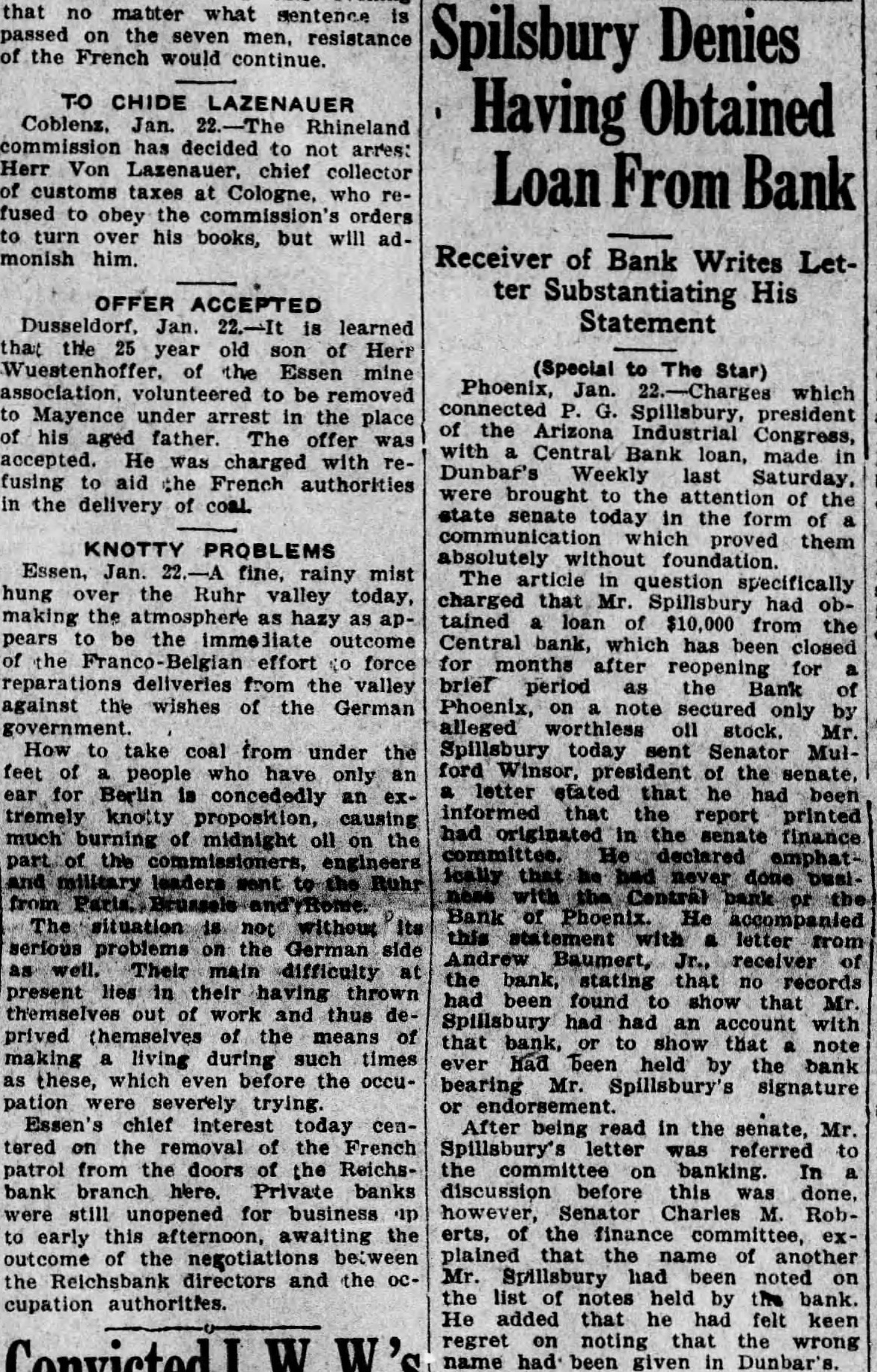
Spilsbury Denies Having Obtained Loan From Bank Receiver of Bank Writes Letter Substantiating His Statement (Special to The Star) Phoenix, Jan. 22.β€”Charges which connected P. G. Spilsbury, president of the Arizona Industrial Congress, with a Central Bank loan, made in Dunbar's Weekly last Saturday, were brought to the attention of the state senate today in the form of a communication which proved them absolutely without foundation. The article in question specifically charged that Mr. Spilsbury had obtained a loan of $10,000 from the Central bank, which has been closed for months after reopening for a brief period as the Bank of Phoenix, on a note secured only by alleged worthless oil stock. Mr. Spilsbury today sent Senator Mulford Winsor, president of the senate, a letter stated that he had been informed that the report printed had originated in the senate finance committee. He declared emphatically that he had never done business with the Central bank or the Bank of Phoenix. He accompanied this statement with a letter from Andrew Baumert, Jr., receiver of the bank, stating that no records had been found to show that Mr. Spilsbury had had an account with that bank, or to show that a note ever had been held by the bank bearing Mr. Spilsbury's signature or endorsement. After being read in the senate, Mr. Spilsbury's letter was referred to the committee on banking. In a discussion before this was done, however, Senator Charles M. Roberts, of the finance committee, explained that the name of another Mr. Spilsbury had been noted on the list of notes held by the bank. He added that he had felt keen regret on noting that the wrong name had been given in Dunbar's.


Article from Arizona Daily Star, March 20, 1923

Click image to open full size in new tab

Article Text

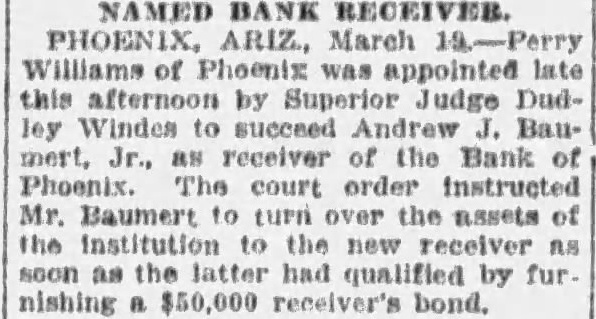
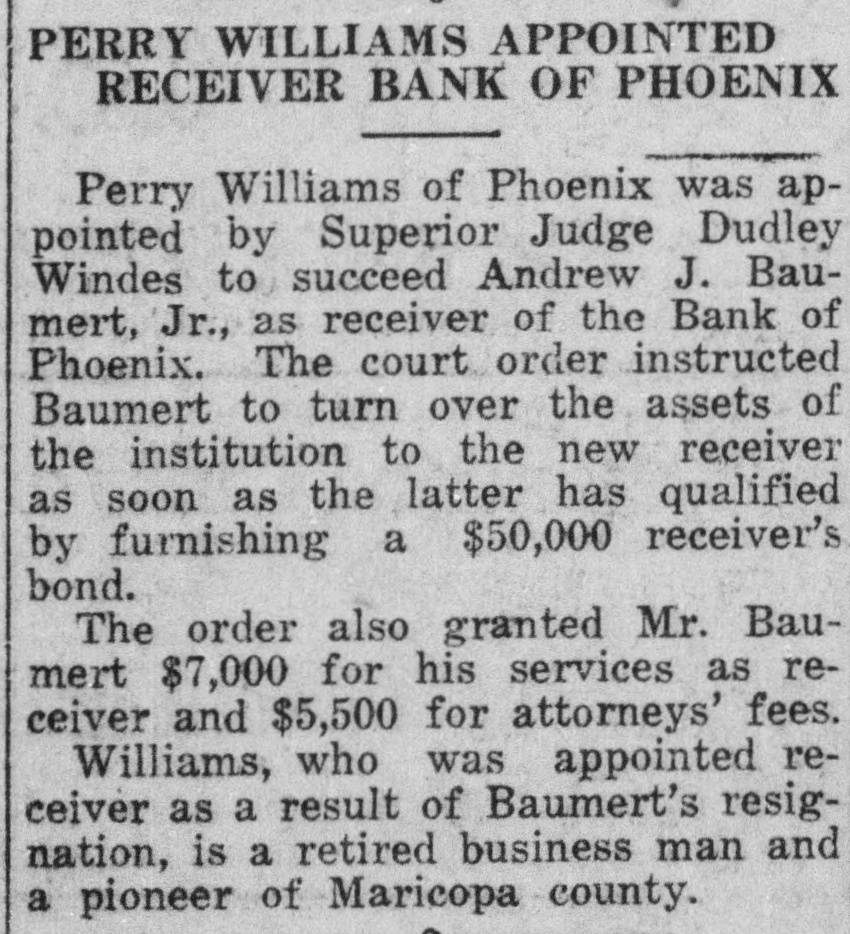
Phoenician Will Succeed Baumert As Bank Receiver Phoenix, Ariz., March 19.β€”Perry Williams of Phoenix was appointed late this afternoon by Superior Judge Dudley Windes to succeed Andrew J. Baumert, Jr., as receiver of the Bank of Phoenix. The court order instructed Mr. Baumert to turn over the assets of the institution to the new receiver as soon as the latter had qualified by furnishing a $50,000 receiver's bond. The order also granted Mr. Baumert $7,000 for his services as receiver and $5,500 for attorney's fees. Mr. Williams, who was appointed receiver as the result of Mr. Baumert's resignation, is a retired business man and a pioneer of Maricopa county.


Article from El Paso Times, March 20, 1923

Click image to open full size in new tab

Article Text

NAMED BANK RECEIVER. PHOENIX, ARIZ., March 19.β€”Perry Williams of Phoenix was appointed late this afternoon by Superior Judge Dudley Windes to succeed Andrew J. Baumert, Jr., as receiver of the Bank of Phoenix. The court order instructed Mr. Baumert to turn over the assets of the institution to the new receiver as soon as the latter had qualified by furnishing a $50,000 receiver's bond.


Article from The Coconino Sun, March 30, 1923

Click image to open full size in new tab

Article Text

PERRY WILLIAMS APPOINTED RECEIVER BANK OF PHOENIX Perry Williams of Phoenix was appointed by Superior Judge Dudley Windes to succeed Andrew J. Baumert, Jr., as receiver of the Bank of Phoenix. The court order instructed Baumert to turn over the assets of the institution to the new receiver as soon as the latter has qualified by furnishing a $50,000 receiver's bond. The order also granted Mr. Baumert $7,000 for his services as receiver and $5,500 for attorneys' fees. Williams, who was appointed receiver as a result of Baumert's resignation, is a retired business man and a pioneer of Maricopa county.


Article from The Coconino Sun, July 4, 1924

Click image to open full size in new tab

Article Text

any funds were on deposit in the Central Bank of Phoenix or in the Bank of Phoenix. That there was no record whatever of this money and that this money was never turned over to defendant or received by defendant at the time he assumed office for at any other time. The answer further says "that any funds or any public moneys of the state of Arizona, which may have been collected and received in the office of the State Land Commissioner, and may have been lost to the state of Arizona either through the insolvency of the Central Bank of Phoenix, or Bank of Phoenix, or lost for reason of any lack of deposion tary bond of that bank, or lost for reason of lack of and other proper security to the state for any such deposits, were public funds received in the office of the State Land Commissioner during the term of a predecessor to defendant in that office, and during that preceding term placed in said bank; and were funds as to which no account was ever rendered to this defendant by such predecessor, and were funds which never came into possession of defendant, and were funds as to which the records of the State Land Department contained no record thereof as public funds, or otherwise, and were public funds, which if lost to the state of Arizona, are so lost due to the acts of other officers of the state, and not lost through act of defendant at all concerning such funds. "That after the Central Bank of Phoenix suspended business in March 1921, it was discovered that an account existed in said bank, which carried upon its books as the 'State Land Department, Change Account, in which there appeared to be a balance of seven hundred three and 43-100 dollars, due from the bank, and subject to check to be drawn by B. H. Clark, deputy state land commissioner." That none of the records in the office of the state land commissioner disclosed anything at all as to the source of such account nor was there in said office any records, vouchers, or documents, which in any manner connected that deposit or ac. count with the official business of that office. Nor was such account or any item thereof, or portion thereof, included in the accounting as be tween this defendant and the pteceding state land commissioner. That defendant is informed and believes and SO states as true, that B. R. Clark removed from office of the state land commissioner all returned checks, vouchers, checkbooks, bank and pass book, and such other records is kept by him pertaining to the account in this paragraph referred to, and did so prior to the time this deiendant came into office as state land commissioner. And caused such action to be taken by the Central bank as would put said clerk in possession of checks drawn and paid from account, and of bank statements as to the condition of said account, after he ceased to be such deputy state land commissioner. That attached to this answer and made a part hereof, are three photographs, one of a ledger sheet of the books ofthe Central Bank of Phoenix, which shows the state of said account as it finally appeared upon said books, one of which shows