Bank of Chicago (Chicago, IL)

Episode Information

Episode UID
9220152090895
Episode Type
Suspension โ†’ Closure
Bank Type
state
Bank ID
922015209 hash
Start Date
July 11, 1874
Location
Chicago, Illinois (41.850, -87.650)

Metadata

Model
gpt-5-mini (chosen from majority vote of a three-model LLM ensemble)
Short Digest
0e67f141b9d37578

Response Measures

None

Description

Institution went into voluntary liquidation/assignment rather than a brief suspension; later litigation and receiver activity followed.

Events (5)

1. July 11, 1874 Suspension
Cause
Voluntary Liquidation
Cause Details
Bank voluntarily assigned assets and went into liquidation because it could not meet claims after panic-related collection problems; suits and inability to collect large outstanding accounts prompted suspension.
Newspaper Excerpt
Friday THE BANK WENT INTO LIQUIDATION ... The Bank of Chicago, formerly the National Loan and Trust Company, has suspended, owing to financial embarrassments growing out of the panic.
Source
newspapers
2. July 12, 1874 Receivership
Newspaper Excerpt
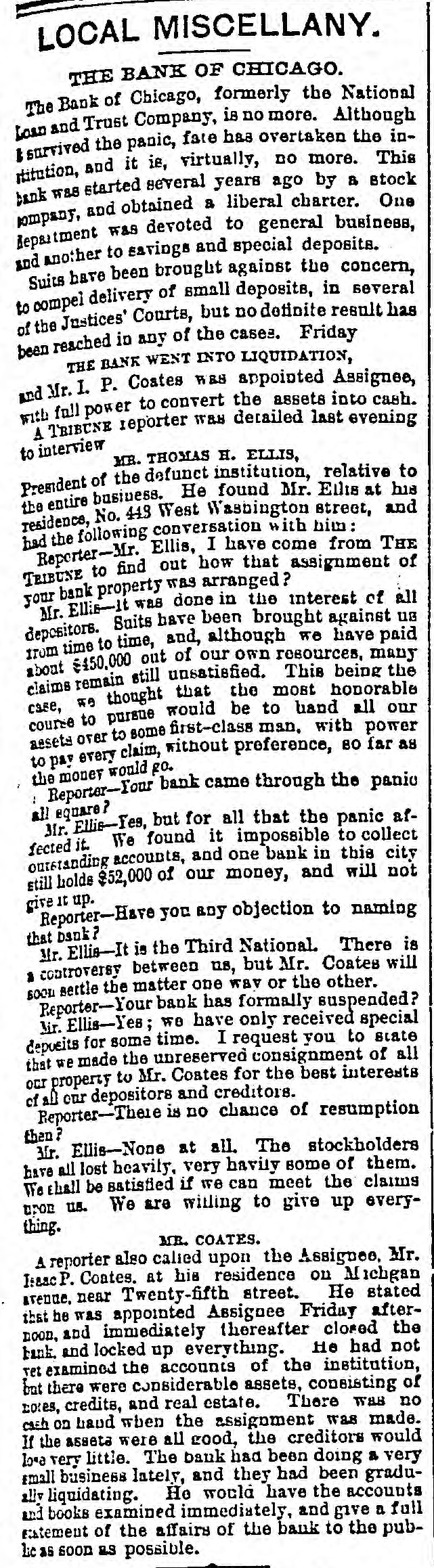
Friday THE BANK WENT INTO LIQUIDATION, and Mr. I. P. Coates was appointed Assignee ... Mr. Coates ... stated that he was appointed Assignee Friday afternoon, and immediately thereafter closed the bank. and locked up everything. He had not yet examined the accounts of the institution, but there were considerable assets ... There was no cash on hand when the assignment was made. If the assets were all good, the creditors would have very little. The bank had been doing a very small business lately, and they had been gradually liquidating. He would have the accounts and books examined immediately, and give a full statement of the affairs of the bank to the public as soon as possible. (Chicago Daily Tribune, 1874-07-12).
Source
newspapers
3. January 21, 1879 Other
Newspaper Excerpt
Liability of the Stockholders of the Bank of Chicago. ... motion for Injunction by the Receiver of THE BANK OF CHICAGO against the depositors who are seeking to sue the stockholders. The case has assumed considerable importance ... the outstanding liability of the stockholders was $119,000 ... Creditors representing $131,000 of claims had begun suits. (Chicago Daily Tribune, 1879-01-21).
Source
newspapers
4. February 4, 1879 Other
Newspaper Excerpt
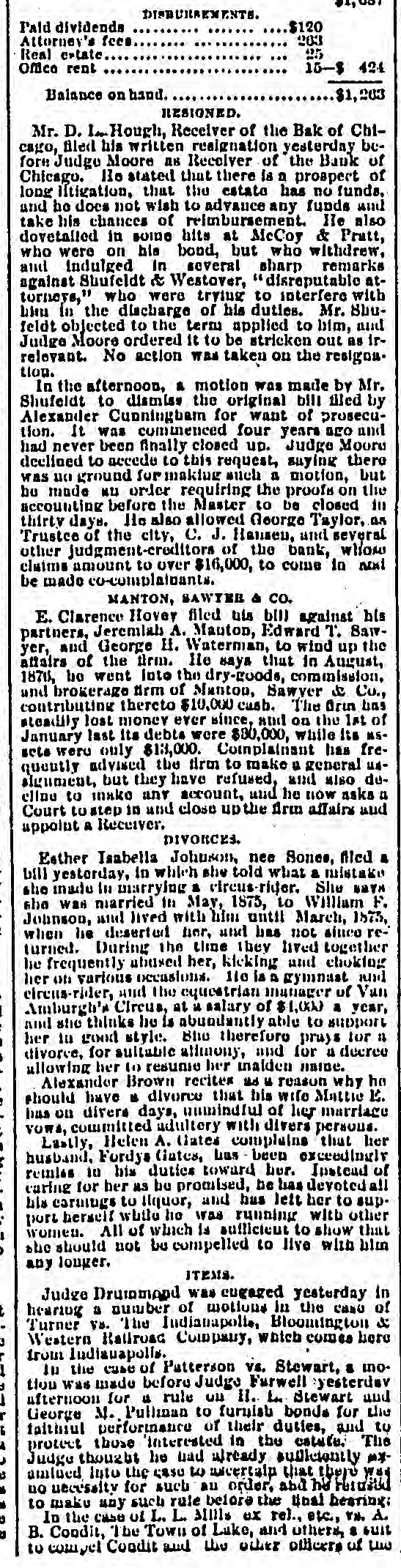
RESIGNED. Mr. D. Hough, Receiver of the Bank of Chicago, filed his written resignation yesterday before Judge Moore ... He stated that there is a prospect of long litigation, that the estate has no funds, and he does not wish to advance any funds and take his chances of reimbursement. (Chicago Daily Tribune, 1879-02-04).
Source
newspapers
5. June 21, 1882 Other
Newspaper Excerpt
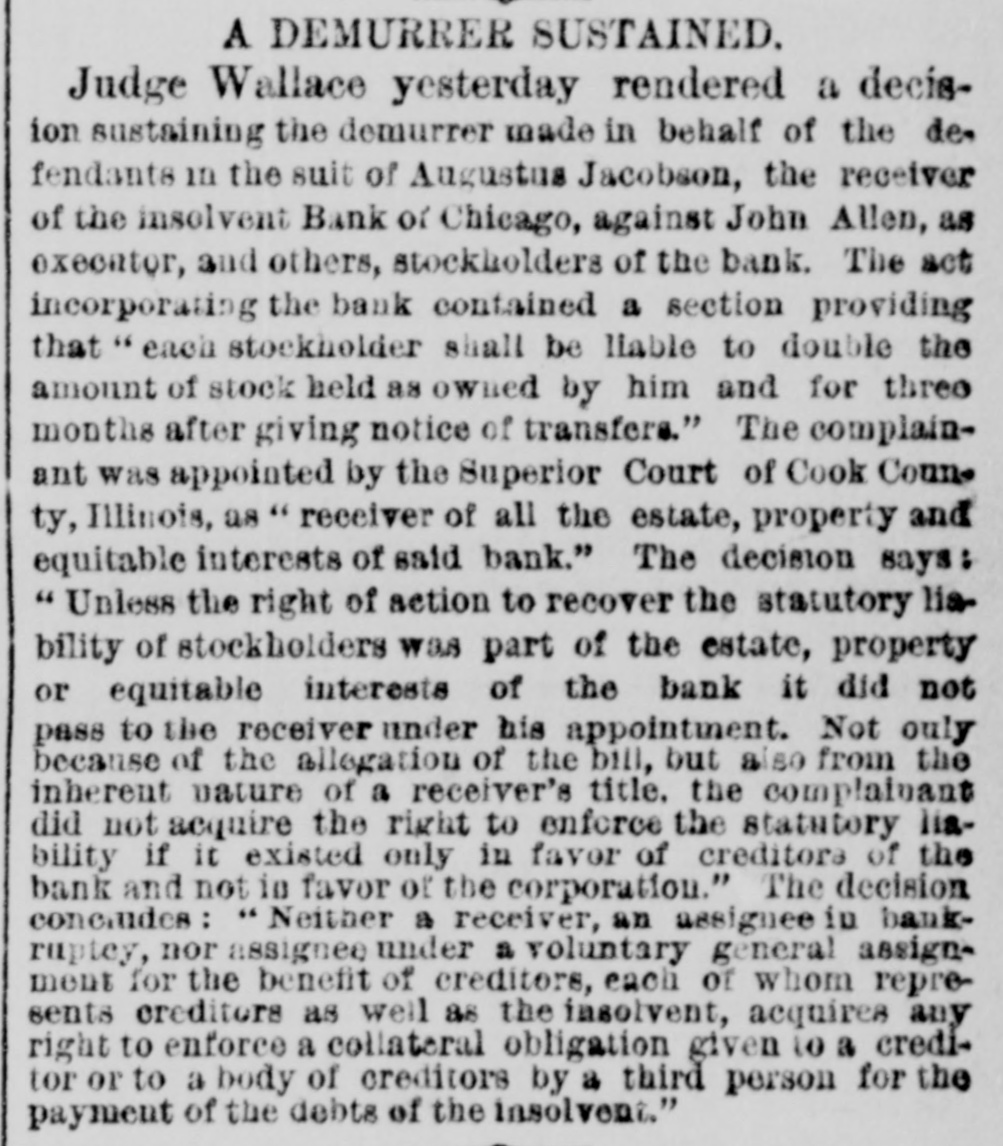
Judge Wallace yesterday rendered a decision sustaining the demurrer made in behalf of the defendants in the suit of Augustus Jacobson, the receiver of the insolvent Bank of Chicago, against ... stockholders of the bank. (New-York Tribune, 1882-06-21).
Source
newspapers

Newspaper Articles (11)

Article from Chicago Daily Tribune, September 22, 1873

Click image to open full size in new tab

Article Text

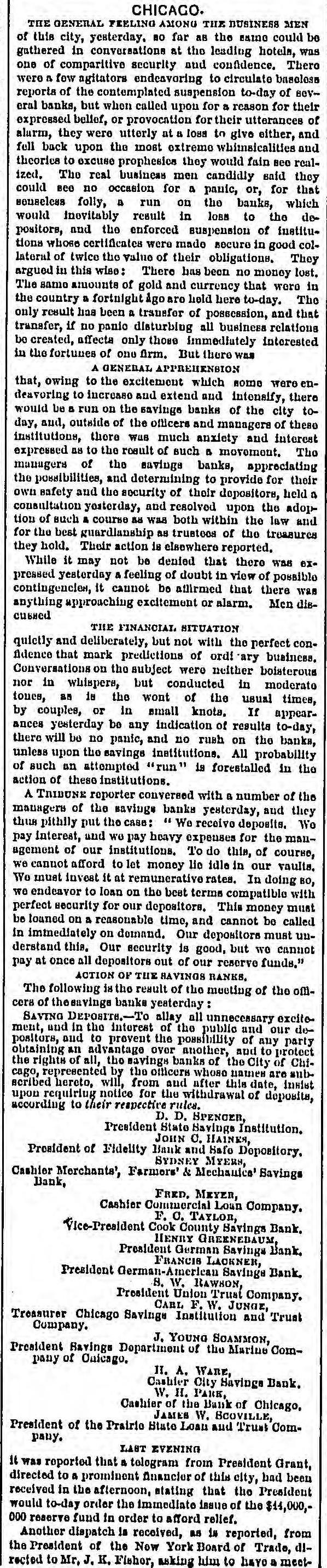
argued in time The same amounts of gold and currency that were in the country a fortnight Ago aro hold here to-day. The result has been A transfer of if no panio disturbing all only transfer, possession, business relations and that be created, affects only those immediately interested in the fortunes of one firm. But there was A GENERAL APPREHENSION that, owing to the excitement which some were endeavoring to increaso and extend and intensify, there be a run on the savings banks of the city tooutside of the officers and managers would day, and, and of interest these institutions, there was much anxiety expressed as to the result of such a movement. The of the savings banks, the and determining to managers possibilities, provide appreciating for their own safety and the security of their depositors, held a consultation yesterday, and resolved upon the adop& course as was both within the law and best as trustees of for tion the of such guardianship the treasures they hold. Their action is elsewhere reported. While it may not be denied that there was expressed yesterday & feeling of doubt in view of possible contingencies, it cannot be affirmed that there was anything approaching excitement or alarm. Men discussed THE FINANCIAL SITUATION quietly and deliberately, but not with the perfect confidence that mark predictions of ord! ary business. on the subject were in but conducted nor Conversations whispers, neither in boisterous moderate touce, as is the wont of the usual times, by couples, or in email knota. If appearances yesterday be any indication of results to-day, there will be no panic, and no rush on the banks, unless upon the savings institutions. All probability of such an attompted "run" is forestalled in the action of these institutions. A TRIBUNE reporter conversed with a number of the of the savings banks yesterday, and they the case: We receive and we pay heavy expenses mallmanagers pay thus interest, pithily put deposits. for the We agement of our institutions. To do this, of course, we cannot afford to let money lie idle in our vaults. We must invest it at remunerative rates. In doing BO, we endeavor to loan on the best terms compatible with for our depositors. This money must on a reasonable time, and in on domand. Our unperfect be immediately loaned security depositors cannot be must called derstand this. Our security is good, but we cannot pay at once all depositors out of our reserve funds." ACTION OF THE HAVINGS RANKS, The following is the result of the meeting of the officera of the avings banks yeaterday : SAVING DEPOSITE.-To allay all unnecessary excitement, and in the interest of the public and our depositors, and to prevent the possibility of any party obtaining an advantage over another, and to protect of the savings banks of the City of Chiby the officers whose names are hereto, will, from and after scribed cago, the rights represented all, this date, insist subupon requiring notice for the withdrawal of deposits, according to their respective rules. D. D. SPENCER, President State Savings Institution. JOHN C. HAINES, President of Fidelity Bank and Hafo Depository. SYDNEY MYERS, Cashier Merchants', Farmers' & Mechanica' Savings Bank, FRED. MEYER, Cashier Commercial Loan Company. F. C. TAYLOR, Vice-President Cook County Savings Bank. HENRY GREENEDAUX, President German Savings Bank. FRANCIS LACKNER, President German-American Savings Bank. 8. W. RAWHON, President Union Trust Company. CARL F. W. JUNGE, Treasurer Chicago Savings Institution and Trust Company. J. YOUNG SOAMMON, President Havings Department of the Marine Company of Calcago. H. A. WARE, Cashier City Savings Bank. W. II. PARK, Cashier of the Bank of Chicago, JAMES W. BCOVILLE, President of the Prairio State Loan and Trust Company. LAST EVENING it was reported that a tologram from President Grant, directed to & prominent financior of this city, bad been received in the afternoon, stating that the President would to-day order the immediate issue of the $14,000,000 reserve fund In order to afford relief. reported. from

Article from Knoxville Weekly Chronicle, October 8, 1873

Click image to open full size in new tab

Article Text

THE FINANCIAL CRASH. At the Stock Exchange. Diffenity. Looking to New York for a Solution of the NEW YORK, Sept. 30.-At the resumption of business at the Stock Exchange, Smith & Severe received cheers. The impression prevails that all the leading houses will pull through. is unsettled but improved. still Sterling M. The stock market is Western with3,P. excitement and closes firm. 91 out at 661: Rock Island, PaUnion Lake Shore. quoted 74} Union Pacific, 19g cific Mail, 33. was made in the order United enApplication Circuit Court to-day foran Currency States the Comptroller of the the Comjoining of the Bank of from proceeding and monwealth the Receiver also further for a citation in the of the vacated and the to matters show be cause the why bank, and Receivershipshould appointment that denot and void, on the ground of never refused to any notes. The clared the banks circulating null redeem citation October was 7th. its and made returnable is in motion and granted Money unlock the currency. events of it is hoped, will day the day, 2a3 premium early in the Money Sterling, big busines, but commision. Greenbacks, closed nominal. closed 61. at dull, No #a] special feature in gold. Governments nothing CHICAGO, doing. Sept. States 30. The/Union quiet. National bank has gone into liquidation. MEMPHIS, Sept. 30. At a large meeting mornof Commerce this a to consider the financial was received from resolution ing, at the Chamber the situation, would banks not of to the effect that they to the the city but would open in addition to be suspend, business, an exchange account moving usual in kind, for the purpose of cotton. paid Which was unanimously adopted by the Chamber. More Workmen Discharged. YORK, Oct. -The Grant locomo- dis NEW works at Patterson, New Jersey, 400 tive 170, and the Delaware tunnel of workmen, charged on account of the scarcity currency. The Cummings Car Company, trouble of Jer- is City, has suspended, the comthat sey a large amount due from railroad panies cannot be collected. WASHINGTON, Oct.1 -The financialsit- new closed yesterday, without any The liquidation of Bank of Chicago, a National features. uation had excitement. the Union rather depressing effect but caused looking to anxiety exists, and all are Much New York for a solution of the difficulty Oct. -Matters are orders proCINCINNATI, quietly, with more jobbing the and ceeding but little disposition to operate on usual large scale. Brighter Prospects, CHICAGO, Oct. 1.-The financial much situahere this morning presents a The tion prospect than yesterday. of currency million dollars being receipts brighter Some three continue reported deposits large. yesterday, while demands upon have aloff, in fact some banks are falling begun to furnish their customers The ready their usual accommodations. before with is that it will not be long channels. prospect will resume its wonted Bank that the Third business in a few It will business is resume stated National another days, proba- week. by the beginning of grain bly is much firmer feeling in the in market, There with an advancing tendency prices. Attempt to Force Jay Cooke & Co. into Bankruptry, PHILADELPHIA, Oct. 1.-In the Codwal- United Cates Circuit Court before Judge States order was granted last week upon Jay der, an of Edward Wilson to show why they a Cooke petition & Co., which against should was not to adjudicated bankrupts, continbe been returned to-day but was of debt ued have until next week at the request and by consent of the petitioner. ors NEW YORK, Oct. 1.-There was very feeling in financial circles to-day, event. quiet absence of any exciting suspended with firm an of Northrup & Chick influThe but the failure had no the Staock Exchange as ence on the suspension by the withdrawal of had this morning no stocks, deposits. being the caused in firm forwas another sharp advance leading There exchange to-day, and the 1071 for eign advanced their rates to bankers sterling, and 109 for sight, & sixty days suspension of Henry Clews Stock Ex. Co. was The officially announced in the change bank to-day. officers report that the coun- deThe for currency to be sent to the banks mand has fallen off. Several town have telegraphed to try out of banks others stop have fur- rether shipments and some York. turned greenbacks total amount to New paid on account at noon The with interest is $29,945.74 Beginning to Resume. MEMPHIS, Oct. 2.-The First National Bank has YORK, resumed. Oct. 2.-The Danford Loco- the NEW Works is only working half of in motive time. They have plenty of cashed. money but can't get their checks bank LOUISVILLE, Oct. The Planters' the Peoples' Bank and the Louis- from Bank, City National Bank, withdrew that ville Clearing House, on the combination ground; the was no necssity for a by there and the Clearing House was abolished mutual consent. HOME NEWS.


Article from Chicago Daily Tribune, July 12, 1874

Click image to open full size in new tab

Article Text

LOCAL MISCELLANY. THE BANK OF CHICAGO. The Bank of Chicago, formerly the National Loan and Trust Company, is no more. Although 1 survived the panic, fate has overtaken the institution, and it ie, virtually, no more. This bank was started several years ago by a stock company, and obtained a liberal charter. One depaitment was devoted to general business, and another to savings and special deposits. Suits have been brought against the concern, to compel delivery of small deposits, in several of the Justices' Courts, but no definite result has been reached in any of the cases. Friday THE BANK WENT INTO LIQUIDATION, and Mr. 1. P. Coates was appointed Assignee, with full power to convert the assets into cash. A TRIBUNE reporter was detailed last evening to interview MR. THOMAS H. ELLIS, President of the defunct institution, relative to the entire business. He found Mr. Ellis at his residence, No. 448 West Washington street, and Ellis, I have come from THE out how that assignment of had ther following conversation with him: your bank property was arranged? Mr. Ellis-1t was done in the interest of all depositors. Suits have been brought against us from time to time, and, although we have paid about $450,000 out of our own resources, many claims remain still unsatisfied. This being the case, #0 thought that the most honorable course to pursue would be to hand all our assets over to some first-class man. with power to pay every claim, without preference, 80 far as the money would go. Reporter-Your bank came through the panic all square? Mr. Ellis-Yes, but for all that the panic affected it. We found it impossible to collect outstanding accounts, and one bank in this city still holds $52,000 of our money, and will not give it up. Reporter-Have you any objection to naming that bank ? Mr. Ellis-It is the Third National. There is a controversy between us, but Mr. Coates will soon settle the matter one way or the other. Reporter-Your bank has formally suspended? Mr. Ellis-Yes; we have only received special deposits for some time. I request you to state that we made the unreserved consignment of all our property to Mr. Coates for the best interests of all our depositors and creditors. Reporter-Theie is no chance of resumption then? Mr. Ellis-None at all. The stockholders have all lost heavily, very havily some of them. We shall be satisfied if we can meet the claims upon us. We are willing to give up everything. MR. COATES. A reporter also called upon the Assignee, Mr. IssacP. Coates. at his residence on Michgan avenue. near Twenty-fifth street. He stated that he was appointed Assignee Friday afternoon, and immediately thereafter closed the bank. and locked up everything. He had not vet examined the accounts of the institution, but there were considerable assets, consisting of 10:es, credits, and real estate. There was no cash on hand when the assignment was made. If the assets were all good, the creditors would love very little. The bank had been doing a very small business lately, and they had been gradually liquidating. He would have the accounts and books examined immediately, and give a full statement of the affairs of the bank to the public as soon as possible.


Article from The Andrew County Republican, July 24, 1874

Click image to open full size in new tab

Article Text

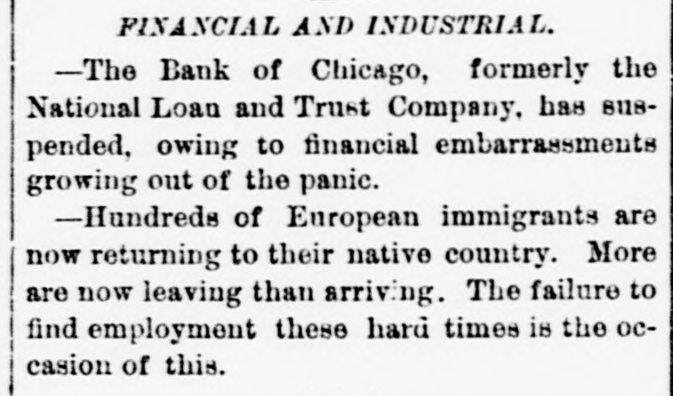
FINANCIAL AND INDUSTRIAL. -The Bank of Chicago, formerly the National Loan and Trust Company, has suspended, owing to financial embarrassments growing out of the panic. -Hundreds of European immigrants are now returning to their native country. More are now leaving than arriving. The failure to find employment these hard times is the occasion of this.


Article from Chicago Daily Tribune, May 20, 1875

Click image to open full size in new tab

Article Text

nance on the Tremoval of night-soil, which was 1 laid over. Adjourned. h THE COURTS. $ a Faint Hope for the Creditors of the T Hank of Chicago-Judgments and & New Mults. The Bank of Chicago better known AR the National Loan and Trust Company, in connection with the State Insurance Company, had its day in court yesterday to the disgust of its former Assignee, Issac P. Costes. When the bank went into vol1 untary liquidation it assigned all its property to Mr. Coates for the payment of its creditors. But 0 they fallod to get paid as fast an they desired, and one of thom, Alexander Cunningham, filed & creditor's bill on behalf of himself and all other creditors who chose to Join. Some time after, D. L. Hough, Esq., was appointed Itecolver by Judge Moora. Mr. Coates, howover, claimed be had the Lost right to the bank's property, and refused to delivor it over. A motion was made Tuesday for a rule on him to surrender. and yosterday Judge Moore decided it by granting the rule desired. It was claimed on the part of the complainant in the creditor's bill that Mr. Coates was in effect play.ug into the hands of the bank officers, and had grossly neglected to do his daty, and also that individual creditors had been taking care of their private interests ability. by suing the stockbolders on their individual liBy the order of the Judge, Mr. Coates is required to surrender every book or paper and all assets of every kind he may have belonging to the bank, and the unfortanate policy-boide.s of the State Insurance Company may hope to get & sinal drop or comfort in due titne. DIVORCES. f Henry B. Brush complains that bis wife, t Marian. has descried him, and ne therefore asks for a divorce. UNITED STATES COURTS. William Graif began a muit for 83,500 against T. C. Es.or, P. C. Goble. and W. R. England. BANKRUPTCY ITEMS. e Richards. Shaw, Fiten, & Winstow, claiming $403.97, and Eddv. Harvey & Uniter, claiming $75, filed au involuntary pasition agains; U. 11. Hatlated, a merchant of Morris, LII. They 5 charge that the debtor, about the 1st of May, made a traudulent assignment of all his gooda to Samuel Ward. A rule to show cause May 31 and injunction were Issued. or Sidner P. L. Underwood, a member of the Board of Trade, Illed # Detaion to 00 declared & 2 banarupt. ะฆะฐ schedules show dobts amounting to about $35,000, and no assots to meet them. of The bankrupt was a insurer of Underwood, Burton & Co., and also of Underwood, Herron & Co. The CABO was referred to the Register. Smith. Jacob Gale WAS appointed Assignee of J. G. SUPERIOR COURT IN BRIEF. n, Horace Burton sued isaac Myer, W. Forrey, and Janies Baxter for $1,200. 6 Fried & Co. began a Buit for $2,000 against Isaao S. Rosebury and C. 11. Faich. er CRIMINAL COURT. William Armstrong pleaded guilty to the lar0ceny of two colls, and was seatenced to three 00 years at Joliet. Another indictment for bur0glary was stricken from the douzet, with leave to reinstate. d Matthew Barth pleaded guilty to burglary, and was remained for sentence. Another indict11, docset. ment for the same offense was stracken from the Charles Baker pleaded guilty to the larcenv of a sot of HAID from A. and A. Gran 115, and was sentenced to cighteen months in tuo l'enttentiary. It John Purwick was tried for the larceny of leadhe pipe from the home of Samiel Jacobs, found y, nguilty, and went to the Helorin School for four years. of & Mary Mallen pleaded guilty to the larceny of be two pieces of eno:u from T. Puolps & Co., and was remained for sentence. John Home was thed for the larceny of n via 10 quantity of clotuing, lound guilty, and remandod for sentence. of In the case of William Wray, for burglary, he mation was made for continuance, and the case m passed until the 23th inst. The attorneys of B. K. Turner, the alleged IEdeed-forger, were in couit vesterday to argue by the motion for a change of venue. The motion was passed until this morning. go The Grand Jury was discharged at noon of yesterday withou: completing the investigation of the Weich-Davian Casj, owing to the ausence all of material witnesses. The caso will occupy the nd attention of the next jury. THE GALL. JUDGE Garr-177, 187. 191 103, 193, 190, 200, 201, 203, 205 to 203, 210 to 214. JUDGE JAMESON-38, 42, 12ยฝ, 15, 40, 49, 51, 53. 031/2. 54 to G4. JUDGE Moons-40, 47. 48, 40. all Lie Judoa Roomas-146, 117, 153 to 175. JUDGMENTS. Supraion COUNT-COSPLSON-Haiman Lowry vs. Thomas S. Dickurson, $163,57,-Pridp Russed V3. of Menry and Freder.cke Breyer, $131.52 to JUDGE GART-U. M. Stemuardt 0: al. vs. John I. Wildams, $317.-F. M. Hale et at VS. Francis E. Hinckley, $1.1.-Urane Brothers Manufacturing Company als vs. Onicago Class and Water Works Construction Company, $3,000,21,-Jatnes McGinley, use of J. T. Mo. he Cord vs. Horace A. Huriburt, J. G. Curtise, E. F. std Lawrence, and Rodman Carter, $70). Cincuir COURT-COWFESSIONS-John Rowle VS. August C. H. Kraft, JUDGE Rooras-National Bink of North America vs, Nathau Blayer, debt $345,002.43, and damages $3,170.71. entire.-Daniel Metwen VA. A. T. Daty, $103.Citizens' National Bank of Fairbault Va, Ira Hohnes, $3,418,05,-11.1 I. Morgan vs. Thomas D. Boyder and the J. L. Los, $1,173,75,-John Knight vs. John Eabert, $1,1 9.40.-Handy, Simmons & Co. vs. George R. Clarge, Rouben P. Liyton, and O. P. Hilva,$130,-J. F. Norton YS. Monroe W. Johnson, $580.60.-L. B. Shepard et al., va. Francis cas Agnew, Jacger. $1.0.0,05 $204.10.-Thomas Nicholes et al. vs. Henry


Article from Chicago Daily Tribune, January 21, 1879

Click image to open full size in new tab

Article Text

THE COURTS. Liability of the Stockholders of the Bank of Chicago. Record of Judgments, New Suits, Criminal Business, Etc. Judge Moore yesterday was treatedtoanother section of argument on the motion for Injunetion by the Receiver of THE BANK OF CRICAGO against the depositors who are seeking to sue the stockholders. The case has assumed consuderable importance to the stockholders of the various defunct banks of this city, and over a week ago Judge Moore requested the attorneys in the case to notify the attorneys of the Fidelity, State Savings, and " Bechive " banks to come In and take part. They did no: appear last Monday, when the argument began, and it was then continued until yesterday. The questions are. to whom are the stockholders liable, whether to depositors Individually or to the Receiver, and whether such liability is to be enforced at law or In equity. In the case of the Bank of Chicago, however, still other questions are raised as to the legality of the incorporation of the bank, and whether its stockbolders are not liable ns partners. Incidentally, also, objections are made to the form of the petition of the Receiver, which is filed for the purpose of enjoining the prosecution of suits by depositors against the stockholders, and to enforce the charter liability against the latter for the beuefit of all the creditors. The arguinent yesterday was only a continuation of that made a week ago. The bill was filed a couple of months ago, and a motion for Injunction made and argued at Intervalsof about once a week ever since. Shufeldt & Westover appeared for the creditors who are suide the stockholders, Gen. Thompson and Edwin Walker for the bank, and 0. K. A. Hutchinson and Alfred B. Mason for stockholders. Mr. Charles Hitcheock was also present on behalf of the Fidelity Bank, and J. L. High for the State Savings Institution. The argument was then taken up de novo, as though It came up for the first time. Mr. Edwin Walker stated the object of the bill, and asked for an injunction. Mr. Shufeldt claimed that the Receiver was not In a position to ask for such relief. because the original suit of Cunningham vs. The Bank of Chicago, on which the present petition was based. had never becu prosecuted to final decree so as to make it necessary for the Receiver to go on. The creditors had chosen to take auother mode for relief by individual suits. The oustanding liability of the stockholders was $119,000, of which $84,000 was held in New York. Creditors representing $131,000 of claims had begun suits. and still more were seeking to come In. A number of ailidavits by different stockholders and others were then read, a synopsis of which was published in THE THISUNE about two weeks ago. Gen. Thompson read the affidavits of A. A. Munger and Reuben Hatch denying the charge that they had conspired with the Receiver, and stating that they wished whatever WAS due from their to go to all the creditors as 11 whole. They also alleged that Shufeldt & Westover were to get trum 50 to 1.) per cent on all claims recovered by them against stockholders. Mr. Walker followed on behalf of the Receiver. He stated the stockholders did not expeet to excape from their just liability, but wished to have their money go for the benefit of all the creditors. They should have their Habillty enforced in one case, 60 the Receiver could collect It for all the creditors. A court of equitv bad jurisdiction as well as a court of law in such a case, and the former had is right to restrain the prosecution of individual suits, atthough it inight not Interfere with the prosecution of common-law suits to Judgment only. The arguments were not concluded, but were postponed for another week to give the Judge an opportunity to hear another sites. DIVORCES. Elisa Cortes filed her Dill vesterday against her husband, J. Henry Cortes, charging him with cruelty and drunkenness, and praying for a divorce. Frank Rehm also asked to be released from his obligations to his wife Frances, she having deserted him over three years ago. Next came Lucy A. Corse, who claims to have been a faithful and loving wife to Cyrus J. Corse from July 15, 1569. to November, 1874, when she was obliged to leave him on account of bis repeated and glaring marital indellity. And he-wants a divorce for that reason. Eliza Jane Brooks has M husband named James Brooks at one time, James Rosso at another, and James Russell on still other occasions. This makes it difficult for visitors to tind his address In the directory, and she prefers a man who has only one cognomen. Jaines is now spending the whiter In the neighboring village of Juliet, having been convicted of attempting to proctire an abortion. He will not be home until next autumn, and Mrs. Brooks Rosso-Russell desires to foreclose any equity of redemption he may have to her services when he is released. Lastly, Lucy M. Schuttler complains that her husband John has repeatedly tried to kill her or throw herout of a window becauseshe wantedto attend church. She thinks the timeof religious persecution is over in this country, and asks to be allowed to pursue her convictions without hindrance from him. ITEMS. John Flynn, who was indicted come time ago by the Grand Jury in the United States District Court for passing counterfeit bank-notes, yesterday withdrew his nica of not guilty and ontered one of guilty before Judge Blodgett. Itis attorney then represented that the prisoner was in III health, and that a petition was circulating for his pardon, and the Judge agreed to postpone sentence until the petition for pardon can be sent on to Washington. Martin Blaedel. Indicted for robbing a postoffice. pleaded guity, and entered into a recorINZADCO in the sum of $500 for his appearance. None of the Judges of the Appellate Court put in an appearance yesterday in court, and it 14 not known whether they will be In to-day, or bether any opinions will be given. A discharge was issued to Sidney P. Walker yesterday. C. D. Lusk was appointed Assignee of Wallace Warren, and John T. Barrow of William Chappel. A first dividend of 18 per cent was declared in the case of J. II. Vicker. Asisgnees will be chowen this morning for A. H. Walker and Anderson Minor.


Article from Chicago Daily Tribune, January 22, 1879

Click image to open full size in new tab

Article Text

THE COURTS. Decision in Regard to the Bank of Chicago Suits. A War Between the Commercial Agencies. Record of Judgments, New Suits, Criminal Business, Etc. Judge Moore has been engaged at intervals for some weeks hearing arguments on a motion for Injunction by the Receiver of THE BANK OF CHICAGO to prevent the creditors of the bank from prosecuting sults against the stockholders, and yes. terday morning he granted the Injunction as asked. He said when the motion was Drst made In the creditor's bill of Cunningham against the bank, be had some doubts whether the Hability of the stockholders was an asset, but the question since then had been repeatedly argued in the Superior and Circuit Courts, and the Supreme Court in the Lamar Insurance Company case had referred to See. 21 of the chapter on Corporations, In the Revised Statutes. That provided, among other things, that, If n company allowed a judgment to go egainst It and an execution to be returned No property found," suits In equity might be brought against the stockholdcrs, and each stockholder might be required to Day his pro rata share of such debts to the extent of the unpaid portion of bis stock, after exhausting the assets of the Company. The Supreme Court had held that the sult was brought under that section of the law. In the present Instance all the suits to be enjoined were suite at law, and there was no doubt but that such sults would lie against the stockholders under the provisions of the charter. But suits in equity could also be brought, and both prosecuted together, until floal decision in one case or the other, and when the money was paid once that was the end of It, and the stockholder was released. The Judge did not think the numerous cases cited had any application, for the present ault was sustainable under Sec. 25. The original auit was a bill against the bank and the stockholders, and the present was only a bill for Injunctions to prevent other parties from Interfering with the Receiver In hisefforts to enforce the liability of the stockholders. The assets ought to be divided among all the creditors. The stockholders had no right to ask for nn Injunction to prevent suits against them unless they deposited in Court the amount for which they were liable. They had complained of the heavy costs and prolonged litigation,but they were themselves the cause of It. He did not think there was any truth In the charge of conspiracy by the Receiver with any of the stockholders, but he regretted that eteps had not been taken earlier to recover the amounts due from them. The Judge asked what would be the effect of on Injunction on suits against the New York stockholders. Mr. Shufeldt thought the injunction would have DO effect against them. Mr. Walker and the different attorneys for the stockholders here were of the opinion that New York courts, out of comity, would stop the prosecution of such suits when they knew that an injunction bad been issued here. Mr. Westover admitted for the purposes of the motion that the bank had been properly organized, 80 that its stockholders were not llable as partners. A long discussion then followed, in which all took a hand, as to the form of the injunction order, and whether the stockbolders must first deposit the ir money In court. Finally Judge Moore directed the different attorneys to prepare two orders, requiring the payment of the money as a condition precedent to the Issuance of the injunction, and the other r without that stipulation. and submit them both to him this morning. If the parties could agree, the order would be entered at once. The probability is that the partics will not agree. and that the morning will be consumed in another argument of the same question. In the case of the State Savings Bank. on a similar petition of Judge One, the Receiver, Judge Farwell refused to hear the argument. on the ground that Judge Williams was more familiar with the matter. The case was originally brought before Judge Williams, but sent by him to Judge Farwell to be heard, and the latter thus sends It back again. TAPPAN, M'KILLOP & CO. ^ bill was tiled yesterday In the United States Circuit Court by Theodore E. Leeds, of New Brighton. N. Y., against Tappan, McKillop & Co., of this city, Rand, McNally & Co., The MeKillop & Sprazue Company of New York, and T. M. Rianbard (Receiver), and George P. Gifford, of Wisconsin, to restrain the Issue of the Commercial Agency Register by Tappan, McKillon & Co. Complainant states that the MeKillop & Sprague Company were until intely the owners of the Commercial Agency Register, a book which is published at Irregular Intervals, and designed to give the commercial standing of merchants and traders throughout the country. The first number was published in July, 1876, and the last in July, 1678, and in the interval thirteen numbers have been issued, all of which were copyrighted In due form according to law. In October Inst the McKillon & Sprague Company falled, and Thomas M. Rianhard Was appointed Receiver, and took possession of all the Company's assets. including the above copyrights. In December last he sold the latter to complainant for the 8750 cash, and the assignment Was recorded with the Librarian of Congress. These books, It is charged. ere com-


Article from Chicago Daily Tribune, January 24, 1879

Click image to open full size in new tab

Article Text

bank and which owed, $155,305.47 a left then balance was there of $19,239.50. This was applied on the amount owing by the bank on the MeArthur account, leaving still due $18,090.02 of postal funds and $7,248.03 of money-order funds. At the same time, also, the Secretary of the Treasury held $100,000 of bonds deposited by the bank to secure Its circulating notes, and, the bank refusing to redeem them, the Comptroller declared the bonds forfeited, and used part of them to take up the notes. There is still n balance of $80,000 on this account in the Treasury, and a further balance of over $30,000 which has been collected during the settlement of the bank's affairs. This will be more than enough to pay all the indebtedness due the Government. The latter, however, does not know whether its claim is a preferred debt against the bank. which can be paid out of the balance in its hands, or whether the money should be paid over to the Receiver. to be distributed pro rata among all the creditors. In this dilemma IL asks for an account of the amount due it from the bank, and for a decree explaining and establishing its rights In the premises. THEY WANT TO BE RELEASED. In the case of Cunningham YS. The Bank of Chicago, a petition was filed yesterday by Alex McCoy and L. (1. Pratt, stating that they are two of the sureties on the $50,000 bond given by D. L. Hough as Recolver of the bank. Since the execution of the bond, Cunningham, the plaintif. has abandoned his suit In chancery and begun one at law, and the Receiver has taken some steps which they hadnot anticipated. They therefore with to be released from their liability as sureties. THE MARINE COMPANY. The Metropolitan National Bank of New York commenced a suit Wednesday in the Circuit Court against William II. Dunbar, James Goodwin. William Lebaum, Joseph M. Marsh. Thomas Murris, Abijah C. Perkins, Jerusba C. Pomeroy, Mrs. S. Richards, Mrs. R. C. Richardson, Mrs. R. C. Richardson, guardian, Sampson Reed, Joseph S. Reed, Elizabeth Reed, James Reed, Samuel S. Rogers, Mrs. Ann P. and Henry K. Sheldon, John L. Sibley, Israel Sheldon, Florence R. D., Amanda E., Mrs. M. S., and J. Y. Scammon, Solomon A. Smith. Charles M. Besver, C. M. and B. F. Seaver, trustees, Daniel Underhill, the Rev. Thomas Worcester, Mary WIIletts, Mrs. F. A. Whiting. Increase B. Wheeler, Increase 8. Wheeler, trustec, J. G. and D. L. Webster, trustees, J. J. Willetts, Foleman Wheeler, Daniel Willetts. Moses J. Wentworth, John A. Appleton, Henry Larcom, Abbott, Rebeeca W. P. Buckley, C. O. Brewster, Coddington Billings, Mary A. Brownell, George M. Hogue, Jacob Butler, Mrs. Samuel N. Clark, Calvin Clark, D. Luther Clark, Catherine P. Carter, Eliza F. Copeland, Emily Carter, Mrs. William J. Cutler, Matilda F. Clark. J. II. H. Carter, trustees; David Dows, Harriett 8. Dodd, Maria B. Doolitte, Charles E. Ebert, John Forsythe, Lydia llobart, Tilly B. Hayward, Lechmere National Bank, Lincoln Life-Insurauce Company, E. B. McCage, New Jerusalem Society of Boston, Mrs. Mary K. Peck, Walter L. and Clarence J. Peck, and Benjamin W. Raymond, who are characterized as partners under the firm name of The Marine Company of Chlcago, The damages are laid at $200,000. Only the praceipe was filed, but It is well known the Metropolitan National Bank was a large creditor of the Marine Company when it falled, and failing to get paid has sued the stockholders. The sult is under the recent decision of the Supreme Court to the case of Levache vs. McCarthy, the ground being taken that the bank was never properly incorporated, and that its stockholders are liable as partners. This same point, It will be remembered, was urged In the Bank of Chicago case, recently before Judge Moore. A BANK AS WAREHOUSEMAN The Illinois Trust and Savings Bank filed a betition yesterday in the Circuit Court stating that It is the manager of the Noely & Hambleton Elevator, Class A, on behalf of the owners. Albert E. Neelv and Joseph W. Hambleton, and that It desired to take out a license as provided by law to operate such nn elevator. Judge Williams ordered the license to be issued, the bank giving a bond in the sum of $10,000, with William H. Mitchell as surety. DIVORCES. The divorce-mill has been unusually active this week, probably because parties whose domestle affairs are unsettled or inharmonious are anxious to get them straightened out before the time of house-cleaning and moving. The first applicant for relief yesterday was Anos Homann, wbo charges her busband, Charles Homann, a saloon-keeper at 108 West Lake street, with sampling his own liquors too generously for his OWD good or her comfort. The next was Lotta L. Walts, whose husband, Edward B. Watts,deserted her in January, 1875, about nine months after their marriage, and has since then been living with other women. Next came Mary Edgerton, who has lately become convinced that ber husband, John M. Edgerton, has been unfaithful to his marriage vow. Stie left him on that account, and now asks to have the separation legalized and made flust. This Unished up the list in the Superior Court, and the Circuit Court then took a band. The first sult of the day was a bill for divorce by Elizabeth Edwards, who says that she faithfully performed her wifely duty to James L. Edwards from their marriage in July, 1873, down to January, 1875, when he cloared out, and the last she heard of him he was in Callfornia. She also accuses him of cruelty and failure to provide for her or the children, and asks for the usual decree. Edith O. Warren complains that she has been obliged to support herself the past two years owing to the desertion of her husband, Louis B. Warren, and she falls to see why she should bear penses. his name when be does not bear her exLastly, for there must be an end to everything, Catherine M. Oberhoff put in ber complaint that ber busband left her in December, 1st2, six months after their marriage, and has not found his way back: She has kept the Tatch-string bung out up to the present time, but now she announces her intention to pull It 10, and be "Dot at home " If be comes back. UNITED STATES COURTS The Remington Bewlog Machine Company bezan a suit la debt yesterday against Elijah Tracey, claiming $1,500. The Singer Manufacturing Company brought suit in debt against Albert Decker and R. J. Hanna to recover $2,000 damages. Maria M. Chapman Candide filed a bill against Julia and George E. Hall, A. S. Barnes, trustee. and others, to foreclose a mortgage for $2,000 OD Lots 2 and 3, Block 3, of Webster's Bubdivision of Lots 3 and 4, Block 45, in Canal Trustees Subdivision of Sec. 21, 89, 14. SUPERIOR COURT IN BRIEF. Frank Schnenemann tiled a bill yesterday against his partner, August Leuke, asking for a settlement of the coal business in which both were engaged from April, 1576, to June, 1878. Preston, Kean & Co. the bill against Mary


Article from Chicago Daily Tribune, February 4, 1879

Click image to open full size in new tab

Article Text

DISBURSEMENTS. $120 Paid dividends 263 Attorney's fees 25 Real extate Office rent 15-$ 424 Balance on hand. $1,263 RESIGNED. Mr. D. Hough, Receiver of the Bak of Chicago, filed his written resignation yesterday before Judge Moore ะ”ะ’ Receiver of the Bank of Chicago. He stated that there is a prospect of long litigation, that the estate has no funds, and he does not wish to advance any funds and take his chances of reimbursement. He also dovetalled in some hits at McCoy & Pratt, who were on his bond, but who withdrew, and indulged In several sharp remarks against Shufeldt & Westover, "disreputable atturneys," who were trying to interfere with him In the discharge of his duties. Mr. Shufeldt objected to the term applied to bim, and Judge Moore ordered it to be stricken out as Irrelevant. No action was taken on the resigns. tion. In the afternoon, a motion was made by Mr. Shufeidt to dismiss the original bill filed by Alexander Cuoningbam for want of prosecution. It was commenced four years ago and had never been finally closed up. Judge Moore declined to accede to this request, saying there was no ground for making such a motion, but be made MII order requiring the proofs on the accounting before the Master to be closed in thirty days. lle also allowed George Taylor, as Trustee of the city, C. J. Hansen, and several other judgment-creditors of the bank, whom claims amount to over $16,000, to come In not be made co-complainants. MANTON, SAWTER & CO. E. Clarence Hover filed tiis bill against his partners, Jeremiah A. Mauton, Edward T. Sawyer, and George H. Waterman, to wind up the aftairs of the firm. He says that In August, 1870, be went into the dry-goods, commission, and brokerage firm of Manton, Sawyer & Co., contributing thereto $10,000 cash. The firm has steadily lost money ever since, and on the 1st of January last its debts were $80,000, while its MSacts were only $13,000. Complainant has frequently advised the firm to make a general ussignment, but they have refused, and also deellne to make any account, and he now asks a Court to step in and close up the firm affairs and appoint a Receiver. DIVORCES. Eather Isabella Johnson, nee Sones, filed a bill yesterday, in which she told what a mistake she made In marrying a circus-rider. She DATA she was married in May, 1875, to William F. Johnson, and lived with him until March, 1575, when he deserted her, and has not since returned. During the time they lived together he frequently abused her, kicking and choking her on various occasions. 110 is a gymnast and eircus-rider, and the equestrian manager of Van Amburgh's Circus, at 14 salary of $1,000 a year, and she thinks he is abundantly able to support her in good style. Bhe therefore prays for 11 divorce, for sultable allmony, and for a decree allowing her to resume her malden name. Alexander Brown recites as " reason why he should have is divorce that his wife Mattie E. has on divers days, unmindful of her marriage VOWA, committed adultery with divers persons. Lastly, Helen A. (lates complains that her husband, Fordya Gates, has been exceedingly remiss to his duties toward her. Instead of caring for her as be promised, be has devoted all his earnings to liquor, and has left her to support herself while he was running with other women. All of which 1s sufficient to show that she should not be compelled to live with him any longer. ITEMS. Judge Drummand was cugaged yesterday in hearing a number of motions in the caso of Turner Vs. The Indianapolis, Bloomington & Western Retiroad Company, which comes here from Indianapolis. In the case of Patterson vs. Stewart, & motion was made before Judge Furwell yesterdev afternoon for a rule on II. L. Stewart and George M. Pullinan to furnish bonds for the faithful performance of their duties, and to protect those interested in the estate. The Judge thought he had already sufficiently MXamined Into the caso to ascertain that there Was no necessity for such au order, and he Hirdied to make any such rule before the tinal hearing: In the case of L. L Mills ex rel., etc., VN. A. B. Condit, The Town of Luke, and others, 8 suit to combel Condit and the other officers of the


Article from Chicago Daily Tribune, March 12, 1879

Click image to open full size in new tab

Article Text

The Tremont House, and Bryant & Stratton's College. Record of Judgments, New Suits, Bankruptcy Matters, Etc. H. W. Jackson, Receiver of the Third National Bank, filed B report stating that William Steuges, bankrupt, owed the bank $59,031, which was partially secured by eighteen Receiver's certificate for $1,000 each of the Burlington & Southwestern Railway, Linneus Branch. S. J. Walker, also a bankrupt. also owed the bank $188,030.16, partly secured by ten bonds of the same road. The Receiver has extensively advertised these securities for sale, and the best offer he could get was 001/ cents on the dollar for the certificates and 101/1 cents on the dollar for the bonds. After conference with various parties, he sold the securities for this amount to Smith Bros., of Boston, and now asks to have this sale confirmed. An order to that effect was accordingly mode. The Receiver also filed a petition to be allowed to sell an undivided 27 of the 8. W. 1/4 of Sec. 28, 30, 18, except that portion thereof be. longing to the Chicago, Burlington & Quincy Railroad Company, and excepting also that DRT of 10 X 'M '8 Plus only 10 % 'M only 10 ยฝ "At que Scc. 28, lying south of the above road, which la subject to a trust-deed for $13,000. He bas recelved an offer of $400 per acro cash for the land, and he was authorized to sell at that figure. THE BANK OF CHICAGO. A couple of weeks ago Judge Moore made an order restraining Buits by individual depositors against the stockholders of the Bank of Chicago, but directing the Receiver to go on and push the stockholders to a settlement. The Receiver had before that time illed a petition against the stockholders to compel them to pay up, and yesterday Mrs. Marion Munger, one of the stockholders, filed her answer. She denies totally all the charges ngainst her, and claims, first, that she never was a stockholder in the bank. Second, that, If she ever was a stockholder, she sold and transferred all her stock and gave notice thereof, as prescribed by law, more than three months prior to the institution of any sult against her on that account, and she Insists such limitation is a complete defense both against creditors and Receiver. Third, that suits of individual credItors of the back against her to the amount puu 'Supuad are more pun 000'00$ jo such creditors assert that the commencement of a suit fixes the liability in favor of the plaintiff first commencing, and therefore no order for the payment of the money asked for by the Receiver could be made without making all such creditors partics. Fourth, that she has many other defenses against the claim. Lastly, she professes her extreine willingness to meet her obligations, If any, to the bank, and wishes painquisled oq Sour Jan more onp uins Sun 1007 protects ans anq Manuary DU up on 01 show pan has Japan Assistment Aun bence dismissed with her costs. MILL somes 'SA "[" 10 anounds "V 'V JO 0803 off) up Couch, Judge Farwell yesterday appointed Bradford Hancock Receiver "of all the property, equitable interests, things to action, and effects of the defendant, James Couch, belonging or in any way appertatning to him at the time of the commencement of this action." An order was also entered for the appearance of Couch before a Master In Chancery to make the necessary deeds, and to submit to any examination that may be wished to be made of his property. This, of course, includes the Tremont House, but subject to any existing tense to Rice, 80 that Haneock's duties in that respect will only be to collect the rents of the hotel. The amount of the bond which Hancock is to give has not yet been flxed. THE BRYANT & STRATTON BUSINESS COLLEGE. U PRID Robilition 0 ONG WHOM Maj V bill in the Superior Court against George K. Rix, impleaded with Henry B. Bryant and F. Q. Ball, to set asido an alleged fraudulent sale of the Bryant & Stratton Business College to Rix. Yesterday Rix filed his answer, in which Lic admits that be bought Bryant's interest in the College for $3,500, and has been running the school over since. Ile, however, claims he 31 una 01 person won puu wordbox VUM 11 II" pjud five years. 80 as to fulfill contracts for scholarship and tuition made by Bryant. Bryant also undertook tosell certain copyrights in schoolbooks used in the school, but he bad no power to make such transfer, and complainant expressIV disclaims any right in or claim to such copyrights. Rix further dentes that the purchase by him was a sham or colorable, or made to protect Bryant's interest, but charges It was made in the utmost good faith. That he was at first unwilling to buy as he had then R permanent situation as bookkeeper of the Clinton WireCloth Company with an ample salary, but finally consented by the desire of obtaining for bitnself A business of his own that be might work up. ะŸะพ also states that by his efforts the college has been Improved and been put into a more flourishing condition than It had enjoyed 01 Insurancess on on pum Teans's JOJ him is really for the Interest of the conditions, as the assignee of Bryaut has his notes and chattel mortgage, which are worth far more than the personal property of the collego would bring. He denies that he la playing tuto Bryant's hands or working in his


Article from New-York Tribune, June 21, 1882

Click image to open full size in new tab

Article Text

# A DEMURRER SUSTAINED. Judge Wallace yesterday rendered a decision sustaining the demurrer made in behalf of the defendants in the suit of Augustus Jacobson, the receiver of the insolvent Bank of Chicago, against John Allen, as executor, and others, stockholders of the bank. The act incorporating the bank contained a section providing that "each stockholder shall be liable to double the amount of stock held as owned by him and for three months after giving notice of transfers." The complainant was appointed by the Superior Court of Cook County, Illinois, as "receiver of all the estate, property and equitable interests of said bank." The decision says: "Unless the right of action to recover the statutory liability of stockholders was part of the estate, property or equitable interests of the bank it did not pass to the receiver under his appointment. Not only because of the allegation of the bill, but also from the inherent nature of a receiver's title, the complainant did not acquire the right to enforce the statutory liability if it existed only in favor of creditors of the bank and not in favor of the corporation." The decision concludes: "Neither a receiver, an assignee in bankruptcy, nor assignee under a voluntary general assignment for the benefit of creditors, each of whom represents creditors as well as the insolvent, acquires any right to enforce a collateral obligation given to a creditor or to a body of creditors by a third person for the payment of the debts of the insolvent."