Click image to open full size in new tab
Article Text
EVERHART REFUSAL TO TESTIFY
UPHELD BY JUSTICE SIDDONS
(Continued from First Page.) Roberts, bearing on financial rela- tionships between Fall and Sinclair and the Tres Ritos Cattle & Land Co. The witness balked on one ques- tion but answered after the court directed him to do so. The five questions which Everhart refused to answer on the ground of self-incrimination were: "Do you know of any loan to the Tres Ritos Cattle Co. made by Sin- clair in 1922?" "Do you know of any loan to Fall by Sinclair in 1922?" "Did you pay any bills for freight on cattle while in Sinclair's office in New York in 1922?" "Do you know of any transaction since February 1, 1922, between the Tres Ritos Cattle Co. and Sinclaire?" "For whom were you trustee of the 33 shares mentioned in this sheet?" This latter question dealt with a stock certificate of the land and cattle company upon which were written in Fall's handwriting "certificate of col- lateral, M. D. Thatcher, Pueblo Colo."
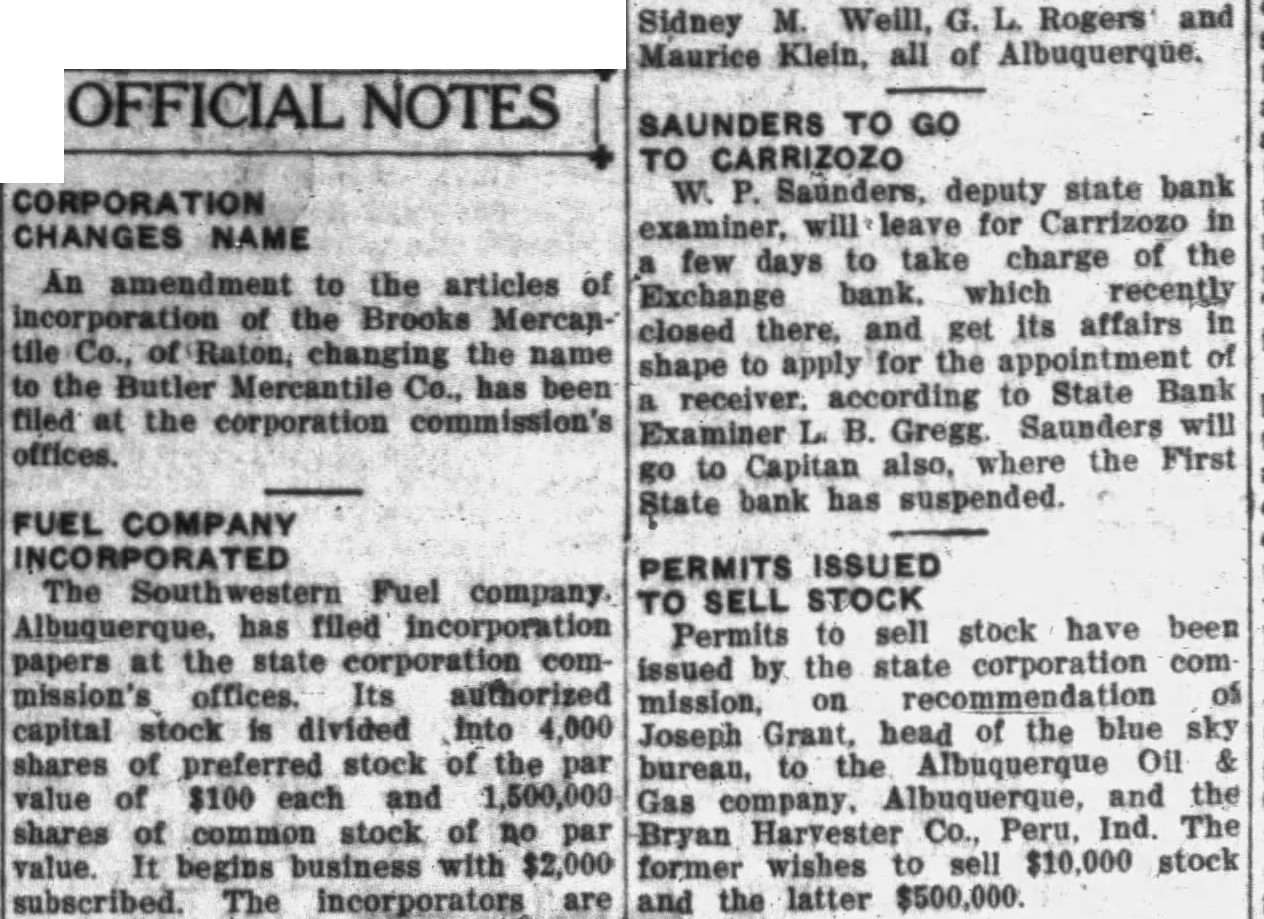
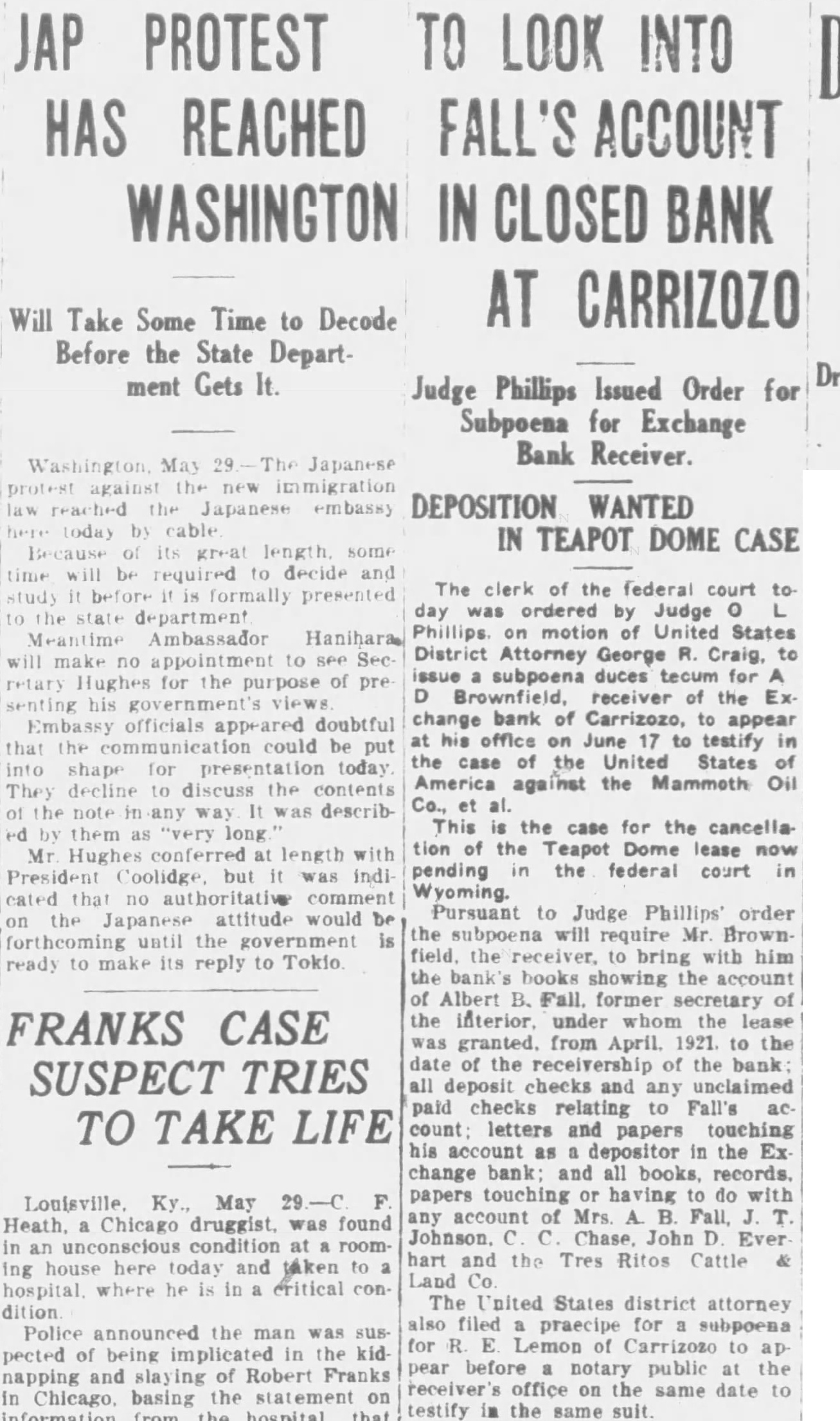
Refusals Sustained Again. A Government witness yesterday, who is an official of the Thatcher estate, testified the estate held some stock of the Tres Ritos Co. as col- lateral for an advanced loan. When Roberts sought to have the witness identify the handwriting he declined to answer, but Justice Siddons ruled that he should answer it. Whereupon he said, "Secretary Fall's, I think." Justice Siddons upheld the conten- tion of the witness that he should not answer the other five questions and he was finally excused. It cost the Government $253.40 to have Everhart refuse to answer ques- tions which the prosecutors deemed vital to their case. The witness col- lected that amount from United States Marshal Edgar C. Snyder after the left the stand. He has been in at- tendance on the court for 14 days at $2 per day, making a $28 witness fee. He was paid $3 a day for his subsist- ence for 16 days, including Saturday and Sunday when court was not in ses- sion, making another $48, and his mile- age fee amounted to $177.40, totaling $253.40. Everhart left this afternoon for Pueblo, Colo., his residence. Following Everhart's testimony Roberts produced numerous banking officials and employes and delved into the distribution of the $90,000 in Lib- erty bonds which turned up in Pue- blo, Colo., in May, 1922, in the hands of Everhart, according to evidence submitted yesterday. From the wit- nesses he obtained banking records referring to deposits of Liberty bonds and coupons, but when the noon recess was reached he had not connected these up coherently for the jury. From the testimony and document- ary evidence produced by the wit- nesses, it was shown that on Novem- ber 22, 1922, Liberty bonds in the amount of $15,150 were deposited in the First National Bank of Texas to the credit of Fall, and that on October 21 of the same year $5,000 in Liberty bonds were deposited to the defend- ant's account. Witnesses from this bank-J. E. Benton, vice president and cashier, and I. Gonzales, receiv- ing teller-testified that the numbers were recorded. Fall personally did not make the deposit, they said. On March 30, 1923, Liberty bonds in the amount of $50,000 were deposited in the Exchange Bank of Carrizozo, N. Mex., to the account of Fall. In addition, coupons valued at $875 were deposited. Proof of this action was given by A. D. Brownfield of El Paso, receiver for the bank at that time; R. E. Lemon of Carrizozo, then as- sistant cashier, and B. S. Thurmond, an employe, now living in Hatch, N. Mex. Testimony that 90 coupons of the first Liberty loan 3½ per cent were forwarded to the Federal Reserve Branch Bank, in Denver, in October, 1922, from the First National Bank of Pueblo, where $90,000 were deposited by Everhart in May, 1922, according to evidence yesterday, was given by B. A. Carlisle, assistant cashier of the bank, and Mrs. H. J. Smith of Pueblo, then a clerk in that institution. J. E. Olson, managing director of the Den- ver Reserve Branch Bank, gave testi- mony and documentary evidence that the coupons were received. Roberts next produced a receipt de- livered by Olson for $300,000 in Liberty bonds purchased from brokers for the Continental Co. by the Dominion Bank. This documentary evidence was pro- duced by Hector G. Henderson of Mon- treal, an employe of the Dominion Bank of Montreal, in whose New York agency the Continental Co. maintained an account. Various items entered into the ledger on April 13, 1922, showed pur- chases made for the Continental Co. of $300,000 of first United States Lib- erty bonds. The first entry showed purchase of $100,000 in bonds from Solomon Brothers, the second entry $100,000 worth from Walter Brothers and two additional entries of $50,000 each from Rhoades & Co. Henderson testified that he had made a note of the numerical numbers of each bond in the regular form and locked up in safe. "To whom were they delivered?" asked Roberts. "They were delivered to Olson on May 8," was the reply. "Did you get a receipt?"
Produces Receipt for Bonds. Henderson produced a receipt from the Dominion Bank's agency in New York signed by Olson. "Where was the delivery made " Roberts asked. "To the agents in New York." "Olson carried the bonds away," Henderson testified. "How were they wrapped?" "They were wrapped in brown pa- per, in a bundle," Henderson replied. At this point the coart interrupted examination of the witness, the hour of recess having arrived. Just before Roberts had hooked up the delivery of the bonds to Olson sev- eral other bank employes were put on the stand to identify Liberty bonds deposited in their banks. These witnesses included Mrs. Martha Anderson and Marguerite Trada of the Denver Federal Reserve Branch Bank. Preparing the way to producing evidence of the bonds delivered to Olson, Roberts put on the stand Rob- ert Ray of New York, employe of the New York agency of the Dominion Bank of Canada. "Did the Continental Trading Co. have an account with you?" Roberts asked. "It did," Ray replied. Ledger sheets of the account were produced to show Liberty bond secu-