Click image to open full size in new tab
Article Text
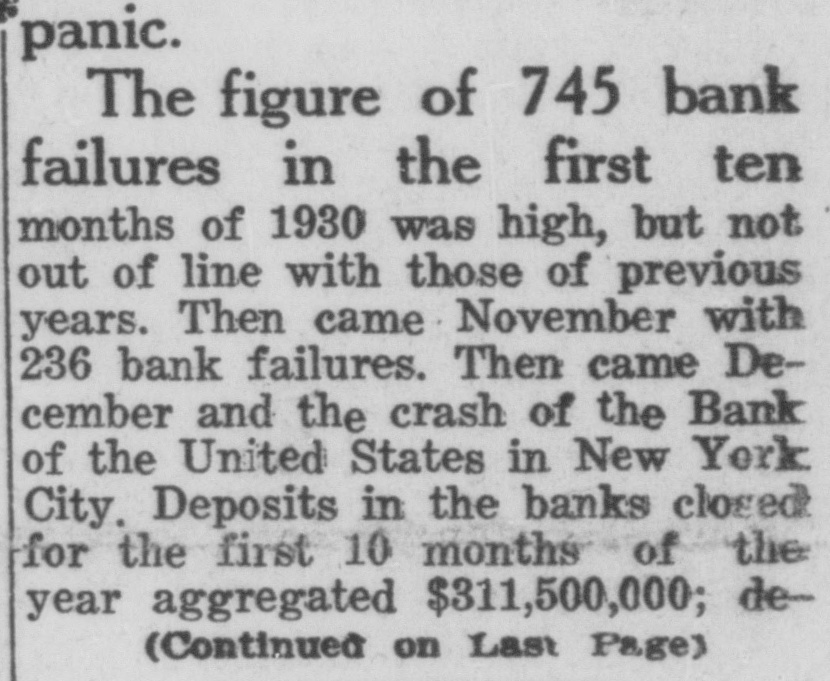
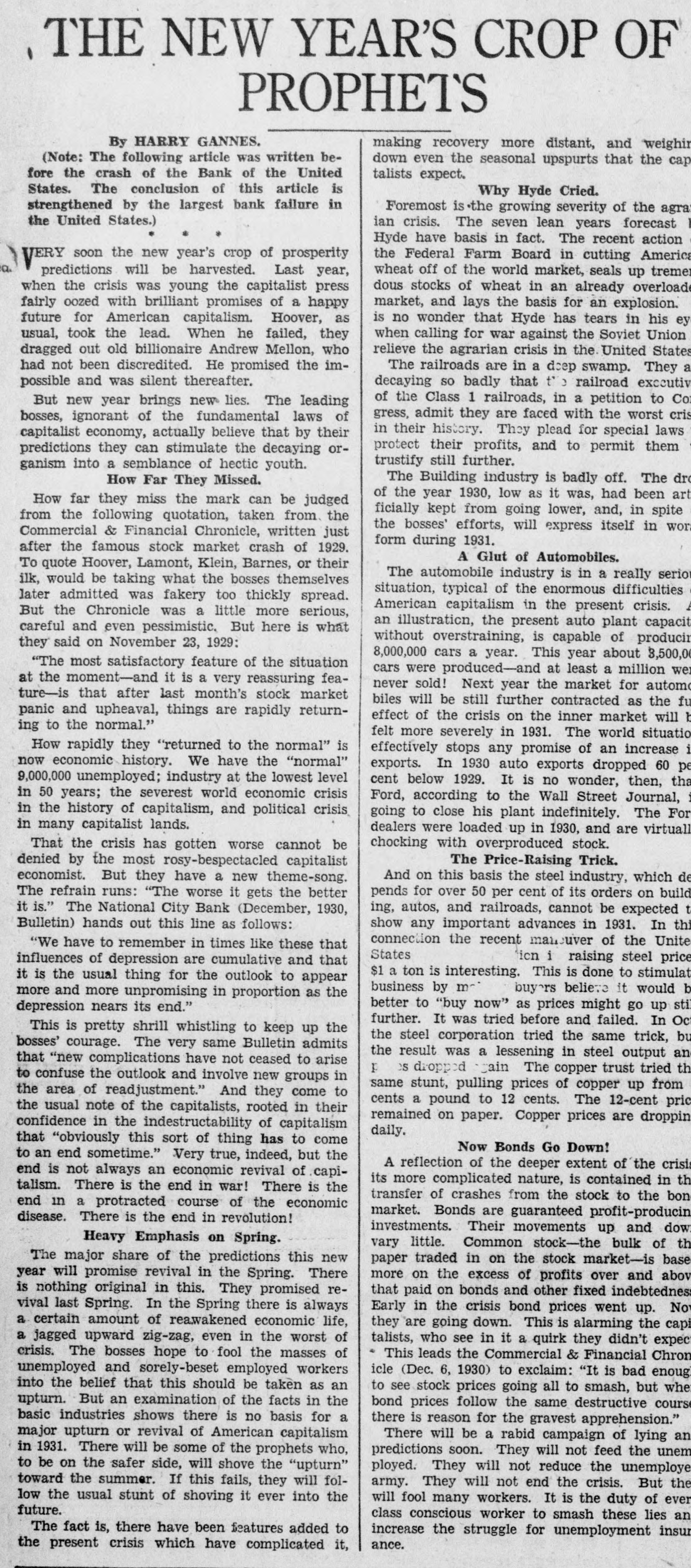
THE NEW YEAR'S CROP OF PROPHETS By HARRY GANNES. making recovery more distant, and weighir (Note: The following article was written bedown even the seasonal upspurts that the cap fore the crash of the Bank of the United talists expect. States. The conclusion of this article is Why Hyde Cried. strengthened by the largest bank failure in Foremost is the growing severity of the agra the United States.) ian crisis. The seven lean years forecast 1 Hyde have basis in fact. The recent action VERY soon the new year's crop of prosperity the Federal Farm Board in cutting America predictions will be harvested. Last year, wheat off of the world market, seals up tremer when the crisis was young the capitalist press dous stocks of wheat in an already overloade fairly oozed with brilliant promises of a happy market, and lays the basis for an explosion. future for American capitalism. Hoover, as is no wonder that Hyde has tears in his ey usual, took the lead. When he failed, they when calling for war against the Soviet Union dragged out old billionaire Andrew Mellon, who relieve the agrarian crisis in the United States had not been discredited. He promised the imThe railroads are in a deep swamp. They a possible and was silent thereafter. decaying SO badly that the railroad exccutiv of the Class 1 railroads, in a petition to Co But new year brings new lies. The leading gress, admit they are faced with the worst cris bosses, ignorant of the fundamental laws of in their history. They plead for special laws capitalist economy, actually believe that by their protect their profits, and to permit them predictions they can stimulate the decaying ortrustify still further. ganism into a semblance of hectic youth. The Building industry is badly off. The dro How Far They Missed. of the year 1930, low as it was, had been art How far they miss the mark can be judged ficially kept from going lower, and, in spite from the following quotation, taken from. the the bosses' efforts, will express itself in word Commercial & Financial Chronicle, written just form during 1931. after the famous stock market crash of 1929. A Glut of Automobiles. To quote Hoover, Lamont, Klein, Barnes, or their The automobile industry is in a really serior ilk, would be taking what the bosses themselves situation, typical of the enormous difficulties later admitted was fakery too thickly spread. American capitalism in the present crisis. b But the Chronicle was a little more serious, an illustration, the present auto plant capacit careful and even pessimistic, But here is what without overstraining, is capable of producir they said on November 23, 1929: 8,000,000 cars a year. This year about 3,500,00 "The most satisfactory feature of the situation cars were produced-and at least a million wer at the moment-and it is a very reassuring feanever sold! Next year the market for automo ture-is that after last month's stock market biles will be still further contracted as the fu panic and upheaval, things are rapidly returneffect of the crisis on the inner market will b ing to the normal." felt more severely in 1931. The world situatio How rapidly they "returned to the normal" is effectively stops any promise of an increase i now economic history. We have the "normal" exports. In 1930 auto exports dropped 60 pe 9,000,000 unemployed; industry at the lowest level cent below 1929. It is no wonder, then, tha in 50 years; the severest world economic crisis Ford, according to the Wall Street Journal, 5 in the history of capitalism, and political crisis going to close his plant indefinitely. The For in many capitalist lands. dealers were loaded up in 1930, and are virtuall chocking with overproduced stock. That the crisis has gotten worse cannot be The Price-Raising Trick. denied by the most rosy-bespectacled capitalist And on this basis the steel industry, which de economist. But they have a new theme-song. pends for over 50 per cent of its orders on build The refrain runs: "The worse it gets the better it is." The National City Bank (December, 1930, ing, autos, and railroads, cannot be expected t Bulletin) hands out this line as follows: show any important advances in 1931. In thi connection the recent maneuver of the Unite "We have to remember in times like these that States icn i raising steel price influences of depression are cumulative and that $1 a ton is interesting. This is done to stimulat it is the usual thing for the outlook to appear business by m~ buyers believe it would b more and more unpromising in proportion as the better to "buy now" as prices might go up stil depression nears its end." further. It was tried before and failed. In Oct This is pretty shrill whistling to keep up the the steel corporation tried the same trick, bu bosses' courage. The very same Bulletin admits the result was a lessening in steel output an that "new complications have not ceased to arise p S dropped tain The copper trust tried th to confuse the outlook and involve new groups in same stunt, pulling prices of copper up from the area of readjustment." And they come to cents a pound to 12 cents. The 12-cent pric the usual note of the capitalists, rooted in their remained on paper. Copper prices are droppin confidence in the indestructability of capitalism daily. that "obviously this sort of thing has to come Now Bonds Go Down! to an end sometime." Very true, indeed, but the A reflection of the deeper extent of the crisis end is not always an economic revival of capiits more complicated nature, is contained in th talism. There is the end in war! There is the transfer of crashes from the stock to the bon end in a protracted course of the economic market. Bonds are guaranteed profit-producin disease. There is the end in revolution! investments. Their movements up and dow Heavy Emphasis on Spring. vary little. Common stock-the bulk of th The major share of the predictions this new paper traded in on the stock market-is base year will promise revival in the Spring. There more on the excess of profits over and abov is nothing original in this. They promised rethat paid on bonds and other fixed indebtedness vival last Spring. In the Spring there is always Early in the crisis bond prices went up. No a certain amount of reawakened economic life, they are going down. This is alarming the capi a jagged upward zig-zag, even in the worst of talists, who see in it a quirk they didn't expect crisis. The bosses hope to fool the masses of This leads the Commercial & Financial Chron unemployed and sorely-beset employed workers icle (Dec. 6, 1930) to exclaim: "It is bad enoug into the belief that this should be taken as an to see stock prices going all to smash, but whe upturn. But an examination of the facts in the bond prices follow the same destructive course basic industries shows there is no basis for a there is reason for the gravest apprehension." major upturn or revival of American capitalism There will be a rabid campaign of lying an in 1931. There will be some of the prophets who, predictions soon. They will not feed the unem to be on the safer side, will shove the "upturn" ployed. They will not reduce the unemploye toward the summer. If this fails, they will folarmy. They will not end the crisis. But the low the usual stunt of shoving it ever into the will fool many workers. It is the duty of ever future. class conscious worker to smash these lies an The fact is, there have been features added to increase the struggle for unemployment insur ance. the present crisis which have complicated it,