gpt-5-mini (chosen from majority vote of a three-model LLM ensemble)
Short Digest
d9d553b8904acf48
Response Measures
Accommodated withdrawals, Borrowed from banks or large institutions, Public signal of financial health, Capital injected, Full suspension, Books examined
Clearinghouse involved: Yes
(loan, examination, or other measures)
Events (5)
1.December 15, 1881Chartered
Source
historical_nic
2.December 18, 1905Run
Cause
Bank Specific Adverse Info
Cause Details
Depositors withdrew after announcement of financial embarrassment tied to John R. Walsh's unprofitable railroad investments and large loans to his enterprises.
Measures
Clearing house banks guaranteed payment; bank employees paid out funds to depositors and payments were to be resumed next day.
Newspaper Excerpt
Promptly at 10 o'clock this morning long lines of depositors formed at the Chicago National Bank ... nearly $6,000,000 ... had been paid out
Source
newspapers
3.December 18, 1905Suspension
Cause
Bank Specific Adverse Info
Cause Details
Suspension followed discovery of large loans to Walsh's private enterprises (railroad and quarry investments) that made assets illiquid or impaired.
Newspaper Excerpt
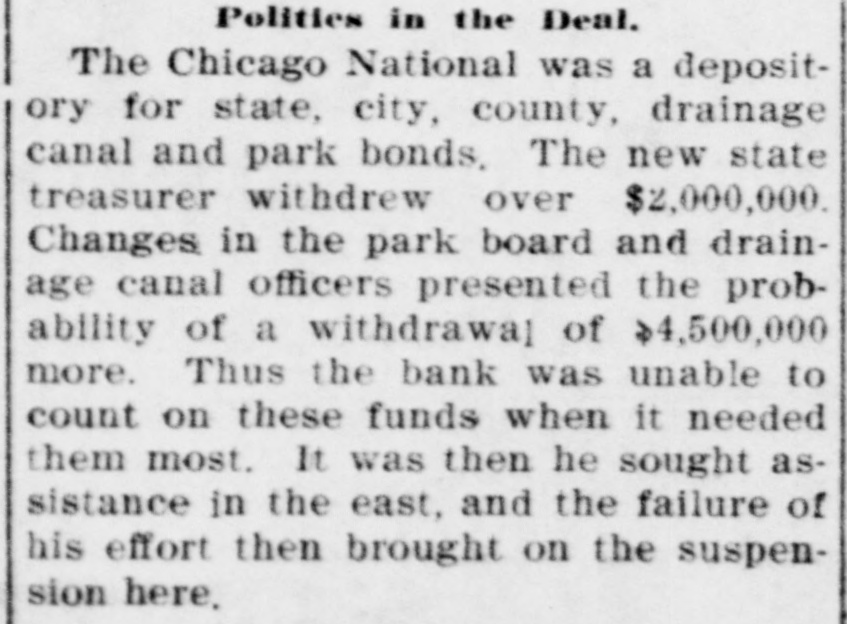
The Chicago National, the Home Savings and the Equitable Trust Co., three banks controlled by Jno. R. Walsh, suspended operations on the 18th.
Source
newspapers
4.March 3, 1906Receivership
Newspaper Excerpt
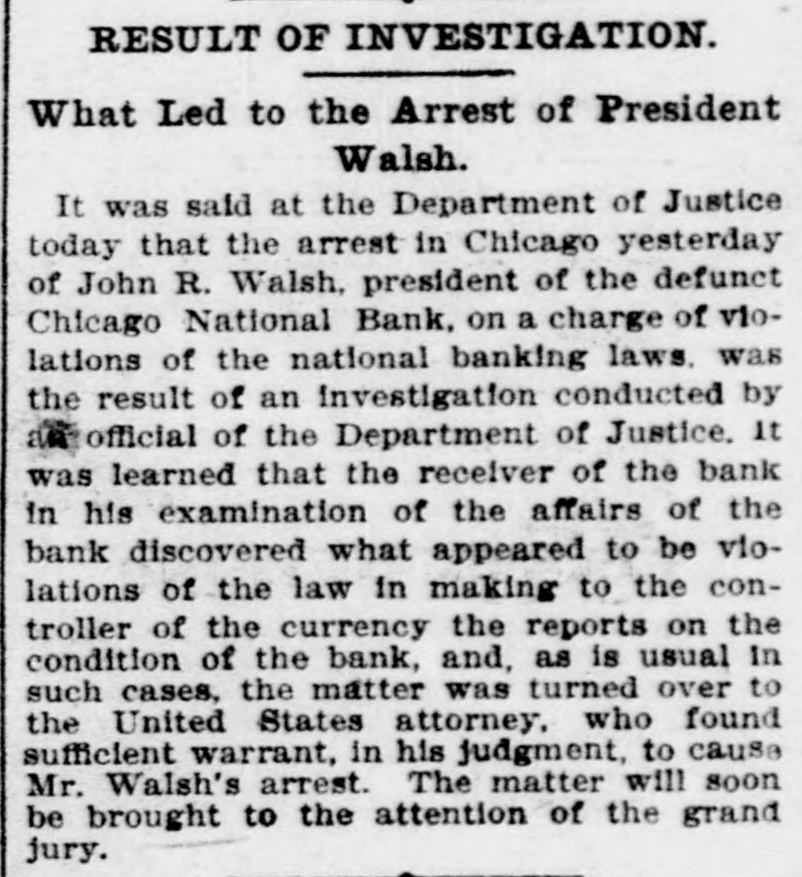
the arrest in Chicago yesterday of John R. Walsh, president of the defunct Chicago National bank ... It was learned that the receiver for the bank discovered what appeared to be violations of the law in making to the comptroller of the currency the reports on the bank's condition
Source
newspapers
5.August 15, 1913Voluntary Liquidation
Source
historical_nic
Newspaper Articles (25)
1.December 19, 1905New-York TribuneNew York, NY
Click image to open full size in new tab
Article Text
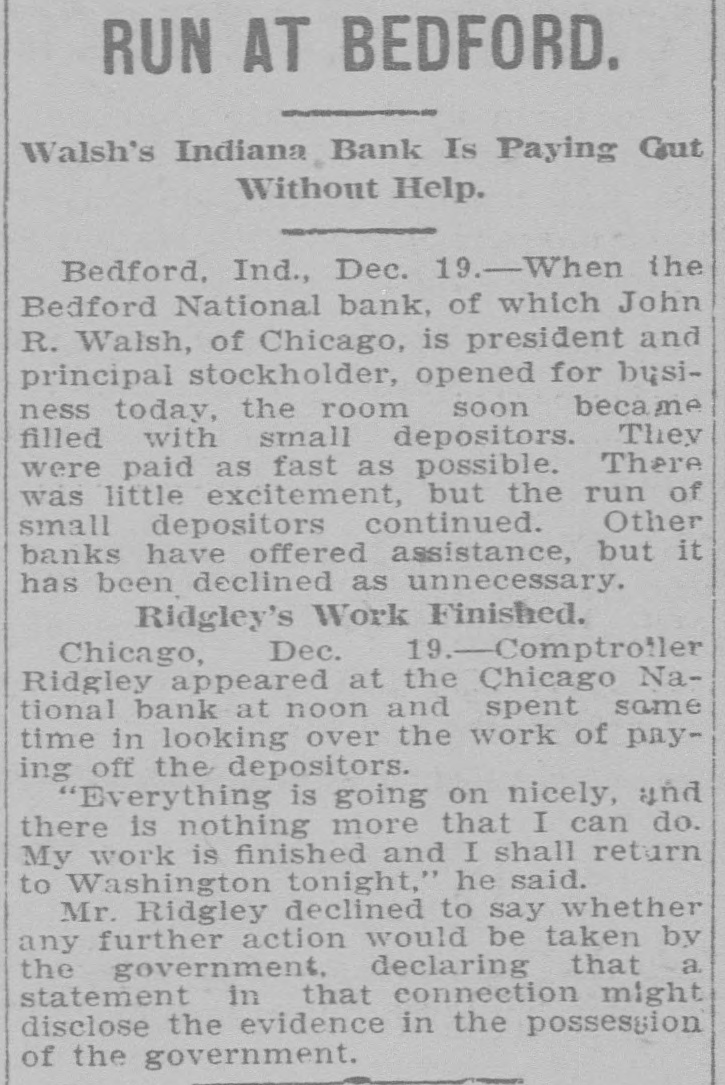
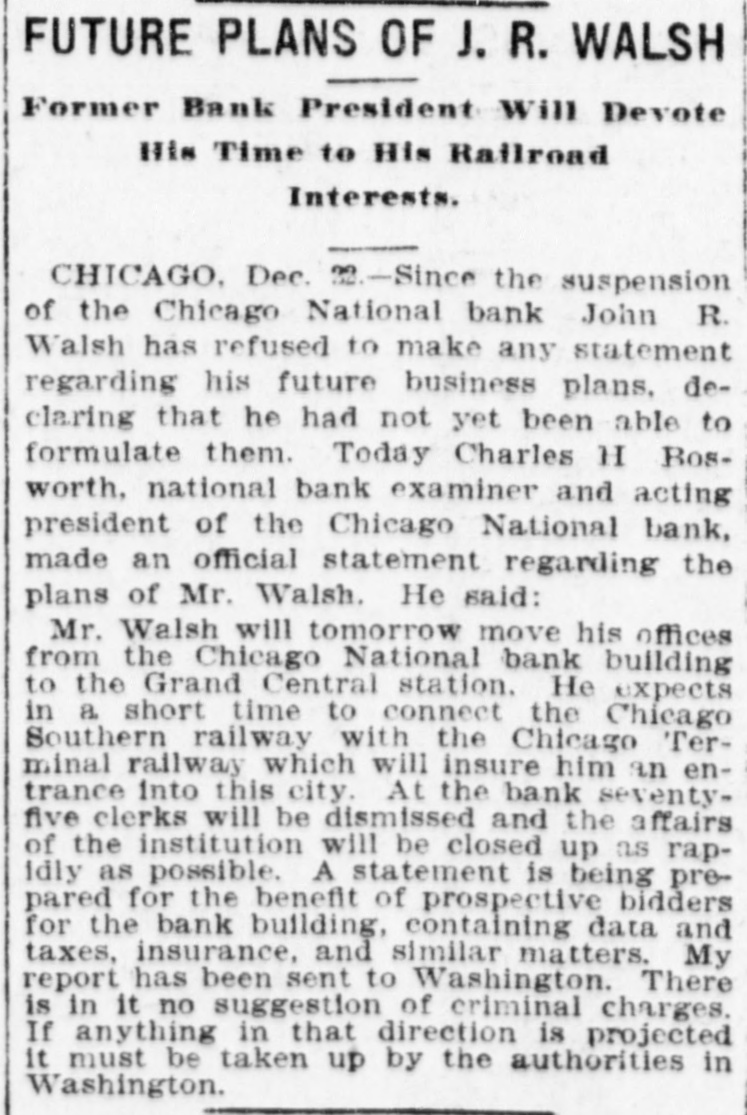
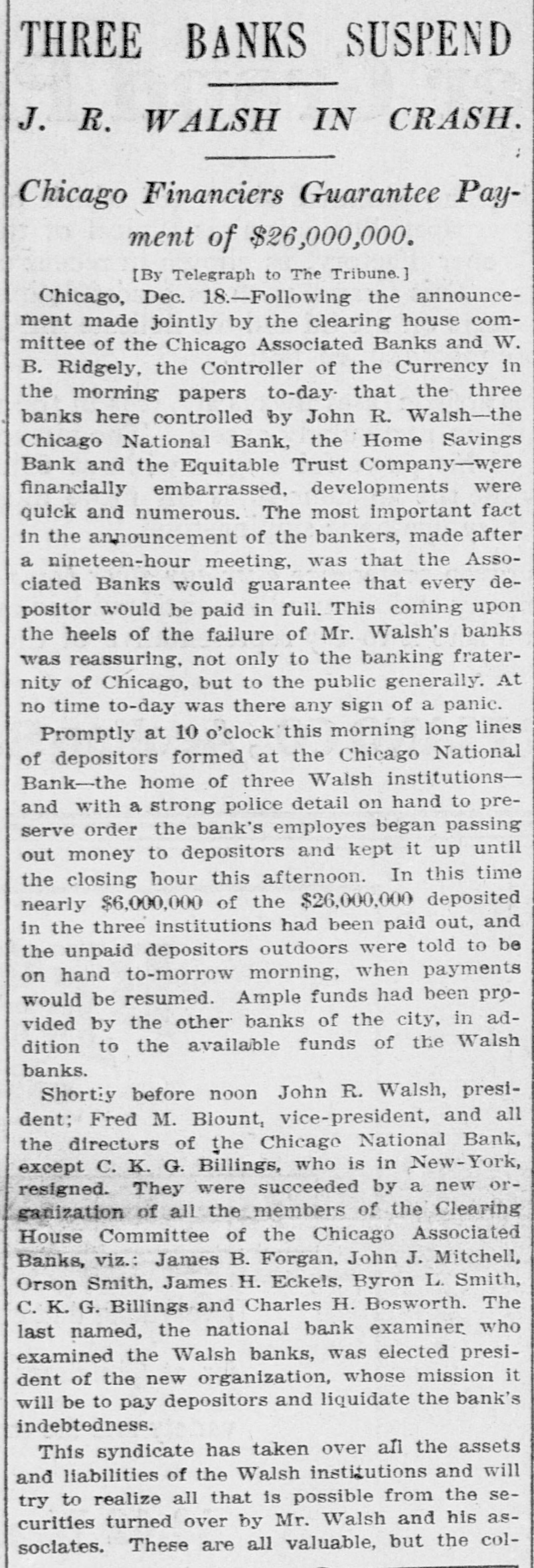
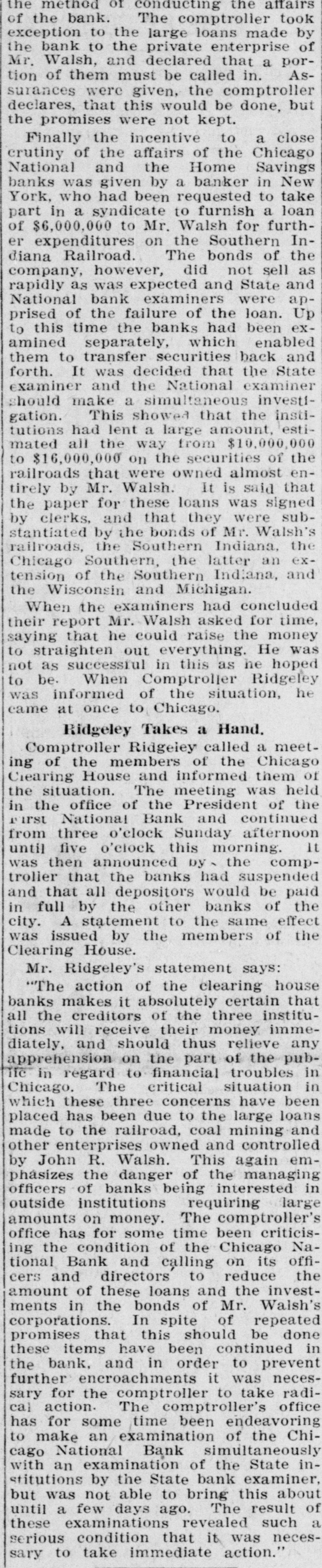
THREE BANKS SUSPEND J. R. WALSH IN CRASH. Chicago Financiers Guarantee Payment of $26,000,000. [By Telegraph to The Tribune.] Chicago, Dec. 18.-Following the announcement made jointly by the clearing house committee of the Chicago Associated Banks and W. B. Ridgely, the Controller of the Currency in the morning papers to-day- that the three banks here controlled by John R. Walsh-the Chicago National Bank, the Home Savings Bank and the Equitable Trust Company-were financially embarrassed, developments were quick and numerous. The most important fact in the announcement of the bankers, made after a mnineteen-hour meeting, was that the Associated Banks would guarantee that every depositor would be paid in full. This coming upon the heels of the failure of Mr. Walsh's banks was reassuring, not only to the banking fraternity of Chicago, but to the public generally. At no time to-day was there any sign of a panic. Promptly at 10 o'clock this morning long lines of depositors formed at the Chicago National Bank-the home of three Walsh institutionsand with a strong police detail on hand to preserve order the bank's employes began passing out money to depositors and kept it up until the closing hour this afternoon. In this time nearly $6,000,000 of the $26,000,000 deposited in the three institutions had been paid out, and the unpaid depositors outdoors were told to be on hand to-morrow morning, when payments would be resumed. Ample funds had been provided by the other banks of the city, in addition to the available funds of the Walsh banks. Shortly before noon John R. Walsh, president; Fred M. Blount, vice-president, and all the directors of the Chicago National Bank, except C. K. G. Billings, who is in New-York, resigned. They were succeeded by a new orgarization of all the members of the Clearing House Committee of the Chicago Associated Banks, viz.: James B. Forgan, John J. Mitchell, Orson Smith, James H. Eckels. Byron L. Smith, C. K. G. Billings and Charles H. Bosworth. The last named, the national bank examiner who examined the Walsh banks, was elected president of the new organization, whose mission it will be to pay depositors and liquidate the bank's indebtedness. This syndicate has taken over all the assets and liabilities of the Walsh institutions and will try to realize all that is possible from the securities turned over by Mr. Walsh and his associates. These are all valuable, but the col-
2.December 19, 1905Rock Island ArgusRock Island, IL
Click image to open full size in new tab
Article Text
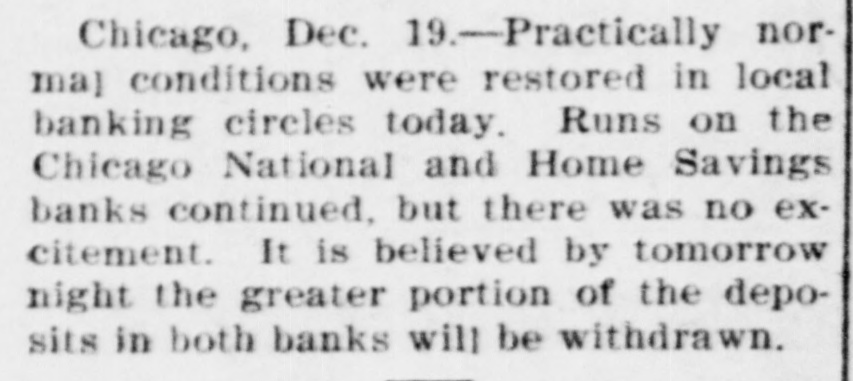
Chicago, Dec. 19.-Practically norma) conditions were restored in local banking circles today. Runs on the Chicago National and Home Savings banks continued, but there was no excitement. It is believed by tomorrow night the greater portion of the deposits in both banks will be withdrawn.
3.December 20, 1905Arizona RepublicanPhoenix, AZ
Click image to open full size in new tab
Article Text
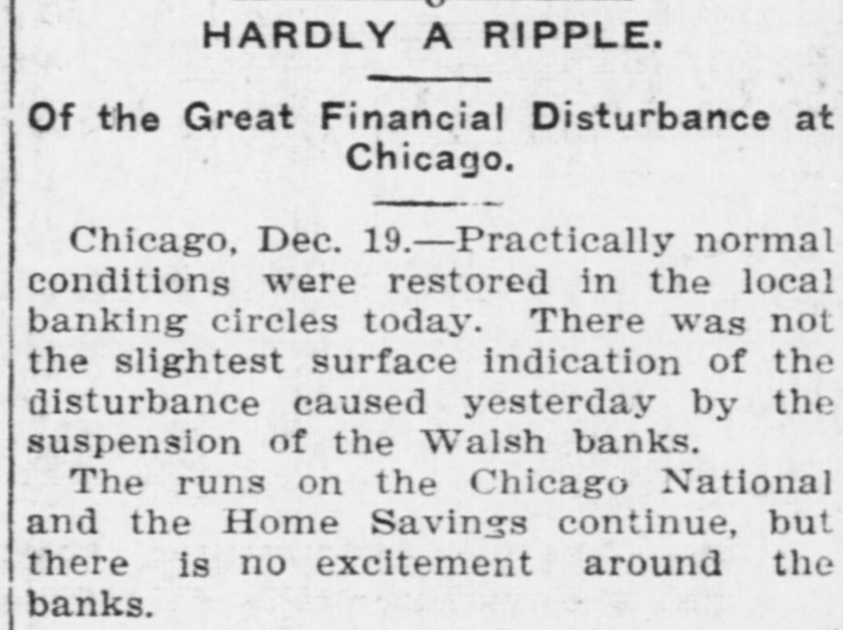
HARDLY A RIPPLE. Of the Great Financial Disturbance at Chicago. Chicago, Dec. 19.-Practically normal conditions were restored in the local banking circles today. There was not the slightest surface indication of the disturbance caused yesterday by the suspension of the Walsh banks. The runs on the Chicago National and the Home Savings continue, but there is no excitement around the banks.
4.December 21, 1905Herald and NewsRandolph, VT
Click image to open full size in new tab
Article Text
Heavy Bank Failures. Monday, the failure was announced of three of the largest financial institutions in Chicago, the Chicago National bank, the Home Savings bank and the Equitable Trust company. The total liabilities are $26,000,000, with assets estimated at $16,000,000. The failures were due to the unprofitable nature of heavy railroad investments made by the principal owner of the banks, John R. Walsh. A panic was averted by the prompt action of the allied banks of Chicago, which came to the rescue and pledged that every dollar due depositors should be paid. Mr. Walsh expects that the assets will realize much more than the estimate, and that the banks will prove to have been solvent.
5.December 21, 1905Ottumwa Tri-Weekly CourierOttumwa, IA
Click image to open full size in new tab
Article Text
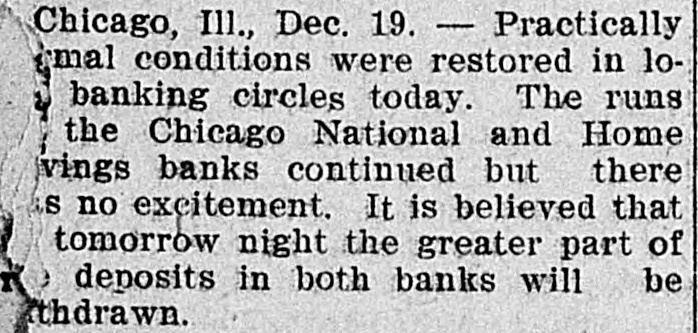
Chicago, Ill., Dec. 19. - Practically Emal conditions were restored in lobanking circles today. The runs the Chicago National and Home vings banks continued but there S no excitement. It is believed that tomorrow night the greater part of deposits in both banks will be thdrawn.
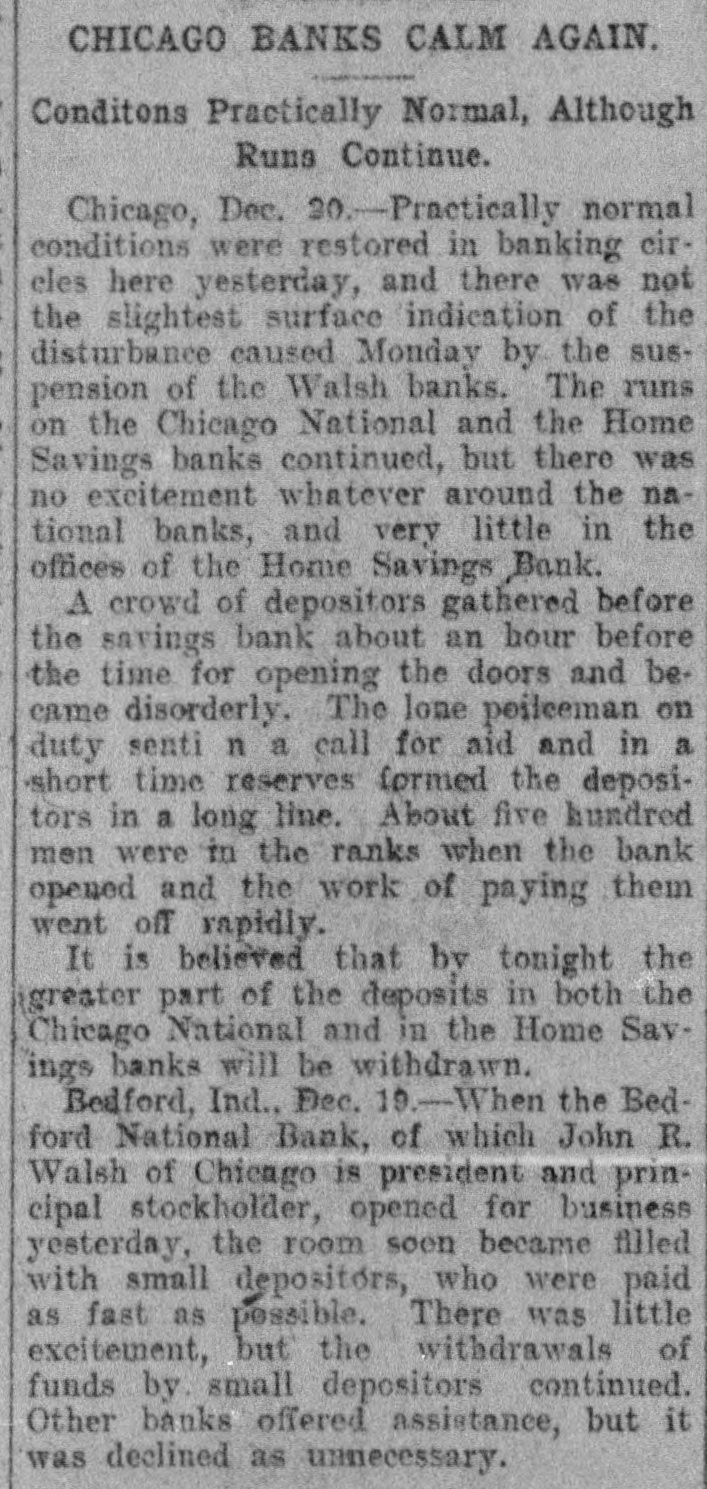
Chicago Banks Recovering. Chicago, Dec. 19.-Practically normal conditions were restored in local banking circles Tuesday and there was not the slightest surface Indication of the disturbance caused Monday by the suspension of the Walsh banks. The runs on the Chicago National and Home Savings banks continued but there was no excitement whatever around the National bank and but very little In the offices of the Home Savings bank.
7.December 22, 1905The Black Hills Union and Western Stock ReviewRapid City, SD
Click image to open full size in new tab
Article Text
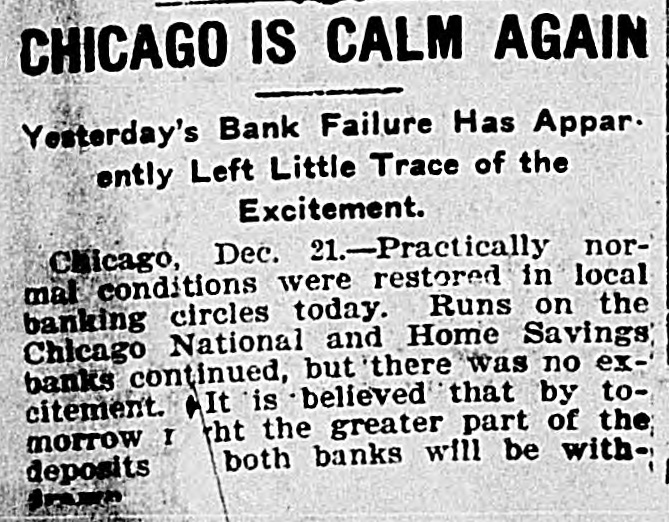
CHICAGO IS CALM AGAIN Yesterday's Bank Failure Has Apparently Left Little Trace of the Excitement. Chicago, Dec. 21.-Practically normal conditions were restored in local banking circles today. Runs on the Chicago National and Home Savings banks continued, but there was no ex-' citement. AIt is believed that by tomorrow I tht the greater part of the both banks will be withdeposits from:
8.December 22, 1905The CommonwealthGreenwood, MS
Click image to open full size in new tab
Article Text
The Chicago National, the Home Savings and the Equitable Trust Co., three banks controlled by Jno. R. Walsh, suspended operations on the 18th. Liabilities $26,000,000, assets $29,000,000. Loans to Walsh's other interests brought about the failure.
9.December 22, 1905Milford ChronicleMilford, DE
Click image to open full size in new tab
Article Text
ny THREE CHICAGO to (nBANKS he g siInstitutions Involved in to of John R. Walsh as in e DEPOSITORS LOSE NOT. enChicago, Dec. 19.-Three of th. k Bargest financial institutions in the west, the Chicago National Bank, the is Home Savings Bank and the Equitable eTrust company, all of them controlled 1by John R. Walsh, of Chicago, and in igreat measure owned by him have n suspended operations. Their affairs a will be liquidated as rapidly as possible and they will go out of business. e Mr. Walsh, who was the president f of the Chicago National Bank and of a the Equitable Trust company, and all a the other officers and all the directors S of the Chicago National Bank have resigned. National Bank Eaminer C. H. Boworth has succeeded Mr. Walsh as e the head of the Chicago National Bank, S and the places of the directors have been filled by men appointed by the ' Chicago Clearing House. Back of the new management stand b the allied banks of Chicago, which have pledged their resources that every depositor. shall be paid to the last cent, and that no customer of any one of the three institutions shall lose anything by reason of the suspension. This action prevented a disastrous financial panic. The immediate cause of the collapse of the institutions controlled by Mr. Walsh-is said to be the large amount of money which they have lent to various private enterprises of his, notably the Southern Indiana railway and the Bedford Quarries company, of Indiana. Mr. Walsh says that if he could have had a little more time and been left untrammeled in his operations he could have saved his banks and made enormous profits for himself and his associates. He bases this statement on his estimate of the value of the bonds of the Southern Indiana Railroad company. The liabilities of the three institutions are estimated in the aggregate at $26,000,000. Against this amount the banks and the trust company have resources that are, on a concervative estimate, worth $16,000,000. The bonds of the Southern Indiana Railroad company are estimated by Mr. Walsh at $16,000,000. They are considered by the comptroller, the state auditor and the clearing house committee to be worth a little more than half of that sum. The directors of the two banks. as well as Mr. Walsh, who has turned all of his private property, as well as that standing in the name of Mrs. Walsh, have pledged real estate and securities 0 valued at $5,000,000, making a total in assets of $29,000,000. estimating the railroad bonds at $8,000,000, against A $26,000,000 liabilities. at The deposits in the bank were $14, 483,000 and there is due to other banks PE $2,038,851. The following statement was issued by Comptroller Ridgely: "A misunderstanding seems to exist as to what has happened to the Chicago National Bank. This bank has not failed or closed its doors. It has been embarrassed by the investment of its assets in unavailable securities, but the banks of Chicago have come to its relief. and have guaranteed the payment in full on demand, of all the creditors of the Chicago National Bank. The bank is open for business as usual, with these guarantees behind it that it will meet all its obligations and every dollar at once."
10.December 23, 1905St. Tammany FarmerCovington, LA
Click image to open full size in new tab
Article Text
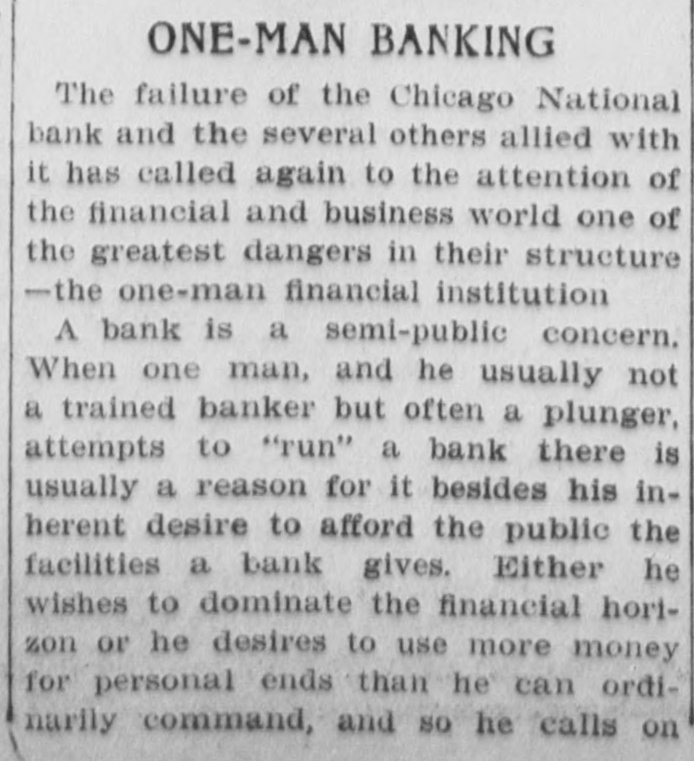
The Chicago National Bank, the Home Savings Bank and the Equitable Trust Company, of Chicago, three institutions in which John R. Walsh is interested suspended business. Politics and injudicious loans was the cause of the crash
11.December 23, 1905Richmond PlanetRichmond, VA
Click image to open full size in new tab
Article Text
THREE CHICAGO BANKS FAIL Institutions Involved in Operations of John R. Walsh. DEPOSITORS LOSE NOTHING Chicago, Dec. 19.-Three of the largest financial institutions in the west, the Chicago National Bank, the Home Savings Bank and the Equitable Trust company, all of them controlled by John R. Walsh, of Chicago, and in great measure owned by him, have suspended operations. Their affairs will be liquidated as rapidly as possible and they will go out of business. Mr. Watsh, who was the president of the Chicago National Bank and of the Equitable Trust company, and all the other officers and all the directors of the Chicago National Bank have resigned. National Bank Eaminer C. H. Boworth has succeeded Mr. Walsh as the head of the Chicago National Bank, and the places of the directors have been filled by men appointed by the Chicago Clearing House. Back of the new management stand the allted banks of Chicago, which have pledged their resources that every depositor shall be paid to the last cent, and that no customer of any one of the three institutions shall lose anything by reason of the suspension. This action prevented a disastrous financial panic. The immediate cause of the collapse of the institutions controlled by Mr. Walsh is said to be the large amount of money which they have lent to various private enterprises of his, notably the Southern Indiana railway and the Bedford Quarries company, of In diana. Mr. Walsh says that if he could have had a little more time and been left untrammeled in his operations he could have saved his banks and made enormous profits for himself and his associates. He bases this statement on his estimate of the value of the bonds of the Southern Indiana Railroad company. The liabilities of the three institutions are estimated in the aggregate at $26,000,000. Against this amount the banks and the trust company have resources that are, on a concervative estimate, worth $16,000,000. The bonds of the Southern Indiana Railroad company are estimated by Mr. Walsh at $16,000,000. They are considered by the comptroller, the state auditor and the clearing house committee to be worth a little more than half of that sum. The directors of the two banks, as well as Mr. Walsh, who has turned all of his private property, as well as that standing in the name of Mrs. Walsh, have pledged real estate and securities valued at $5,000,000, making a total in assets of $29,000,000. estimating the railroad bonds at $8,000,000, against $26,000,000 liabilities. The deposits in the bank were $14,483,000 and there is due to other banks $2,038,851. The following statement was issued by Comptroller Ridgely: "A misunderstanding seems to ex1st as to what has happened to the Chicago National Bank. This bank has not failed or closed its doors. It has been embarrassed by the investment of its assets in unavailable securities, but the banks of Chicago have come to its relief. and have guaranteed the payment in full on demand, of all the creditors of the Chicago National Bank. The bank is open for business as usual, with these guarantees behind it that it will meet all its obligations and every dollar at once."
12.March 3, 1906The Providence NewsProvidence, RI
Click image to open full size in new tab
Article Text
WAL SH'S CASE WILL GO BEFORE THE GRAND JURY Washington March 3.-It was said at the department of justice today that the arrest in Chicago yesterday of John R. Walsh, president of the defunct Chicago National bank, on the charge of violation of national banking laws was the result of an investigation, conducted by an offielal of the department of justice. It was learned that the receiver for the bank discovered what appeared to be violationas of the law in making to the comptroller of the curency the reports on the bank's condition The matter was turned over to the United States attorney, who found sufficient warrant in his judgment to cause Mr. Walsh's arrest. The matter will soon be brought to the attention of the grand jury.
13.March 9, 1906The Hawaiian StarHonolulu, HI
Click image to open full size in new tab
Article Text
It sort of looks like the banking fraternity of Chicago was getting sore on their late confrere John R. Walsh. When his banks, the Chicago National and some others, failed, a short time ago, the clearing house banks guaranteed his liabilities in order to prevent a panic. It was thought then that with careful handling his assets might meet his liabilities. It has been found since that the other banks have let themselves in for ten or twelve millions, and now the cable'says that Walsh has been arrested for violating the banking law. No wonder the bankers are sore.
14.March 10, 1906Morris TribuneMorris, MN
Click image to open full size in new tab
Article Text
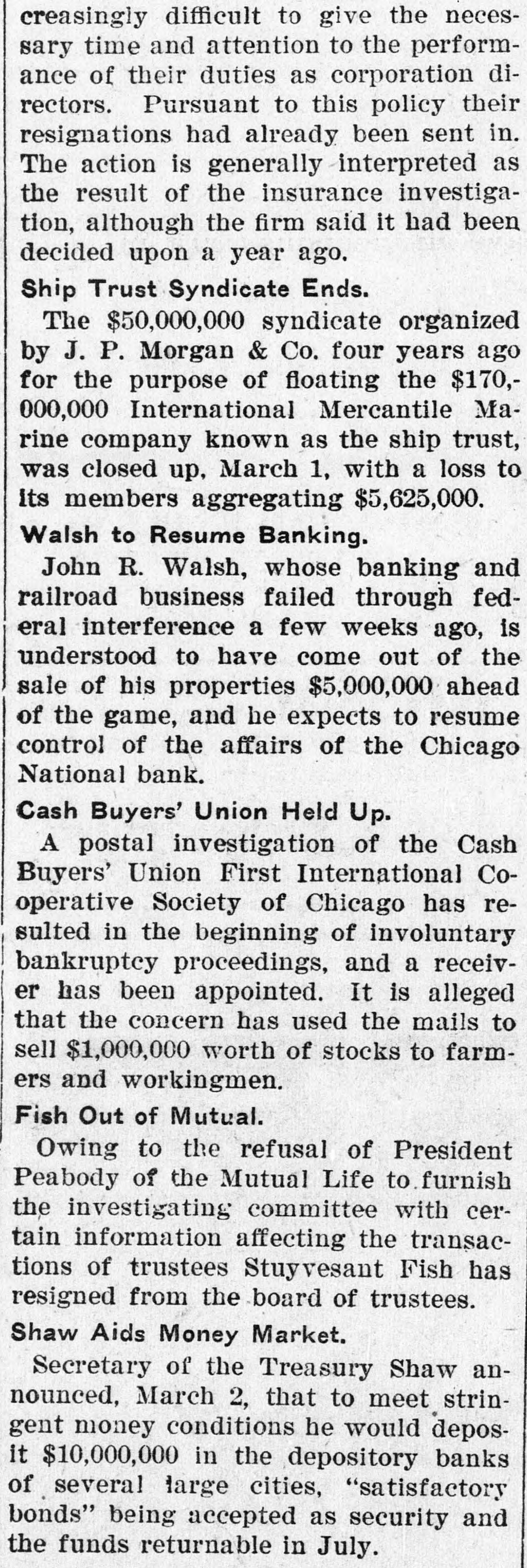
creasingly difficult to give the necessary time and attention to the performance of their duties as corporation directors. Pursuant to this policy their resignations had already been sent in. The action is generally interpreted as the result of the insurance investigation, although the firm said it had been decided upon a year ago. Ship Trust Syndicate Ends. The $50,000,000 syndicate organized by J. P. Morgan & Co. four years ago for the purpose of floating the $170,000,000 International Mercantile Marine company known as the ship trust, was closed up, March 1, with a loss to its members aggregating $5,625,000. Walsh to Resume Banking. John R. Walsh, whose banking and railroad business failed through federal interference a few weeks ago, is understood to have come out of the sale of his properties $5,000,000 ahead of the game, and he expects to resume control of the affairs of the Chicago National bank. Cash Buyers' Union Held Up. A postal investigation of the Cash Buyers' Union First International Cooperative Society of Chicago has resulted in the beginning of involuntary bankruptcy proceedings, and a receiver has been appointed. It is alleged that the concern has used the mails to sell $1,000,000 worth of stocks to farmers and workingmen. Fish Out of Mutual. Owing to the refusal of President Peabody of the Mutual Life to furnish the investigating committee with certain information affecting the transactions of trustees Stuyvesant Fish has resigned from the board of trustees. Shaw Aids Money Market. Secretary of the Treasury Shaw announced, March 2, that to meet stringent money conditions he would deposit $10,000,000 in the depository banks of several large cities, "satisfactory bonds" being accepted as security and the funds returnable in July.
15.May 31, 1907The Washington TimesWashington, DC
Click image to open full size in new tab
Article Text
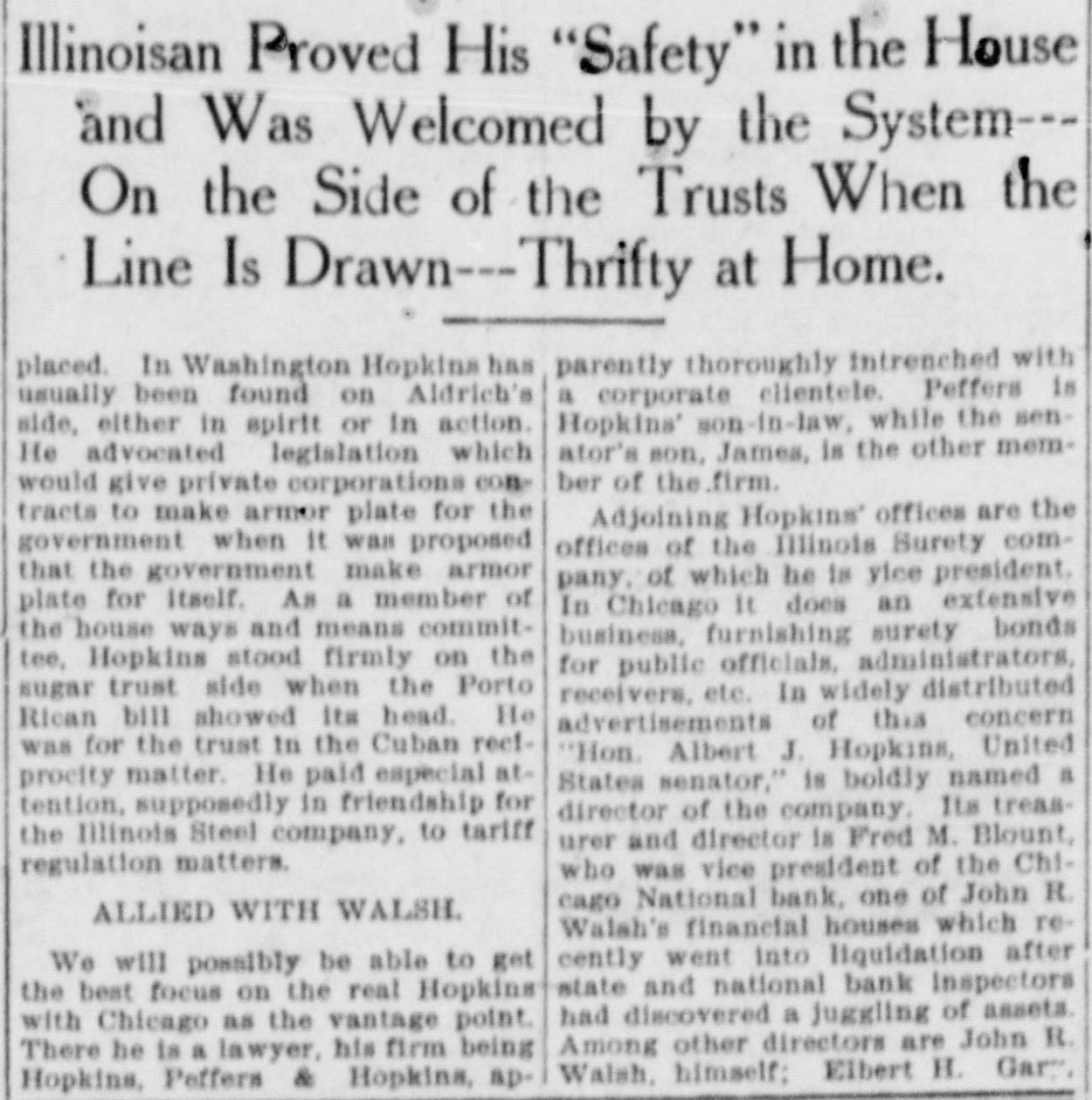
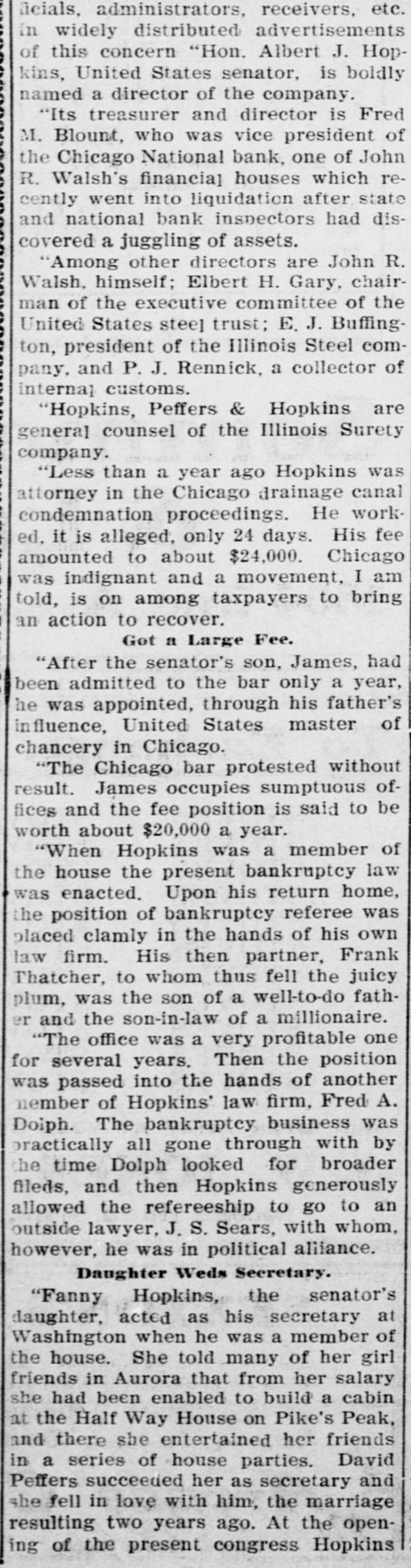
CHICAGO CHRONICLE SUSPENDS PUBLICATION CHICAGO, May 31.-After an existence of twelve years and three days, the Chicago Chronicle suspended publication this morning. The announcement is made in both its morning editions by Horatio W. Seymour, publisher of the paper. The suspension of the paper is the outcome of the failure of the Chicago National Bank a year ago last December. John R. Walsh, president of the bank, was also practicallly the sole owner of the Chronicle, which he founded in 1895, just after. selling the Chicago Herald property to James W. Scott.
16.January 11, 1908Imperial Valley PressEl Centro, CA
Click image to open full size in new tab
Article Text
NEWS IN BRIEF Happenings of the Week Boiled Down For Busy Readers New York landlords cause great suffering to poor people on East Side by wholesale evictions. U.S. Senator Owen, of Oklahoma, accused of acquiring illegally 4,000 acres of land from Indians. Chicago banks have returned to cash basis and financial situation is just what it was before the pinch. President Roosevelt denounces the patronage system and urges enforcement of civil service rules in Census Bureau. Chicago Great Western railroad has been placed in lhe hands of receivers. Overcapitalization caused the trouble. H.O. Havemeyer's will leaves estate of $25,000,000 to widow and three children. No bequests to public institutions. Many gun fights, assaults and on in of tumults Brooklyn and New other Year's camps day the wild and woolly east. This is really important. Los Angeles court decides that a woman need not pay for a tailormade suit that doesn't fit. George Pettibone, accused of complicity in murder of Ex-Gov. Steunenberg, of Idaho, acquitted. Case against Moyer dismissed. District Court of Austin, Texas, appoints receiver to take charge of all property in the state belonging to Standard Oil. Proceedings to dissolve combination between Union Pacific and Southern Pacific to be begun soon by Attorney-General Bonaparte. London Times passes from control of Walter family and into hands of C. A. Pearson, publisher of several newspapers and magazines. Jury in Caleb Powers case disagrees, ten for acquittal and two of for conviction. Fifth trial Powers for the murder of Goebel set for July 6. John D. Rockefeller gives $2, 000,000 to Chicago University as New Year present, making total contribution more than $23, ,000,000. But he hasn't paid that fine yet. United States Supreme Court, by five to four, decides that the employers' liability act, applicable to common carriers engaged in interstate commerce, is unconstitutional. F. Augustus Heinze, the copper operator, indicted and arrested in New York for aiding his brother in looting the Mercantile National Bank to the tune of $400,000. Fowler banking bill proposes to retire all outstanding national bank bond secured notes, and thorizes in lieu thereof a currency based on the general assets of the bank. Hudson Maxim announces invention of torpedo boat to travel
17.January 30, 1908Gloucester County DemocratWoodbury, NJ
Click image to open full size in new tab
Article Text
which he was president. The penalty is not less than five nor more than ten years' imprisonment. No substitute fine is allowed. The fight for the conviction of Walsh began with the suspension of the Chicago National bank, the Home Savings bank and the Equitable Trust three
18.January 31, 1908The Owosso TimesOwosso, MI
Click image to open full size in new tab
Article Text
which he was president. The penalty is not less than five nor more than ten years' imprison-ment. No substitute fine is allowed. The fight for the conviction of Walsh began with the suspension of the Chicago National bank, the Home Savings bank and the Equitable Trust company.
which he was president. The penalty is not less than five nor more than ten years' imprisonment. No substitute fine is allowed. The fight for the convietion of Walsh began with the suspension of the Chicago National bank. the Home Savings bank and the Equitable Trust company three
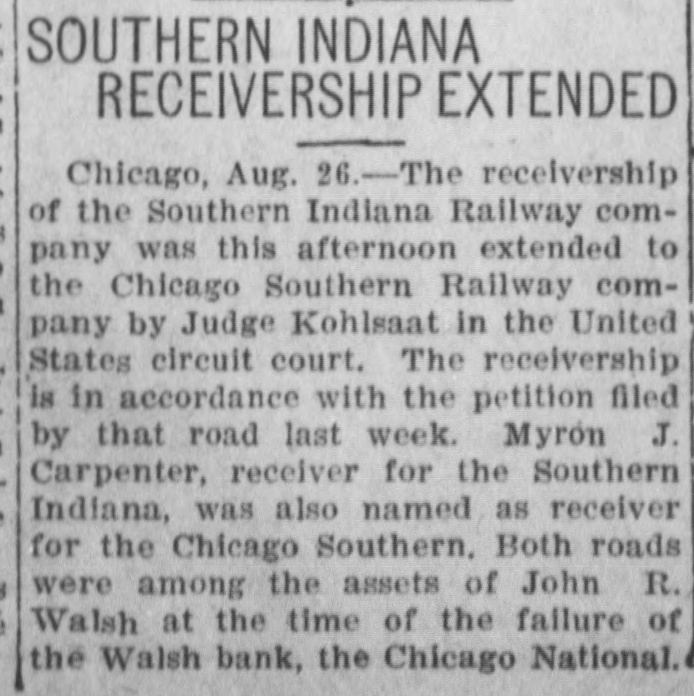
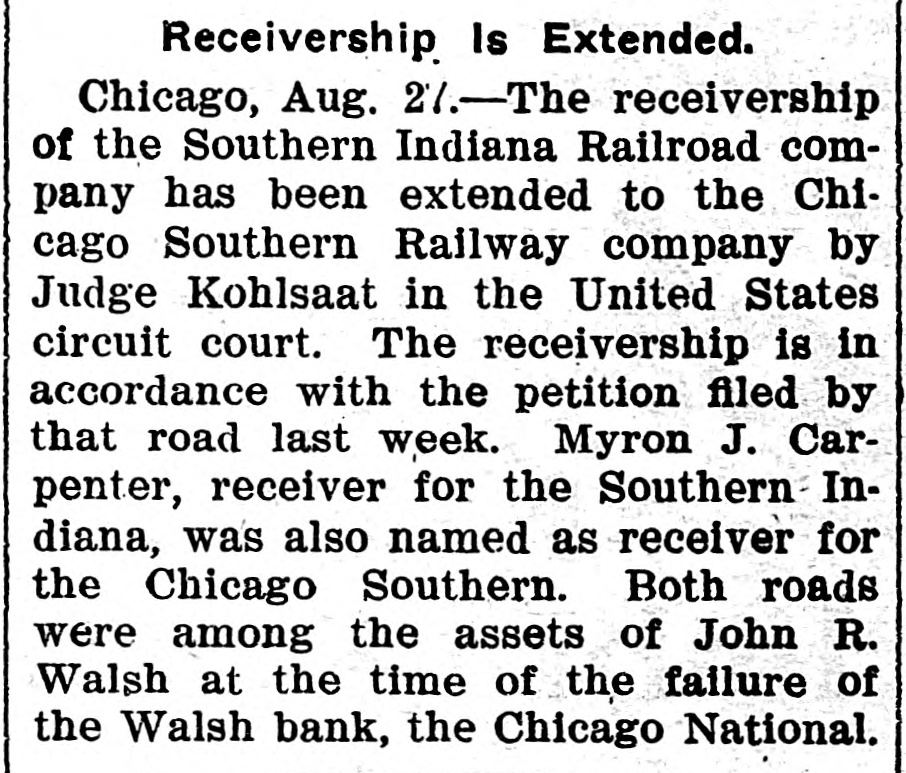
Receivership Is Extended. Chicago, Aug. 27.-The receivership of the Southern Indiana Railroad company has been extended to the Chicago Southern Railway company by Judge Kohlsaat in the United States circuit court. The receivership is in accordance with the petition filed by that road last week. Myron J. Carpenter, receiver for the Southern Indiana, was also named as receiver for the Chicago Southern. Both roads were among the assets of John R. Walsh at the time of the failure of the Walsh bank, the Chicago National.
21.March 24, 1909The Birmingham Age-HeraldBirmingham, AL
Click image to open full size in new tab
Article Text
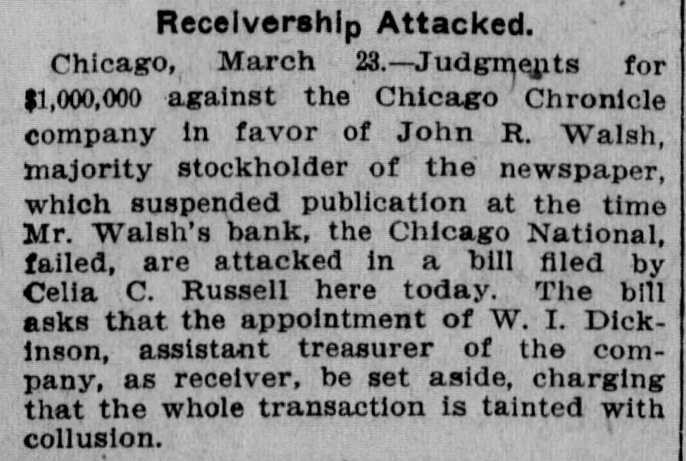
Receivership Attacked. Chicago, March 23.-Judgments for $1,000,000 against the Chicago Chronicle company in favor of John R. Walsh, majority stockholder of the newspaper, which suspended publication at the time Mr. Walsh's bank, the Chicago National, failed, are attacked in a bill filed by Celia C. Russell here today. The bill asks that the appointment of W. I. Dickinson, assistant treasurer of the company, as receiver, be set aside, charging that the whole transaction is tainted with collusion.
22.March 24, 1909The San Francisco CallSan Francisco, CA
Click image to open full size in new tab
Article Text
JUDGMENTS ENTERED AGAINST DEAD PAPER Charges of Collusion Made in Case of Suspended Publication CHICAGO, March 23.-Judgments for $1.000.000 against the Chicago Chronicle company in favor of John R. Walsh as maiority stock holder of the newspaper, which suspended publication at the time Mr. Walsh's bank, the Chicago national, failed, are attacked in a bill filed by Cella C. Russell here today. The bill asies that the appointment of W. I. Dickinson, assistant treasurer of the company. as receiver, be set aside, charging that the whole transaction is tainted with collusion. Judgments for $55,000 were entered against the Chronicle company today in favor of the plaintiff.
23.March 25, 1909Iowa County DemocratMineral Point, WI
Click image to open full size in new tab
Article Text
R. Walsh, majority stockholder of the newspaper which suspended publication at the time of Mr. Walsh's bank, the Chicago National, failed, are attacked in a bill filed by Celia C. Russell here yesterday. The bill asks that the appointment of W. I. Dickinson, assistant treasurer of the company, as receiver, be set aside, charging that the whole transaction is tainted with collusion. Judgments for $25,000 were entered against the Chronicle company in favor of the plaintiff.
24.March 31, 1909Vilas County NewsEagle River, WI
Click image to open full size in new tab
Article Text
Walsh's Claim Attacked. Chicago, Ill., March 24.-Judgments for $1,000,000 against the Colorado Chronicle company in favor of John R. Walsh, majority stockholder of the newspaper which suspended publication at the time of Mr. Walsh's bank, the Chicago National, failed, are attacked in a bill filed by Celia C. Russell here yesterday. The bill asks that the appointment of W. I. Dickinson, assistant treasurer of the company, as receiver, be set aside, charging that the whole transaction is tainted with collusion. Judgments for $25,000 were entered against the Chronicle company in favor of the plaintiff.
25.April 19, 1911Omaha Daily BeeOmaha, NE
Click image to open full size in new tab
Article Text
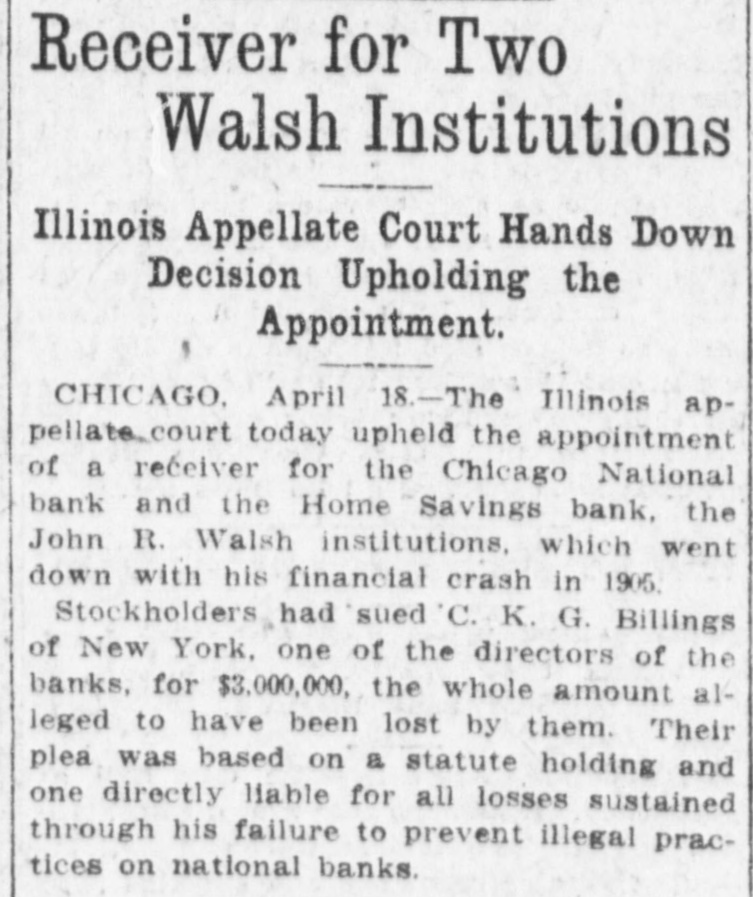
Receiver for Two Walsh Institutions Illinois Appellate Court Hands Down Decision Upholding the Appointment. CHICAGO. April 18.-The Illinois appellate court today upheld the appointment of a receiver for the Chicago National bank and the Home Savings bank, the John R. Walsh institutions, which went down with his financial crash in 1905. Stockholders had sued C. K. G. Billings of New York, one of the directors of the banks, for $3,000,000, the whole amount alleged to have been lost by them. Their plea was based on a statute holding and one directly liable for all losses sustained through his failure to prevent illegal practices on national banks.
Bank runs are almost always and everywhere a deterioration of bank fundamentals.
But not for you.
You are the measure-zero exception: great fundamentals, solid bank, and yet the Diamond Dybvig fairy spread its rumor. Depositors woke up. Your collateral was not prepositioned. The Clearinghouse had it for you.
Do not pass Go. Do not collect $200. Go directly to jail… or worse.